Custom CRM Development: Cost, Timeline and Build vs Buy
Custom CRM Development: What It Costs and When It's Worth It
Search for custom CRM development and you'll find two kinds of page. Vendors tell you that you don't need to build, just customize their platform. Agencies tell you that you do, and quote somewhere between $50,000 and $300,000 without showing where the number comes from.
This guide does the math instead. It compares three ways to get a CRM over three years: building from scratch, starting from an existing codebase, and paying per seat for HubSpot, Pipedrive or Salesforce. Every figure is either sourced or labeled as an assumption, so you can swap in your own numbers.
The honest answer for most small teams is "don't build." The rest of this post is about spotting when you're the exception.
TL;DR
| Your situation | Best path |
|---|---|
| Under ~25 sellers, standard deal pipeline | Buy. Pipedrive or HubSpot will be cheaper for years. |
| 25 to 50+ seats on HubSpot or Salesforce professional tiers | Run the three-year math below. Custom often wins there, especially from a starting codebase. |
| The CRM is part of your product (customers log in to it) | Build. Per-seat SaaS doesn't fit a product you sell. |
| Workflow that fights every off-the-shelf CRM | Build, but start from an existing codebase rather than zero. |
| You need it next month and have no developers | Buy now, revisit in a year. |
What "Custom CRM Development" Actually Means
A custom CRM is software you own: your data model, your screens, your code, running on your infrastructure. That's different from a customizable CRM, where you configure fields, pipelines and automations inside someone else's platform.
The distinction matters for cost. Customizing HubSpot or Salesforce keeps you on a per-seat bill forever. A custom CRM swaps that bill for a build cost up front and a maintenance cost every year after.
There's also a middle path most guides skip: starting from an existing CRM codebase that already has contacts, companies, deals, a pipeline, auth and a database schema, then building only the parts that are unique to your business.
What Every CRM Has to Do (Before It Does Anything Custom)
Whatever path you pick, the same foundation has to exist:
- Contacts and companies as linked records, with search and filters
- Deals and a pipeline, usually a drag-and-drop board plus list and forecast views
- Activities and tasks tied to deals and contacts, with owners and due dates
- Custom fields, because every team tracks something the defaults don't
- Reporting: pipeline value, win rate, activity and forecast
- Permissions, so reps, managers and admins see the right things
- Integrations with email, calendar and usually accounting or billing
None of that is what makes your CRM special, but it's most of the build. That's why the starting point changes the cost so much.
The Three Cost Paths
Path 1: Build From Scratch
In our guide to building a CRM in Next.js, the foundation above takes a developer 12 to 16 weeks, and realistically 16 to 20 once edge cases show up.
As an assumption for the math: one full-stack developer for 16 to 20 weeks, or 640 to 800 hours.
The US Bureau of Labor Statistics puts the median software developer salary at $135,980 a year (May 2025), about $65 an hour. At that rate the build is roughly $41,600 to $52,000 in salary alone, before benefits, design, QA or project management.
Agencies quote more because they price in those extra roles, plus margin. Itransition, which ranks for this topic, puts an entry-level custom CRM at about $90,000 and enterprise builds past $300,000. Knack, a no-code vendor, cites $50,000 to $200,000 or more for full-code development. Neither shows how it got there, so treat them as market quotes rather than benchmarks.
Path 2: Start From an Existing CRM Codebase
If contacts, deals, pipeline, auth and the database already exist, you only build what's unique: your fields, your stages, your integrations, your reports.
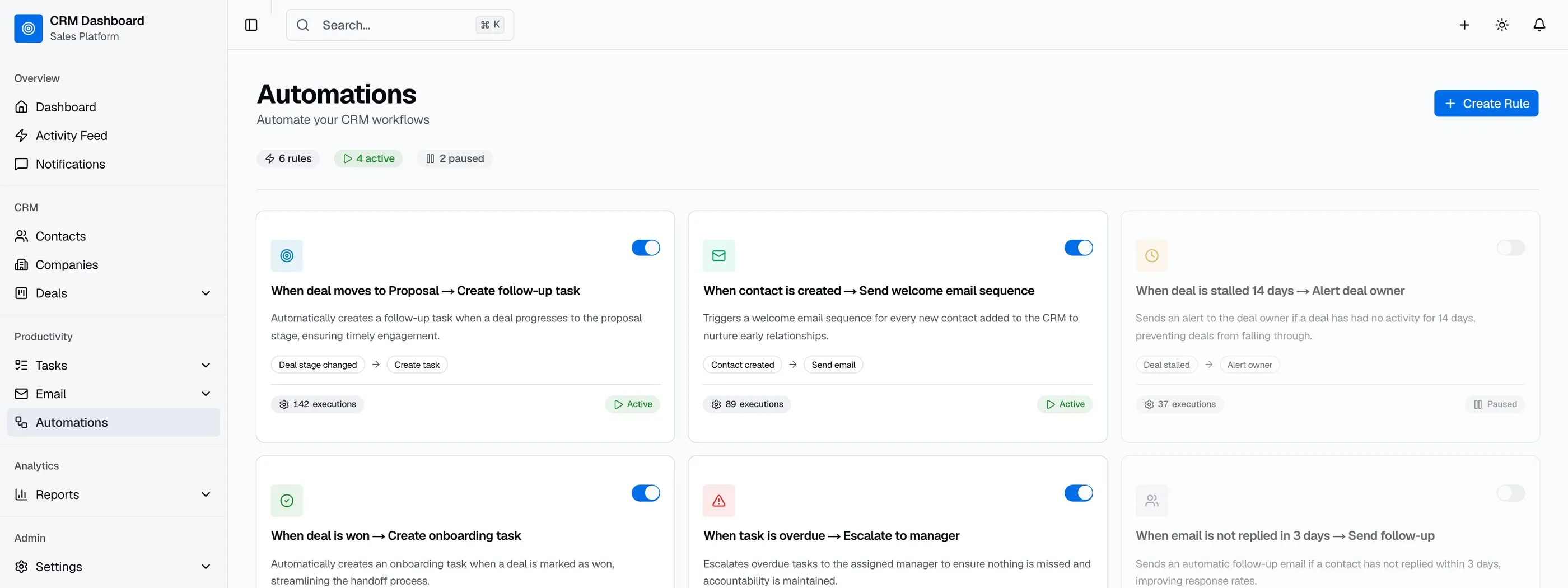
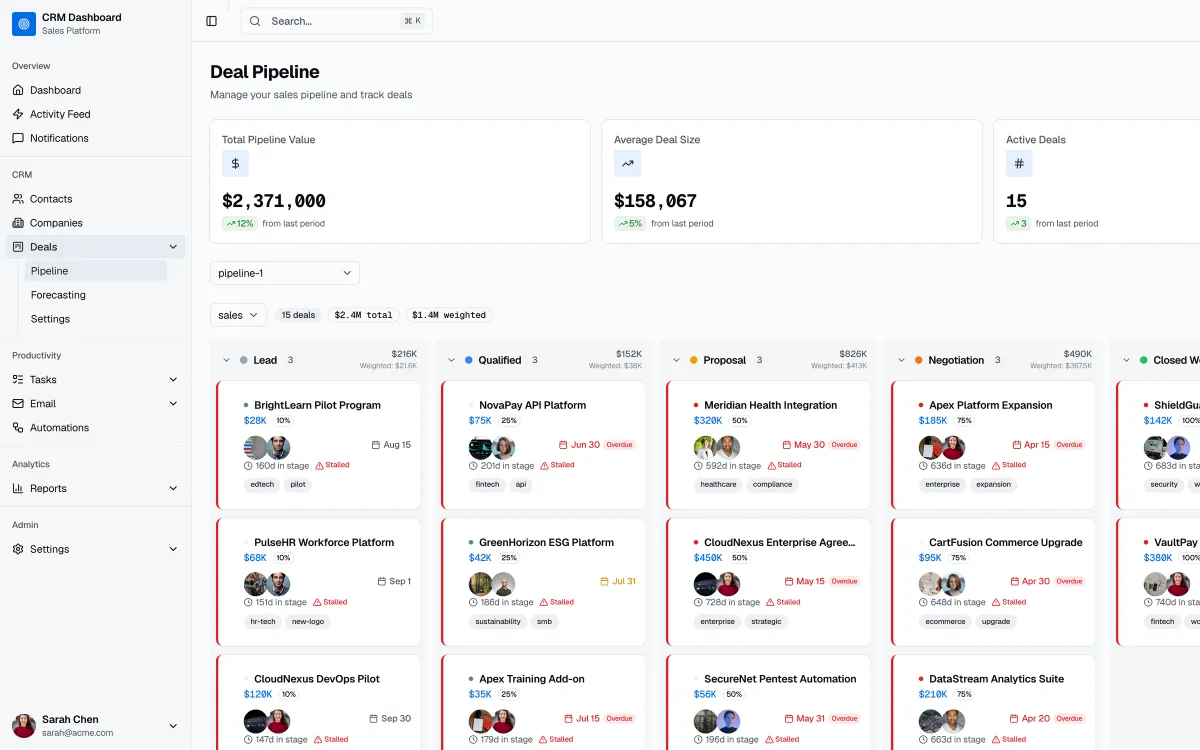
The Full-Stack CRM Kit is one example of that starting point. It ships 45 routes (dashboard, contacts, companies, deals, tasks, email, reports and settings) on a Supabase database with 19 tables, row-level security, Supabase Auth and Server Actions for every change. It starts at $332.
As an assumption for the math: four weeks of customization, or 160 hours, which at $65 an hour is about $10,400, plus the kit. Your number depends entirely on how much is unique to you, so adjust it.
Path 3: Buy Seats in an Off-the-Shelf CRM
Current list prices for the tiers teams usually end up on, per seat per month, billed annually:
| CRM | Tier | Price | Notes |
|---|---|---|---|
| Pipedrive | Premium | $49 | Lite $14, Growth $24, Ultimate $69 |
| HubSpot Sales Hub | Professional | $90 | Plus a required $1,500 one-time onboarding fee |
| Salesforce | Pro Suite | $100 | Starter Suite is $25; Sales Cloud editions run $195 to $550 |
Cheaper tiers exist, and plenty of teams live happily on them. The comparison below uses the tiers teams tend to reach once they need automation, more pipelines and reporting. (If automation is the main reason you're shopping, our CRM automation build order shows which plan each feature needs.)
Three-Year Cost: Custom vs SaaS
For custom builds, the build isn't the end of the bill. Hosting, security updates, dependency upgrades and small feature requests never stop.
As an assumption: five developer hours a week of upkeep, which is 260 hours a year, or about $16,900 a year at $65 an hour. That comes to $50,700 over three years, and it's the same for both custom paths.
Custom, three years (salary cost, before benefits and hosting):
- From scratch: $41,600 to $52,000 build + $50,700 upkeep = $92,300 to $102,700
- From a starting codebase: $10,400 customization + kit + $50,700 upkeep = about $61,100
SaaS, three years (list price, before add-ons and admin time):
| Seats | Pipedrive Premium | HubSpot Sales Hub Pro | Salesforce Pro Suite |
|---|---|---|---|
| 10 | $17,640 | $33,900 | $36,000 |
| 25 | $44,100 | $82,500 | $90,000 |
| 50 | $88,200 | $163,500 | $180,000 |
What the numbers say:
- At 10 seats, buy. Every SaaS option costs less than either custom path.
- At 25 seats, it depends which CRM you'd buy. Pipedrive still wins. Against HubSpot or Salesforce professional tiers, a custom build from a starting codebase (about $61,100) comes in lower, while building from scratch still costs a little more.
- At 50 seats, custom usually wins on cost. A build from a starting codebase beats all three. Building from scratch beats HubSpot and Salesforce by a wide margin but lands just above Pipedrive.
Two things these numbers leave out, and they cut in opposite directions. SaaS bills usually grow with add-ons, extra hubs and a paid admin. Custom builds need benefits, design time and someone who owns the product. If you're close to a break-even line, those details decide it.
When Building a Custom CRM Makes Sense
Cost is only one reason. Build when at least one of these is true:
- The CRM is part of your product. If customers or partners log in to it, per-seat internal tools don't fit, and you'll want your own brand and data model anyway.
- Your workflow fights every CRM you've tried. Multi-party deals, marketplaces, field teams, or pipelines that aren't really sales pipelines.
- You're paying for a lot of seats you'd never need in a lighter tool. The seat math above.
- Data has to stay somewhere specific. Your own database and region, rather than a vendor's.
- You're already paying consultants to bend a platform. Customization spend on HubSpot or Salesforce can quietly approach a build budget.
When Not to Build
Just as important, and the part agency pages leave out:
- You have fewer than about 25 sellers and a standard pipeline. Pipedrive or HubSpot will be cheaper and faster for years.
- Nobody will own it after launch. A custom CRM without an owner decays. Budget the upkeep above or don't start.
- You need it running this month. Buy now; you can migrate later with better knowledge of what you actually need.
- The "custom" part is really just fields and stages. Every mainstream CRM handles that without code.
Timeline: What to Expect
- From scratch: 16 to 20 weeks for the foundation with one experienced developer, longer with integrations and migration.
- From a starting codebase: the foundation is done on day one, so the timeline is your customization, integrations and data migration.
- Done for you: our Done-For-You launches start at $1,999 and typically go live in 2 to 4 weeks, and custom builds start at $2,999 and typically take 4 to 12 weeks. A CRM with several integrations and a data migration will quote above those starting points; the scoping call is where you get a real number.
Don't Forget Data Migration
Moving off an existing CRM is where custom projects slip. Plan for:
- Exporting everything, including notes, activities and attachments, not just contacts and deals
- Deduplicating before import, especially contacts that share an email and companies entered twice
- Mapping fields from the old system to yours, including picklist values and owners
- A cutover plan: freeze edits, run a final export, import, then check record counts against the source
- Running both systems briefly for one sales cycle if the team can tolerate it
If you're keeping a platform like HubSpot or Salesforce alongside a custom tool, the sync between them needs the same care. Our CRM integration services cover exactly that.
How to Scope a Custom CRM Project
Before you ask anyone for a quote, write down:
- Who uses it: roles, seat count now and in two years
- The pipeline: stages, what moves a deal between them, and what's unusual about your process
- The records: which entities you need beyond contacts, companies and deals
- Integrations: email, calendar, billing, accounting, marketing, anything with an API
- Reports: the five numbers leadership asks for every week
- Migration: where the data lives today and how much of it matters
- Ownership: who maintains it after launch, and how much time they have
A quote without those answers is a guess, and a big range is usually the agency pricing in that uncertainty.
Questions to Ask a CRM Development Company
- Do we own the code and the infrastructure accounts from day one?
- Are you starting from an existing codebase or from zero, and why?
- What's included after launch, and what does upkeep cost per month?
- How will you migrate our data, and how do we verify nothing was lost?
- Can we see a working example of a CRM you've built?
Frequently Asked Questions
How much does custom CRM development cost?
Building from scratch with one experienced developer is about 640 to 800 hours, roughly $41,600 to $52,000 in salary at the US median rate, before benefits, design and QA. Agencies publicly quote $50,000 to $300,000 or more. Starting from an existing CRM codebase can cut the build to a few weeks of customization, but every custom CRM also needs ongoing upkeep.
How long does it take to build a custom CRM?
The core (contacts, companies, deals, pipeline, tasks, reports and permissions) takes one developer about 16 to 20 weeks from scratch. Integrations and data migration add to that. Starting from a codebase that already has the core shortens the timeline to the work that's unique to your business.
Is a custom CRM cheaper than Salesforce or HubSpot?
At small team sizes, no. At 10 seats, three years of Pipedrive, HubSpot or Salesforce costs less than building. At 25 seats, a custom build from a starting codebase can undercut HubSpot and Salesforce professional tiers. At 50 seats it beats all three, while a build from scratch beats HubSpot and Salesforce but not Pipedrive.
What's the difference between a custom CRM and a customizable CRM?
A customizable CRM is a platform like HubSpot or Salesforce that you configure with fields, pipelines and automations while paying per seat. A custom CRM is software you own and host, with your own data model, which replaces the seat bill with build and maintenance costs.
Can I build a CRM without starting from scratch?
Yes. You can start from an open-source CRM or a production-ready codebase that already includes contacts, deals, a pipeline, authentication and a database, then build only what's unique. The Full-Stack CRM Kit is one option, built on Next.js and Supabase.
Who owns a custom CRM?
You should, and it's worth getting in writing: the code in your repository, the database and hosting in your accounts, and no license fee to keep using it. That ownership is a large part of why teams choose custom over a platform.
The Honest Take
Most teams asking about custom CRM development should buy a CRM this year. The seat math doesn't justify a build until you're past about 25 users on a professional tier, or until the CRM is something your customers use.
When it does make sense, the biggest lever isn't the agency's hourly rate. It's the starting point. Building contacts, deals, pipelines and auth for the hundredth time is where the $50,000 goes. Start from something that already has them, spend your budget on what makes your process different, and budget honestly for the upkeep that follows.
Want it shipped without hiring a developer?
The build path above assumes you have engineers. If you don't, the team behind thefrontkit does done-for-you launches: we deploy the kit, apply your branding, and wire it to your stack. Fixed quotes, most builds ship in 2-4 weeks, from $1,999.