Custom LMS Development vs White-Label LMS: Cost and Fit
Custom LMS Development or a White-Label LMS: How to Decide
If you're shopping for a branded learning platform, you'll hear two pitches. LMS vendors say white-label their platform: your logo, your domain, live next week. Development agencies say build your own: your features, your data, no per-learner bill. Both are right for someone. The trick is figuring out which someone you are before you sign a contract.
This guide compares the options on cost, timeline and fit. The cost figures come from vendor pricing pages and US salary data, and anything that's our assumption is labeled as one.
TL;DR
- A white-label LMS without the vendor's branding starts at $139 to $199 a month (billed annually) on course-selling platforms like Teachable, Thinkific and Kajabi, and $449 a month (billed yearly) on TalentLMS Pro for corporate training.
- Custom LMS development from scratch is roughly 16 to 22 weeks of engineering for a solo developer, about $41,600 to $57,200 in salary at the US median rate, before design, QA or ongoing upkeep.
- Starting from an existing LMS codebase cuts the build to the parts that are unique to you. You still own the code and host it yourself.
- Open-source platforms (Moodle, Open edX) are free to license and expensive in a different way: hosting, plugins and someone who knows the platform.
- Build custom when the LMS is part of a product you sell, when your learning model doesn't fit a course-and-lesson structure, or when per-learner pricing is growing faster than your revenue.
- Check SCORM and xAPI first. If you need to run packaged content from authoring tools, that one requirement can change the answer.
Three Ways to Get a Branded LMS
1. White-label LMS. You rent a hosted platform and put your brand on it: logo, colors, custom domain, sometimes a branded mobile app. The vendor runs the software, ships updates and handles uptime. You configure; you don't change the code.
2. Open-source LMS. Moodle and Open edX are free to download and run. You (or a hosting partner) handle servers, upgrades and plugins. Branding goes as deep as your theme work, and the data model is theirs.
3. Custom LMS. Software you own, built for how your learners and instructors work. You can build it from scratch or start from an existing LMS codebase and change what you need. Either way, you host it and you maintain it.
Many "custom LMS development" projects in practice sit between 2 and 3: a team either extends an open-source platform heavily or starts from a codebase so they aren't rebuilding login screens and course catalogs.
What a White-Label LMS Gives You
D2L, which sells one, describes a white-label LMS as a platform branded so thoroughly that learners never see the vendor: your name, domain, look and emails. In practice, "white label" on a pricing page can mean anything from a custom domain to a fully branded mobile app, and each piece often sits on a different plan:
- Custom domain. Usually on every paid plan. TalentLMS, Thinkific, LearnWorlds and Kajabi include it from their entry-level paid plans.
- Removing the vendor's branding. Usually a mid-tier feature. On TalentLMS it starts on Pro; on Kajabi it starts on Growth.
- Branded mobile app. Often a paid add-on. Thinkific charges $199 a month for one, LearnWorlds $149 a month on top of the plan, and Kajabi includes it only on Pro.
What stays the vendor's: the data model, the feature roadmap, the permissions system and how far you can change the learner experience. If a feature you need isn't on the platform, your options are asking for it or working around it.
What White-Label LMS Platforms Cost
Here's the cheapest plan on each platform that removes the vendor's branding, as listed on the vendor's own pricing page in September 2026.
| Platform | Plan | Price | How it's priced | Branded mobile app |
|---|---|---|---|---|
| Teachable | Growth | $139/mo annually, $189 monthly | Flat, up to 50 products | Check with vendor |
| Thinkific | Grow | $164/mo annually, $219 monthly | Flat, up to 10,000 current students | $199/mo add-on |
| Kajabi | Growth | $199/mo annually, $249 monthly | Up to 25,000 contacts | Included on Pro ($399/mo annually) |
| LearnWorlds | Learning Center | $249/mo annually, $299 monthly | Up to 2,000 monthly active learners | $149/mo add-on |
| TalentLMS | Pro | $449/mo billed yearly | Tiers by users who log in each month: $559/mo at 401 to 500, $779/mo at 801 to 1,000 | Offered, plan not listed |
| Docebo | Elevate | Quote only | Active users, one-year minimum contract | Add-on on Elevate |
Two groups hide in that table. Teachable, Thinkific and Kajabi are built for selling courses, so they price flat and care about products and contacts. TalentLMS and Docebo are built for training employees, customers or partners, so they price by active users. Absorb and CYPHER Learning also sell white-label corporate LMS platforms, with pricing by quote.
Plans and prices change often. Check the linked page before you compare.
What Custom LMS Development Costs
Our own guide to building an LMS in Next.js breaks a from-scratch build into two-week phases: foundation, course management and video, progress tracking, quizzes, student and instructor dashboards, payments, then polish. A competent solo engineer lands at 16 to 22 weeks once the edge cases show up.
At 40 hours a week, that's 640 to 880 hours. The US Bureau of Labor Statistics puts the median software developer salary at $135,980 a year (May 2025), about $65 an hour. So:
| Path | Hours (our estimate) | Salary cost at $65/hr |
|---|---|---|
| From scratch | 640 to 880 | $41,600 to $57,200 |
| From an existing LMS codebase | 160 to 240 | $10,400 to $15,600, plus the codebase license |
| Upkeep, either path | About 5 hours a week | About $16,900 a year |
Those numbers are salary only. Agencies price in design, QA, project management and margin, so quotes for the same scope usually run higher. The "existing codebase" hours are our assumption for adding what most starting points leave out: video hosting, payments, email notifications and your branding.
Running Costs Are Small Until Video Gets Big
Hosting a custom LMS is cheap at small scale. Supabase Pro is $25 a month and includes 100,000 monthly active users and 100 GB of file storage. Its Team plan, at $599 a month, adds SOC 2 and ISO 27001 reports and a HIPAA add-on, which matters if you sell to enterprises or healthcare.
Video is the line item that grows. Mux doesn't charge to upload video, charges storage from $0.0024 per minute per month, and includes 100,000 delivered minutes a month before delivery billing starts at $0.0008 per minute. A worked example at those starting rates:
- 20 hours of course video stored: 1,200 minutes × $0.0024 = about $3 a month
- 500 learners each watching 5 hours a month: 150,000 minutes delivered, 50,000 above the free allowance × $0.0008 = about $40 a month
Rates change and volume tiers apply, so run your own numbers on the Mux calculator. The point stands: for most course businesses, engineering time dwarfs hosting.
Three-Year Cost Side by Side
Here's what three years looks like. White-label costs are the annual prices above. Custom costs combine the salary estimates, the 5-hour weekly upkeep assumption, Supabase Pro and the Mux video example.
| Option | Year 1 | 3-year total |
|---|---|---|
| Thinkific Grow | $1,968 | $5,904 |
| Kajabi Growth | $2,388 | $7,164 |
| LearnWorlds Learning Center (2,000 active learners) | $2,988 | $8,964 |
| Kajabi Pro (branded app included) | $4,788 | $14,364 |
| TalentLMS Pro, 100 active users | $5,388 | $16,164 |
| TalentLMS Pro, 801 to 1,000 active users | $9,348 | $28,044 |
| Custom, from an existing codebase | About $28,100 to $33,300 | About $63,500 to $68,700, plus the license |
| Custom, from scratch | About $59,300 to $74,900 | About $94,700 to $110,300 |
On cost alone, white-label wins for a standard course business, and it isn't close. Even the cheapest custom path costs several times more over three years, mostly because of the upkeep line. Cut upkeep to 2 hours a week and the codebase path drops to roughly $33,000 to $38,000 over three years, which still sits above every white-label row.
So the case for custom is rarely about saving money on the subscription. It's about the things a subscription can't give you, covered next. (If your costs are driven by thousands of active users on a per-user corporate plan, run the numbers at your real volume, since enterprise tiers are quoted.)
The Open-Source Middle Path: Moodle and Open edX
Open source sits between renting and building. You don't pay a license fee, and you can change anything, but you inherit someone else's architecture.
Moodle is released under the GNU GPL, per its developer documentation. The code is free to run and modify. The "Moodle" name is a trademark, so you can't sell a service under it without permission. Its strength is a huge plugin ecosystem and familiarity in education. Its costs are hosting, upgrades, plugin compatibility and theme work if you want it to look like your brand rather than like Moodle.
Open edX is also open source with no license fees, built for course delivery at scale. You either run it yourself or work with one of its listed hosting providers. It's a heavier platform to operate than Moodle, so it tends to suit universities and large course publishers with engineering support.
Either one is a good fit when you need a mature LMS, want to own your hosting and data, and have (or can hire) someone who knows the platform. It's a poor fit when training has to live inside your own app, since you'd be integrating two large systems instead of extending one.
When Custom LMS Development Makes Sense
- The LMS is part of your product. If learners log in to your SaaS and training lives inside it, a separate white-label portal with its own login feels bolted on. Owning the code lets training share your users, permissions and data.
- Your learning model isn't a course catalog. Cohort programs with live sessions and peer review, certification tracks with proctored exams, or skills matrices tied to job roles all get awkward in platforms built around courses and lessons.
- Per-learner pricing is outgrowing revenue. If you charge little per learner (or nothing, for customer education) and your learner count is climbing, a subscription priced by active users can grow faster than the business behind it.
- You need the data in your own database. Joining completion data with product usage, CRM records or HR systems is much easier when it's already in your Postgres.
- You're selling the platform itself. Agencies and training companies that resell an LMS to clients need licensing that allows it, plus multi-tenant control that most white-label plans don't give.
When a White-Label LMS Is the Better Call
- You need to launch this quarter and your content is standard courses with video, quizzes and certificates.
- Nobody on your team will own the software after launch. A custom LMS without an owner decays fast.
- You rely on SCORM packages from authoring tools like Articulate or iSpring, and the vendor already plays them well.
- Your learner count is small or stable, so the subscription stays a rounding error next to a developer's time.
- Compliance paperwork matters more than features. Established vendors often have SOC 2 reports, accessibility conformance reports and data processing agreements ready for procurement.
What Buyers Underestimate
SCORM and xAPI. Many corporate training teams buy content as SCORM packages. Playing them properly means an LMS that launches the package, talks to its runtime API and stores completion and score data. White-label platforms built for corporate training usually include this. Most custom builds and starter codebases don't, so price it as its own workstream or use a hosted SCORM player service.
Video. Uploading, transcoding, adaptive streaming, captions and signed URLs so videos can't be shared freely. Services like Mux handle the hard parts, but someone still has to wire them in.
Migration. Moving off an existing LMS means users, enrollments, completion history and certificates, not only course content. Completion records often matter for compliance, so decide early what has to come across and in what shape.
Accessibility. Learners need to finish courses with a keyboard and a screen reader, and many buyers (public sector, universities, larger employers) will ask for proof. Budget for an accessibility audit of the lesson player, quizzes and certificates before launch.
Reporting. Admins always want more reports than the first version has: completions by team, overdue assignments, quiz question analysis. Plan the data model so those queries are easy later.
How to Scope a Custom LMS Project
- List your roles. Learner, instructor, admin, and anyone else (managers who see team progress, clients who see their own learners). Roles drive permissions, which drive most of the build.
- Write the content types down. Video, text, live sessions, quizzes, assignments, SCORM packages, downloadable files. Each one is a separate piece of work.
- Decide how people get access. Paid enrollment, invites from an admin, single sign-on from your product, or automatic enrollment by role.
- Name the integrations. Payments, CRM, HR system, email, calendar, video. Integrations are where estimates go wrong most often.
- Separate launch from later. Gamification, discussion forums and AI features can wait. Login, enrollment, content, progress and certificates can't.
- Pick who maintains it. Before the build starts, not after.
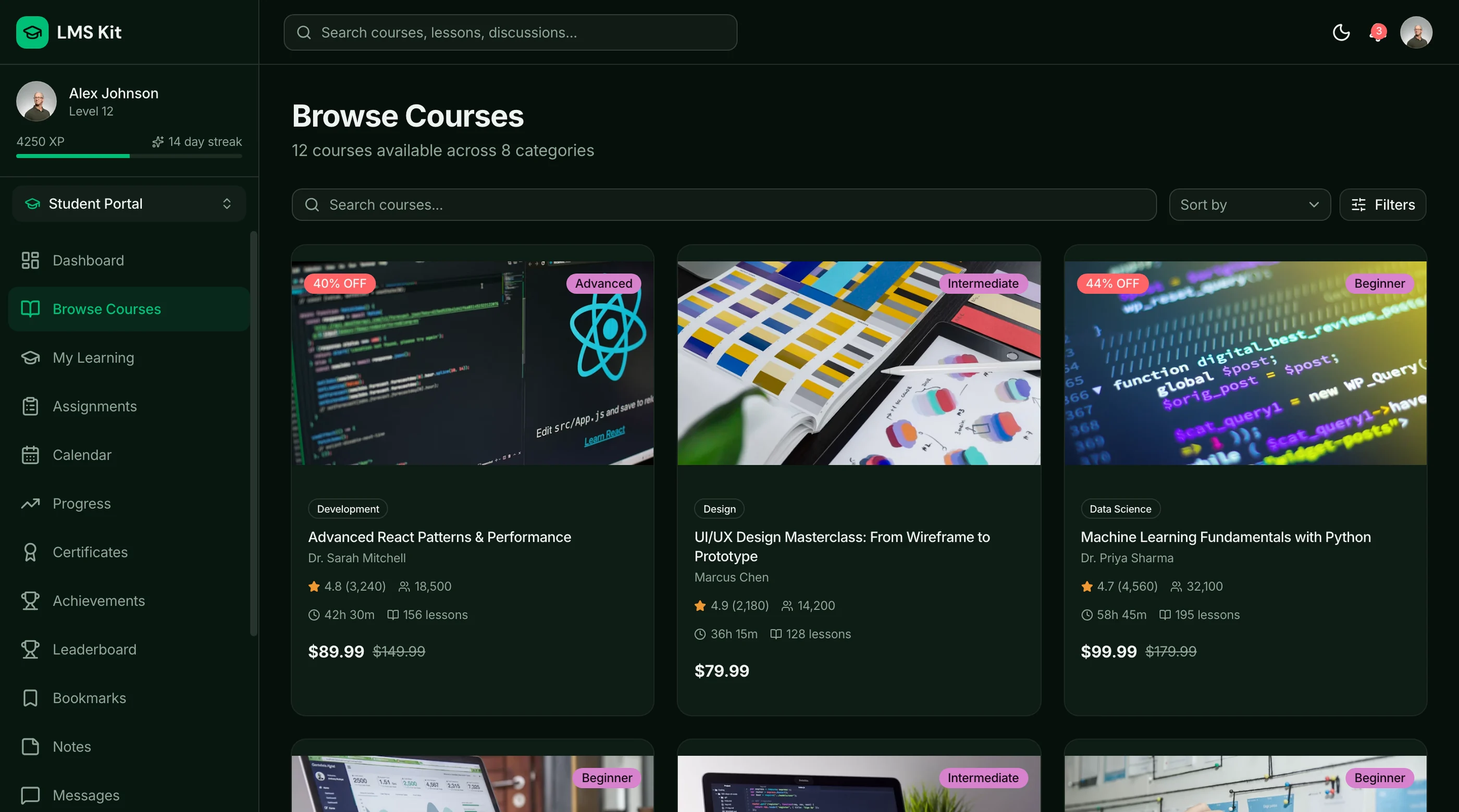
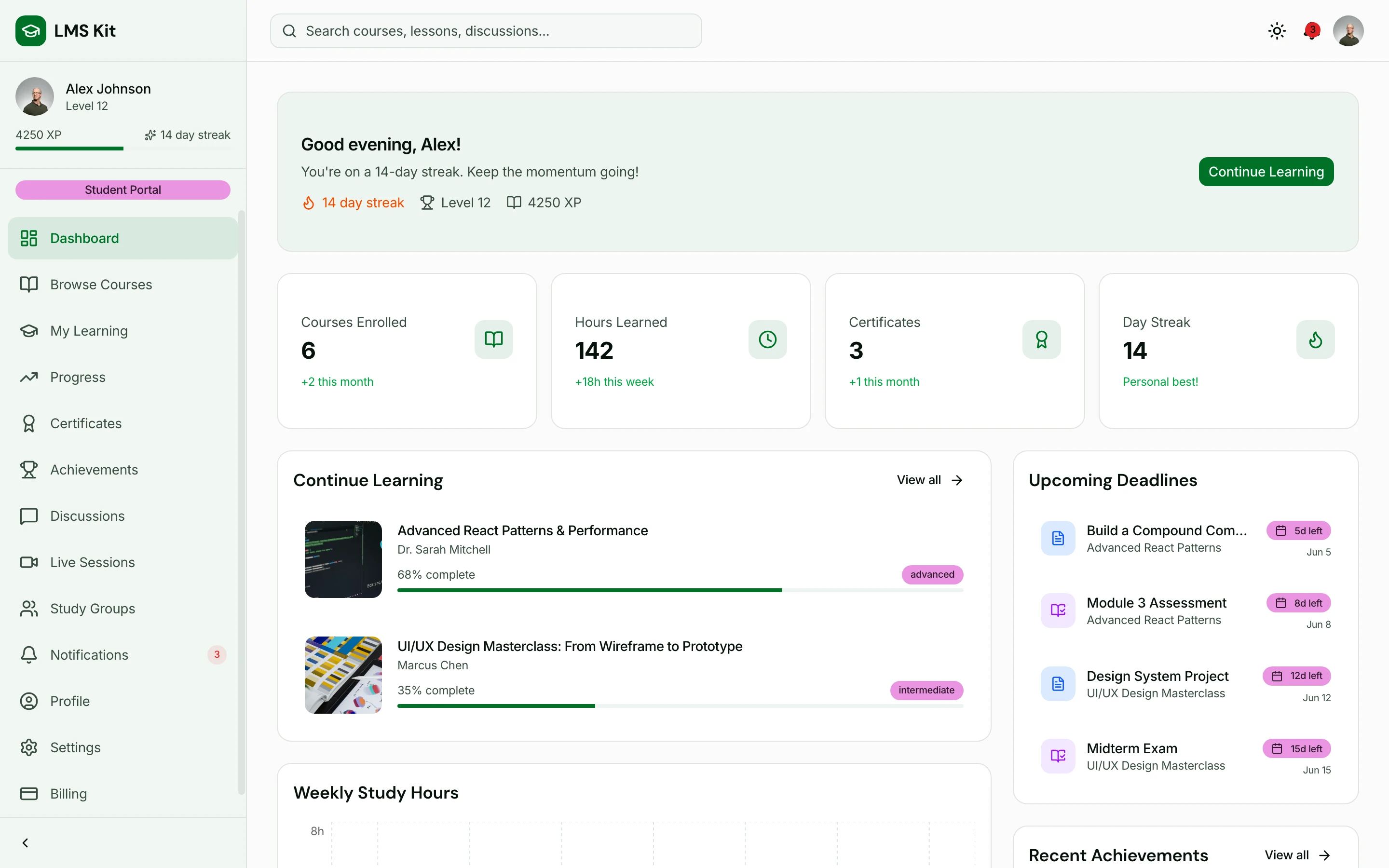
If you want a starting codebase, the Full-Stack LMS Kit has 55 routes across student, instructor and admin portals on Next.js and Supabase, with a 38-table schema, row-level security for each role, quizzes and certificates. It leaves out video hosting, payment processing and SCORM, which you'd add for your use case. If you'd rather hand the whole thing off, our team does done-for-you launches and custom builds on fixed quotes.
Frequently Asked Questions
How much does custom LMS development cost?
A from-scratch build is roughly 640 to 880 engineering hours, which is about $41,600 to $57,200 in salary at the US median developer rate of $65 an hour. Agency quotes run higher because they include design, QA and project management. Starting from an existing LMS codebase can bring the build down to a few weeks of customization.
How long does it take to build an LMS?
A solo engineer typically needs 16 to 22 weeks for a from-scratch LMS with courses, video, progress tracking, quizzes, dashboards and payments. Starting from an existing codebase shortens that to the work that's unique to you, often a few weeks for video, payments and branding.
What is a white-label LMS?
A white-label LMS is a hosted learning platform you can brand as your own, with your logo, colors and domain, while the vendor runs the software. You configure it but don't own or change the code.
How much does a white-label LMS cost?
Removing the vendor's branding starts at $139 a month on Teachable Growth, $164 on Thinkific Grow and $199 on Kajabi Growth, all billed annually. Corporate training platforms price by active users: TalentLMS Pro is $449 a month billed yearly for up to 100 users who log in each month. Branded mobile apps are often extra, at $149 to $199 a month.
Is Moodle a good alternative to building a custom LMS?
Moodle is free to license and has a large plugin library, so it suits teams that need standard courses and have someone who can run and theme it. It's a weaker fit when training has to live inside your own product or when you want a modern interface without heavy theme work.
Can a custom LMS support SCORM?
Yes, but it's extra work. The LMS has to launch SCORM packages and store the completion and score data they report. Most custom builds and starter codebases don't include it, so scope it separately or use a hosted SCORM player service.
The Honest Take
Most teams asking about custom LMS development should start with a white-label platform. For a standard course business, it's cheaper over three years by a wide margin, and you can be live in days.
Build custom when the learning experience is part of a product you sell, when your model doesn't fit courses and lessons, or when you need training data sitting next to the rest of your business data. If that's you, start from a codebase instead of a blank repository, budget for SCORM and video separately, and name the person who'll maintain it before you write a line of code.
Not sure which side you're on? Book a 15-minute call from our custom builds page and we'll tell you honestly, including when the answer is "use Thinkific".
Want it shipped without hiring a developer?
The build path above assumes you have engineers. If you don't, the team behind thefrontkit does done-for-you launches: we deploy the kit, apply your branding, and wire it to your stack. Fixed quotes, most builds ship in 2-4 weeks, from $1,999.