Alternatives to Stripe: 11 Options Compared for 2026
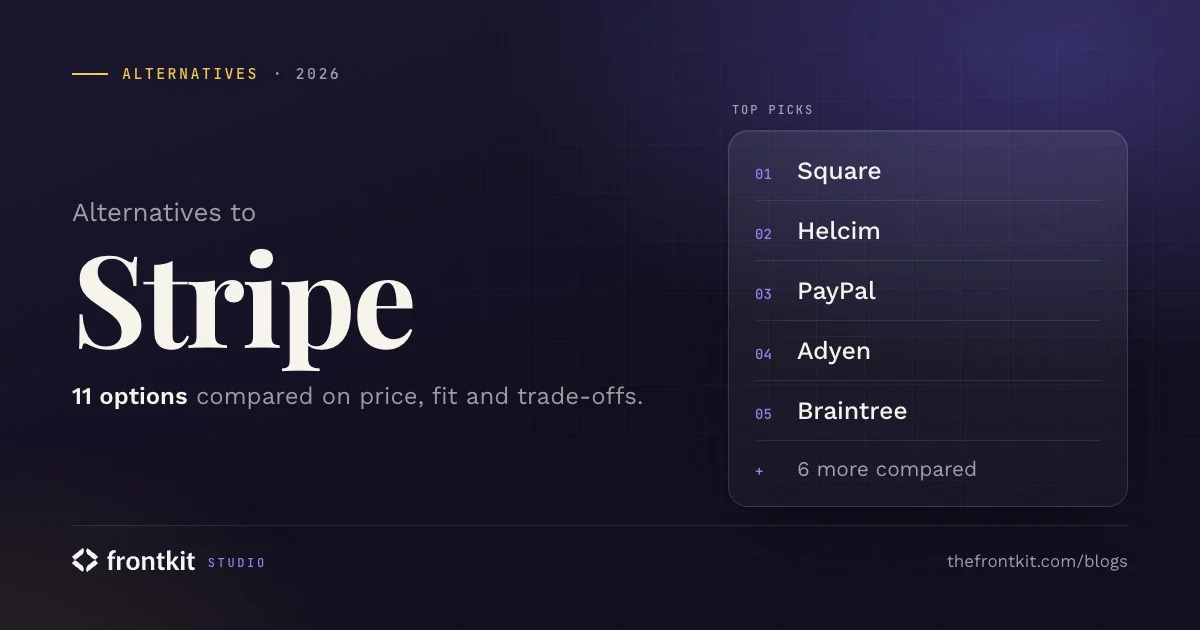
Alternatives to Stripe: 11 Options Compared for 2026
Short answer: the right alternative to Stripe depends on what you sell and where. Square is the easiest pick if you also sell in person. Helcim is the one to check if card fees are the problem, because it passes interchange through with a small markup and no monthly fee. Paddle and Polar act as merchant of record, so they handle sales tax and VAT for software sellers. Adyen and Checkout.com are for high-volume businesses that want a negotiated deal, and Mollie and Razorpay cover Europe and India with local payment methods.
Stripe is still the default for developers, and for good reason. But it isn't the cheapest option for every business, it doesn't take on your sales tax liability on its standard plan, and some teams simply want a second processor so one account review can't stop all their revenue. Eleven alternatives below, each with the fees shown on the vendor's own pricing page.
If you're wiring payments into your own app, see our guides to adding Stripe payments to a Next.js template and adding Razorpay to a Next.js template.
Building a store in Next.js?
The Full-Stack E-commerce Kit gives you 53 routes: a 22-screen storefront, 12 customer account screens and a 15-screen admin panel, on a Supabase backend with row-level security, Supabase Auth and Server Actions. Payments run through Stripe Checkout Sessions with a webhook that creates the order. $332 solo. Try the live demo.
Get the Full-Stack E-commerce Kit →
TL;DR: Quick Picks for 2026
| Need | Top pick | Online card price |
|---|---|---|
| Online plus in-person sales | Square | 3.3% + 30¢ (Free), 2.9% + 30¢ (Plus, $49/mo) |
| Lower card fees, no monthly fee | Helcim | Interchange + 0.50% + 25¢ (under $50K/mo) |
| Buyers who want to pay with PayPal | PayPal | See vendor site |
| Enterprise, global acquiring | Adyen | $0.13 + interchange++ + 0.60% (indicative) |
| Developer API inside PayPal | Braintree | See vendor site |
| High volume, negotiated pricing | Checkout.com | Pricing on request |
| SaaS sellers who want tax handled | Paddle | 5% + 50¢, merchant of record |
| Indie software, public rates | Polar | 5% + 50¢ (free plan) down to 3.4% + 30¢ |
| European payment methods | Mollie | 1.80% + €0.25 (EEA consumer cards) |
| Classic gateway for a merchant account | Authorize.Net | 2.9% + 30¢ plus $25/mo |
| Selling in India | Razorpay | 2% per domestic transaction + GST |
Prices shown were checked on each vendor's own pricing page in November 2026. Card rates vary by card type and country, so treat these as the starting point for your own quote.
What Stripe Does Well
Stripe's strength is that one account covers almost everything a software business needs. Payments, subscriptions through Stripe Billing, marketplace payouts through Connect, fraud screening through Radar, and invoicing all share one dashboard and one API. Its pricing page lists 100+ payment methods and says there are no setup or monthly fees on standard pricing.
The developer experience is the real reason it wins. The docs are clear, the test mode is easy to work in, and nearly every framework, CMS and ecommerce kit ships a Stripe integration first. If you're a developer launching something new, Stripe is usually the shortest path to taking money.
When to Leave Stripe
Four common reasons:
- Card fees eat your margin. Stripe's standard pricing is a flat rate. At steady volume, an interchange-plus processor like Helcim or Adyen can cost less, because you pay the card network's real cost plus a fixed markup.
- You sell software worldwide and don't want the tax work. On standard Stripe, you're the seller, so registering for and filing sales tax and VAT is your job. A merchant of record like Paddle or Polar becomes the legal seller and takes that on.
- You need a strong in-person setup. Stripe has Terminal, but Square was built around retail and restaurants, with POS software included on its free plan.
- You want a second processor. Some businesses leave after an account review or payout hold. Even if you stay, a backup provider means one decision can't stop every sale.
1. Square
The easiest pick if you sell online and in person.
Strengths:
- Free plan with POS app, online store, invoicing and booking
- One system for in-store and online sales
- Checking and savings accounts included
- Hardware and software from the same company
Weaknesses:
- Online rate on the free plan is higher than its in-person rate
- The $49 plan is charged per location
- Less flexible as a pure developer payments API
Pricing: Square Free is $0/month per location: 2.6% + 15¢ in person and 3.3% + 30¢ online. Square Plus is $49/month per location with a 30-day trial: 2.5% + 15¢ in person and 2.9% + 30¢ online.
Best for: Shops, cafes and service businesses that need a card reader and a website on one account. Official site: squareup.com.
2. Helcim
Lower fees through interchange-plus pricing, with no monthly fee.
Strengths:
- No monthly, PCI, statement or signup fees
- Markup gets smaller as your volume grows
- No fee on refunds, and $0 when you win a chargeback
- ACH payments capped at $6 per transaction
Weaknesses:
- Interchange-plus pricing is harder to predict than a flat rate
- Recurring payments add 0.4% per transaction
- Smaller app ecosystem than Stripe
Pricing: No monthly fee. For under $50K a month, it's interchange + 0.40% + 8¢ in person and interchange + 0.50% + 25¢ for keyed and online payments. Markups drop in tiers up to $5M a month. A lost chargeback costs $15. ACH is 0.5% + 25¢, capped at $6.
Best for: US and Canadian small businesses whose main complaint about Stripe is the fee line on the statement. Official site: helcim.com.
3. PayPal
The checkout button many shoppers already trust.
Strengths:
- Huge base of buyers with saved PayPal accounts
- PayPal, Venmo and cards from one integration
- Pay Later options for shoppers
- Works with almost every ecommerce platform
Weaknesses:
- Fees depend on the payment type, so the full fee table takes time to read
- Dispute handling is often criticized by sellers
- Less of a developer platform than Stripe on its own
Pricing: PayPal publishes its fees by payment type on its business fees page. See vendor site.
Best for: Stores where a visible PayPal button lifts conversion. Many teams run it next to their main card processor.
4. Adyen
One global platform for large businesses.
Strengths:
- Online, in-person and in-app payments on one platform
- Local payment methods across many countries
- Interchange++ pricing passes card network costs through
- No monthly, setup, integration or closure fees
Weaknesses:
- Built for larger businesses, with a minimum invoice by industry
- Published fees are marked as indicative
- Longer onboarding than a self-serve provider
Pricing: A fixed $0.13 processing fee plus a payment-method fee. For Visa and Mastercard, the card list shows $0.13 + interchange++ + 0.60%. American Express is listed at $0.13 + 0.80% + 3.95%. Adyen notes these fees are indicative and asks you to contact sales.
Best for: Enterprises and fast-growing brands selling in several countries. Official site: adyen.com.
5. Braintree
A developer-focused gateway owned by PayPal.
Strengths:
- Cards, PayPal and Venmo through one API
- Vaulting and recurring billing tools
- Backed by PayPal's network
- Good fit for marketplaces and mobile apps
Weaknesses:
- Fewer extra products than Stripe (tax, invoicing, banking)
- Developer docs are good but less loved than Stripe's
- Pricing is now presented on PayPal's enterprise pages
Pricing: See vendor site.
Best for: Apps that want PayPal and Venmo as first-class options with a developer API around them.
6. Checkout.com
Enterprise payments with tailored pricing.
Strengths:
- Global acquiring for large online merchants
- Offers flat-rate and interchange++ structures
- No setup or account maintenance fees
- Free option for charities
Weaknesses:
- No public price list
- Not set up for very small businesses
- Every plan goes through the sales team
Pricing: Pricing on request. The page names flat-rate and interchange++ options but lists no numbers.
Best for: High-volume online businesses ready to negotiate. Official site: checkout.com.
7. Paddle
A merchant of record for software companies.
Strengths:
- Paddle is the legal seller, so it handles global sales tax and VAT
- Subscriptions, invoices and checkout included
- No extra charge for added payment methods or subscription migration
- One all-in price
Weaknesses:
- 5% + 50¢ costs more per sale than a plain processor
- Built for digital products, not physical goods
- Less control over the checkout than running your own processor
Pricing: 5% + 50¢ per checkout transaction, no monthly fee. Custom pricing for high-volume businesses, and bespoke pricing for products under $10.
Best for: SaaS and app companies that sell worldwide and want tax compliance off their plate. Official site: paddle.com.
8. Polar
A merchant of record with every rate posted publicly.
Strengths:
- Merchant of record, so international tax is handled
- Free Starter plan, with lower rates on paid plans
- No sales process: every rate is on the pricing page
- Code is public on GitHub
Weaknesses:
- Non-US cards add 1.5%
- $15 per dispute, whatever the outcome
- Payouts run on Stripe, so you're not fully off it
Pricing: Starter is free at 5% + 50¢. Pro is $20/month at 3.8% + 40¢, Growth is $100/month at 3.6% + 35¢, and Scale is $400/month at 3.4% + 30¢. Payouts cost $2 per month of active payouts plus 0.25% + $0.25 per payout.
Best for: Indie developers and small software teams that want merchant-of-record coverage with clear numbers. Official site: polar.sh.
9. Mollie
European payments with local methods built in.
Strengths:
- iDEAL, Bancontact, SEPA and cards in one account
- No minimum costs or lock-in contracts
- Pay-as-you-go plan at €0/month
- Volume pricing above €100,000 a month
Weaknesses:
- Built for European businesses
- Non-EEA cards cost more (3.25% + €0.25)
- Fewer developer extras than Stripe
Pricing: Pay as you go is €0/month. EEA consumer Visa and Mastercard cost 1.80% + €0.25, EEA commercial cards 2.90% + €0.25, and non-EEA cards 3.25% + €0.25. iDEAL is €0.32 per payment and SEPA Direct Debit €0.35.
Best for: EU businesses whose customers pay with local methods more than cards. Official site: mollie.com.
10. Authorize.Net
The classic payment gateway.
Strengths:
- Gateway-only plan if you already have a merchant account
- eCheck support
- No setup or chargeback fees on the gateway
- Supported by older shopping carts and billing systems
Weaknesses:
- $25 monthly fee on every plan
- Daily batch fee on the gateway-only plan
- Dated interface next to Stripe
Pricing: All-in-one (merchant account plus gateway) is $25/month and 2.9% + 30¢ per transaction, subject to eligibility. Gateway only is $25/month plus 10¢ per transaction and a 10¢ daily batch fee. eCheck is 0.75% per transaction.
Best for: Businesses with an existing merchant account or a legacy system that already talks to Authorize.Net. Official site: authorize.net.
11. Razorpay
The default choice for businesses selling in India.
Strengths:
- UPI, cards, net banking and wallets in one account
- No setup fee or annual maintenance charge
- No fee on refunds
- Payouts and payroll products in the same suite
Weaknesses:
- Focused on Indian businesses
- 18% GST applies on top of the platform fee
- International cards cost up to 3%
Pricing: 2% per successful domestic transaction plus 18% GST on the fee. International cards up to 3%. Custom pricing above Rs. 5,00,000 a month.
Best for: Indian businesses and SaaS teams charging Indian customers. Official site: razorpay.com.
Recommendation by Profile
| You | Pick |
|---|---|
| Retail or restaurant with an online store | Square |
| US small business that wants lower card fees | Helcim |
| Store where buyers expect a PayPal button | PayPal |
| Enterprise selling in many countries | Adyen or Checkout.com |
| App that wants PayPal and Venmo through an API | Braintree |
| SaaS company that wants tax handled | Paddle |
| Indie developer selling software | Polar |
| EU business with local payment methods | Mollie |
| Existing merchant account or legacy cart | Authorize.Net |
| Selling in India | Razorpay |
Pricing at a Glance
| Product | Monthly fee | Online card rate |
|---|---|---|
| Square Free | $0 per location | 3.3% + 30¢ |
| Square Plus | $49 per location | 2.9% + 30¢ |
| Helcim | $0 | Interchange + 0.50% + 25¢ (under $50K/mo) |
| PayPal | See vendor site | See vendor site |
| Adyen | $0 (minimum invoice may apply) | $0.13 + interchange++ + 0.60% (indicative) |
| Braintree | See vendor site | See vendor site |
| Checkout.com | Pricing on request | Pricing on request |
| Paddle | $0 | 5% + 50¢ (tax handled) |
| Polar Starter | $0 | 5% + 50¢ (tax handled) |
| Polar Scale | $400 | 3.4% + 30¢ (tax handled) |
| Mollie | €0 | 1.80% + €0.25 (EEA consumer cards) |
| Authorize.Net All-in-one | $25 | 2.9% + 30¢ |
| Razorpay | Rs. 0 | 2% + 18% GST on the fee |
Merchant-of-record rates look high next to a processor, but they include tax collection and filing. Compare them against a processor's fee plus whatever tax software or accountant time you'd need.
Frequently Asked Questions
What is a cheaper alternative to Stripe?
For US small businesses, Helcim is the one to price out first. It charges no monthly fee and passes interchange through with a markup of 0.50% + 25¢ for online payments under $50K a month, which often works out lower than a flat rate. In Europe, Mollie charges 1.80% + €0.25 for EEA consumer cards.
What are the best Stripe alternatives for SaaS?
Paddle and Polar. Both act as merchant of record, so they collect and file sales tax and VAT for you. Paddle charges 5% + 50¢ with no monthly fee. Polar starts at the same rate on its free plan and drops to 3.4% + 30¢ on its $400 Scale plan. If you'd rather keep billing on a regular processor, Braintree and Adyen both support recurring payments.
Is there an alternative to Stripe Connect for marketplaces?
Adyen and PayPal both sell products for platforms and marketplaces that pay out to sellers. Adyen fits larger platforms, and PayPal suits marketplaces whose buyers expect a PayPal button. Pricing for these products usually comes from the sales team, so expect a conversation before you get numbers.
What can I use instead of Stripe and PayPal?
Square if you also sell in person, Helcim if fees matter most, Adyen or Checkout.com at high volume, Mollie in Europe and Razorpay in India. Paddle and Polar are the options if you sell software and want tax handled.
Is Lemon Squeezy still a good Stripe alternative?
Not for new projects. Its pricing page says it's no longer accepting new sign-ups and will shut down on March 31, 2027. Paddle and Polar are the closest merchant-of-record replacements.
How do I switch from Stripe to another processor?
Run the new processor next to Stripe first, then move new customers over. Card data for existing subscriptions usually can't be exported by you directly; most processors ask Stripe for a secure card data migration on your behalf. Rebuild webhooks, receipts and any accounting syncs before you turn Stripe off. If you'd like a hand connecting the new processor to your CRM, accounting and fulfillment tools, our payment workflow automation services cover that.
The Honest Take
Stripe is still the best all-round choice for developers starting from zero. The reasons to leave are specific: fees at scale, sales tax on global software sales, in-person retail, or wanting a backup processor.
Match the alternative to that reason. Square for in-person, Helcim for lower fees, Paddle or Polar to hand off tax, Adyen or Checkout.com when your volume is big enough to negotiate, and Mollie or Razorpay for local methods in Europe and India. If you're building your own store, keep the payment step in one place in your code, so swapping processors later is a small job.
Want it shipped without hiring a developer?
The build path above assumes you have engineers. If you don't, Frontkit Studio does done-for-you launches: we deploy the kit, apply your branding, and wire it to your stack. Fixed quotes, most builds ship in 2-4 weeks, from $1,399$1,999.
Make one of these tools, or a better one? Get it listed in this roundup →
Like these posts? Add Frontkit Studio as a preferred source on Google