Cin7 Alternatives for Small Business: 9 Tools for 2026
Cin7 Alternatives for Small Business: 9 Tools Compared for 2026
Cin7 Core (formerly DEAR Systems) starts at $349/month for Standard, which covers 5 users and 6,000 sales orders a year. Pro is $599/month (10 users) and Advanced $1,199/month (15 users). Cin7 Omni, the multichannel retail product, is quote-only. There's no free plan.
For a mid-market business with several sales channels, that's fair for what you get. For a small business with one Shopify store and a warehouse, it's often more software than you need, and $4,000+ a year before accounting and shipping tools.
Below are 9 alternatives, from $0 small-business apps to manufacturing systems and open-source ERPs. We checked every price on the vendor's own pricing page in September 2026.
Building your own inventory system? Start with the Inventory Management Kit
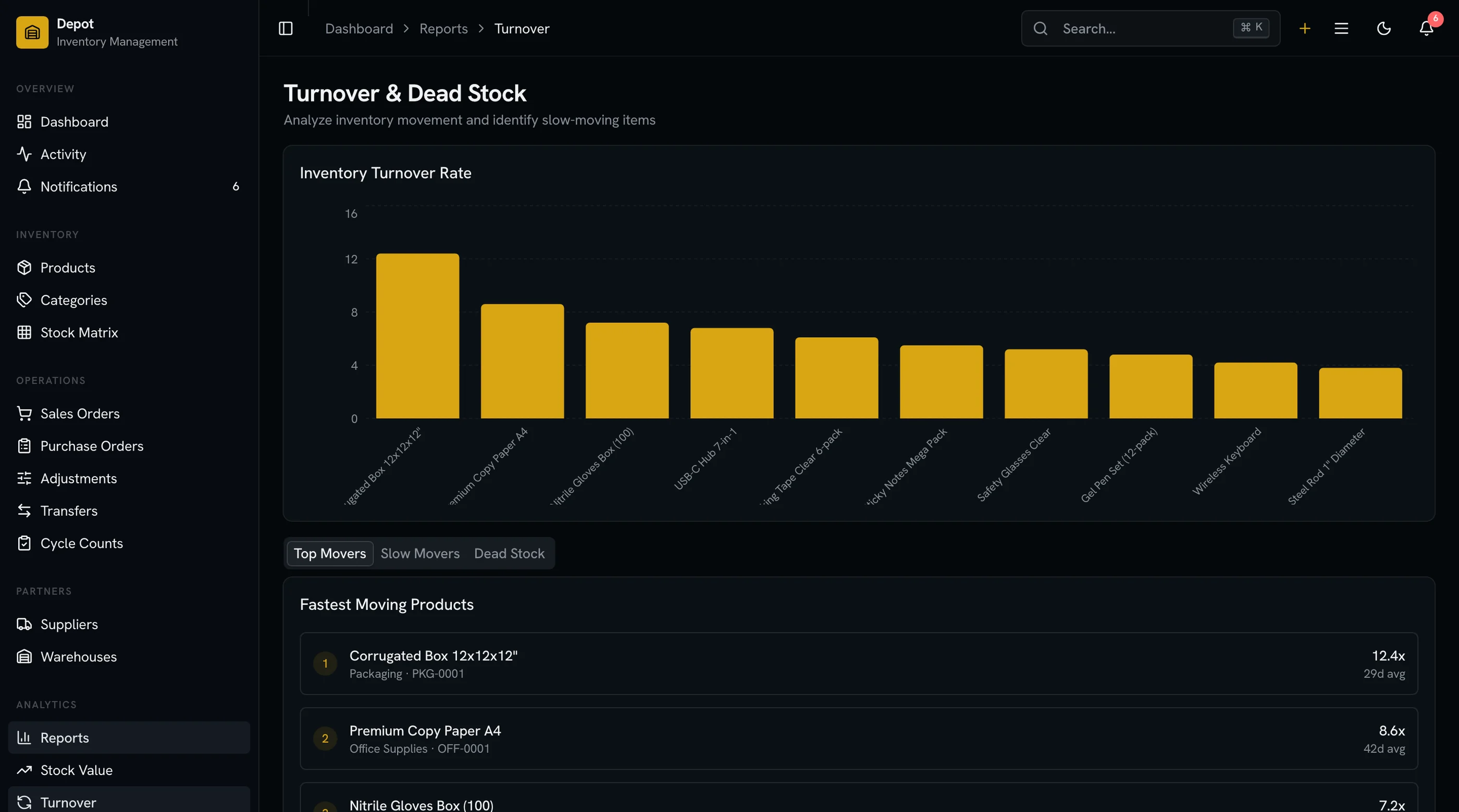
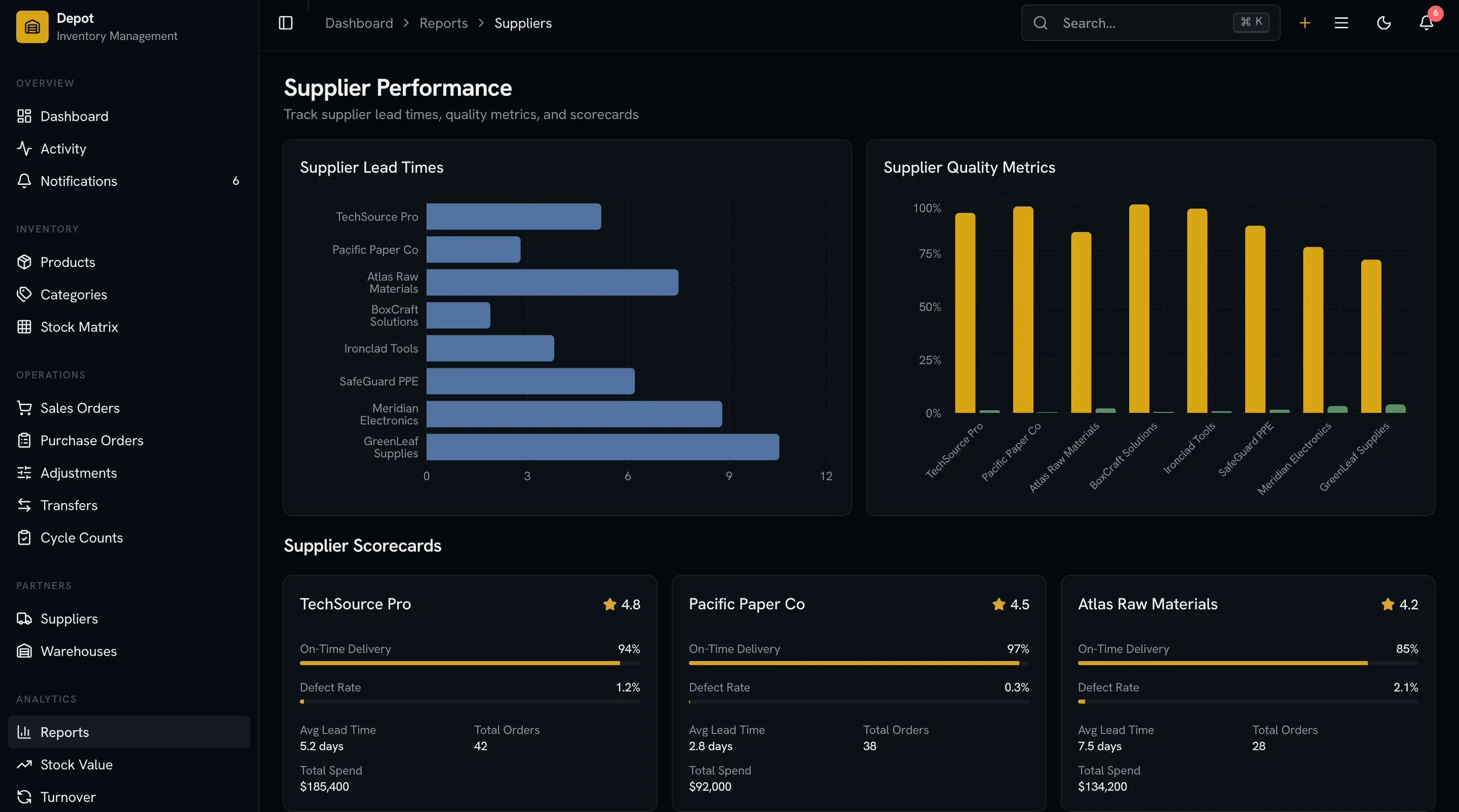
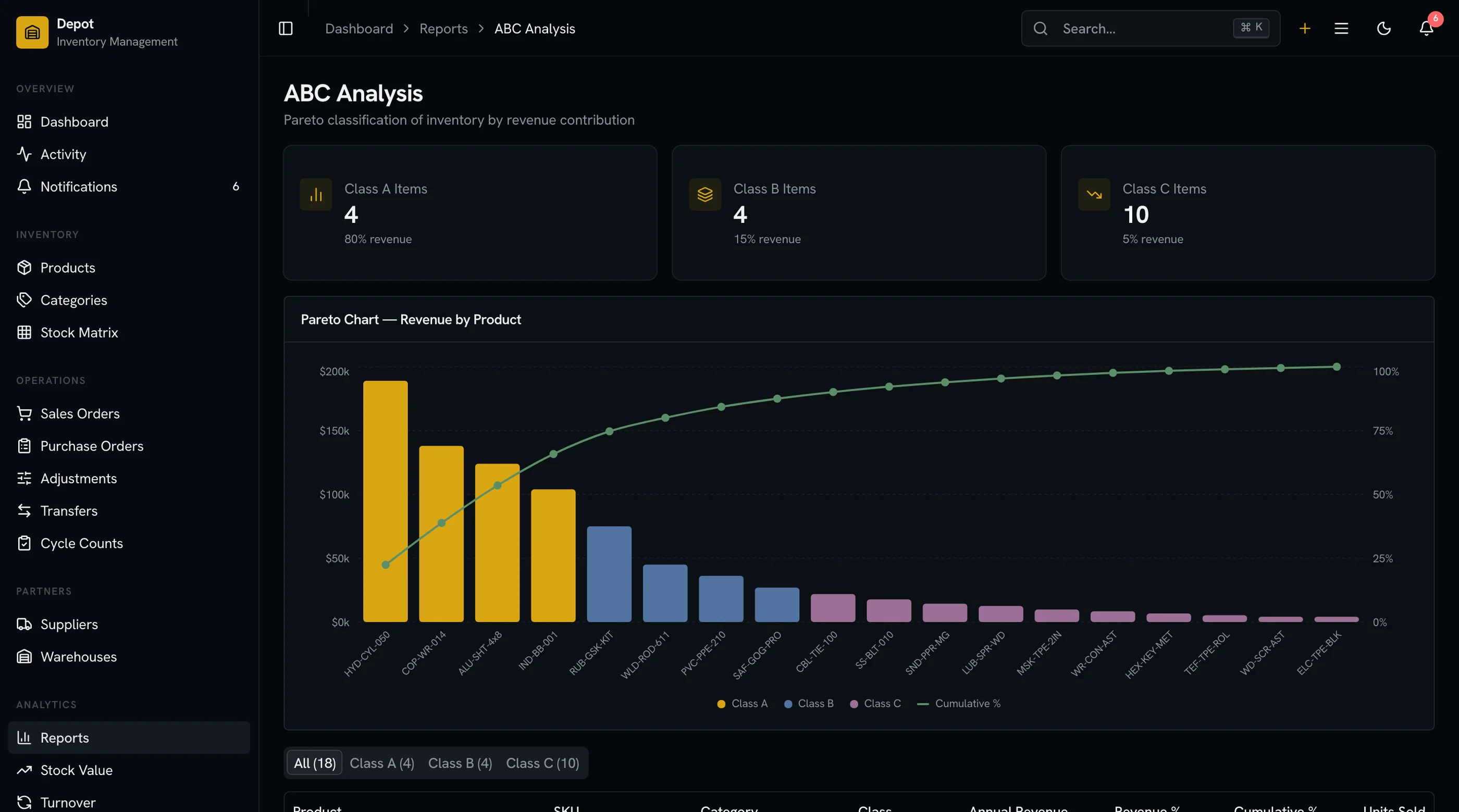
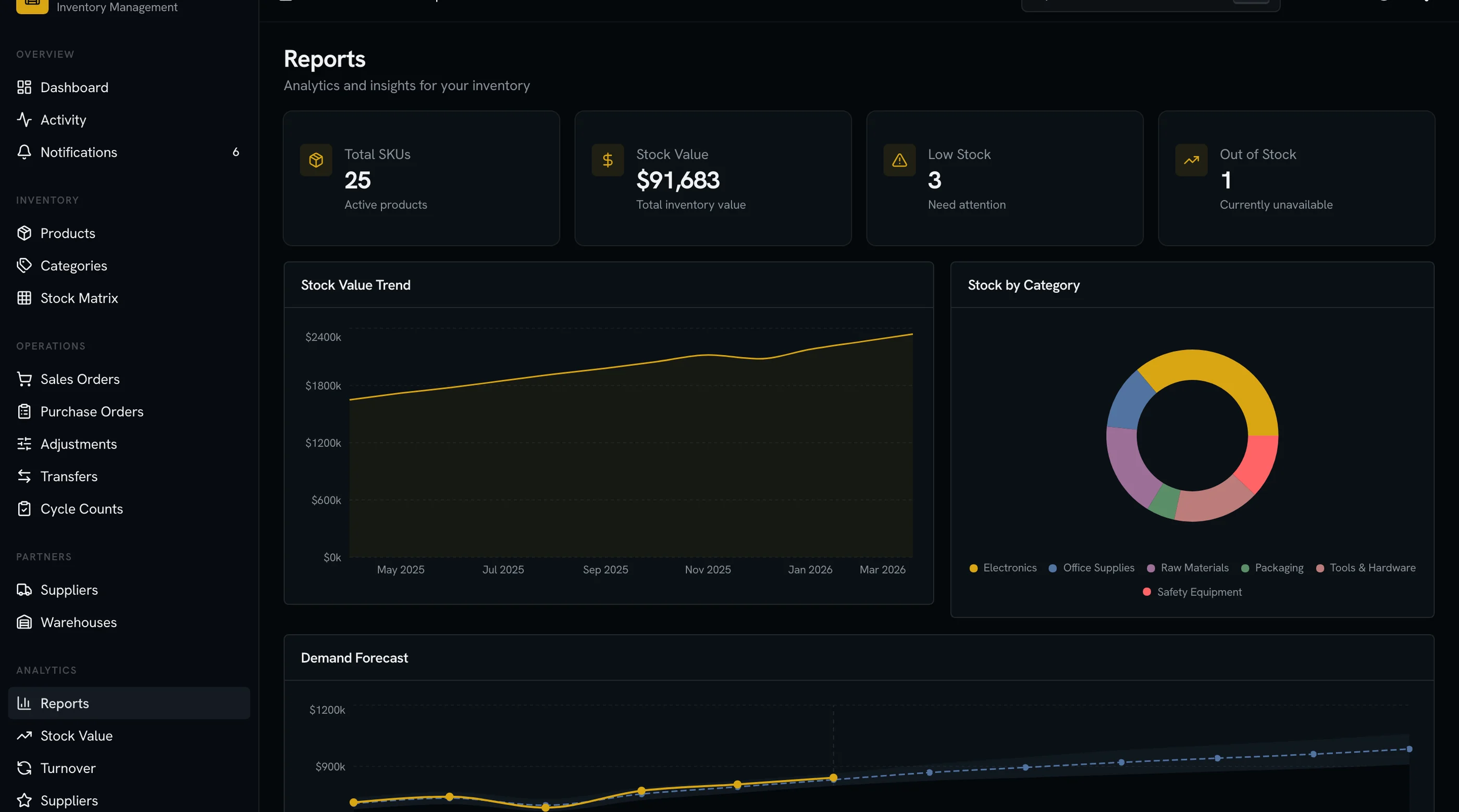
The Inventory Management Kit gives you 32 screens: product catalog, purchase orders with receiving, sales orders, multi-warehouse management, stock transfers, adjustments and cycle counts, a supplier directory, and reports including ABC analysis, stock value and turnover, with 6 Recharts dashboards. Next.js 16, Tailwind v4 and shadcn/ui. $131 solo, $199 team, $349 agency.
Get the Inventory Management Kit → or get every kit (18 total) for $749 via All UI Kits →
TL;DR: Quick Picks for 2026
| Need | Top pick | Price |
|---|---|---|
| Cheapest Cin7-style tool for small business | Zoho Inventory | Free plan, from $29/mo (yearly) |
| Simple, mobile-first stock tracking | Sortly | Free plan, from $49/mo |
| Manufacturing (make-to-order, BOMs) | Katana | From $299/mo |
| Closest like-for-like to Cin7 Core | Unleashed | From $366/mo (yearly) |
| Assembly and kits, plus mobile | inFlow | From $129/mo (yearly) |
| High-volume multichannel e-commerce | Linnworks | Quote |
| Open-source full ERP | ERPNext | Free self-hosted, cloud from $5/mo |
| Open-source modular ERP | Odoo | Free for one app |
| Your own custom system | thefrontkit Inventory Management Kit | $131+ one-time |
What Cin7 Actually Does Well
Cin7's strength is channel depth: Shopify, Amazon, eBay, BigCommerce, WooCommerce and EDI for big-box retail, plus a B2B portal, automation rules and solid purchasing. For operators with 5+ sales channels and complex receiving, it earns its price.
The case to switch isn't that Cin7 is bad. It's that the entry price is steep for small operations, and the fit is wrong if you mainly need simple stock tracking, manufacturing, or a custom workflow.
When to Leave Cin7
- Your software bill is a noticeable share of revenue. Under about $1M in sales, $4,000+ a year is hard to justify.
- You use a fraction of the features. One or two channels and one warehouse don't need Cin7's depth.
- You manufacture. Make-to-order and bills of materials are better served by Katana, Fishbowl or inFlow.
- You need a workflow no off-the-shelf tool supports. That's when building your own starts to make sense.
1. Zoho Inventory
The best-value Cin7 alternative for small businesses.
Strengths:
- Free plan (50 orders a month, 1 user, 1 location)
- Standard $39/month ($29 yearly), Premium $99 ($79), Plus $159 ($129), Enterprise $299 ($249)
- Integrates with Zoho Books, CRM and Commerce, plus Shopify, Amazon and eBay
- Multi-warehouse and a mobile app
Weaknesses:
- UI is functional rather than modern
- Advanced features sit in higher tiers
- Best value if you already use Zoho
Best for: Small and mid-size sellers who want most of what Cin7 does for a fraction of the price.
2. Sortly
Mobile-first inventory tracking for small teams.
Strengths:
- Free plan (100 items, 1 user)
- Advanced $49/month (500 items, 2 users), Ultra $149 (2,000 items), Premium $299 (5,000 items); yearly billing is 50% off in the first year
- Barcode and QR scanning, photo-heavy item records, custom fields
- Great for equipment, tools, samples and field teams
Weaknesses:
- Priced by item count, so it gets expensive with many SKUs
- Not built for multichannel e-commerce or complex order workflows
Best for: Small businesses tracking stock or assets from a phone rather than running multichannel sales.
3. inFlow Inventory
Inventory with assembly and kitting.
Strengths:
- Entrepreneur $161/month ($129 yearly) for 2 users and 100 orders a month; Small Business $436 ($349) for 5 users
- Assembly, kitting and bills of materials
- Purchasing and sales orders, multi-location, lot and serial tracking
- Web, desktop and mobile apps; 14-day trial with no card
Weaknesses:
- Order-count limits, with $0.20 per order overage
- Channel integrations less broad than Cin7
Best for: Product businesses that assemble kits or bundles.
4. Katana
The manufacturing-first alternative.
Strengths:
- Built for make-to-order and make-to-stock manufacturers: bills of materials, production planning, shop floor
- Core from $299/month with unlimited users and SKUs (usage-based on sales orders)
- Free plan for 30 SKUs to try it
- Integrates with Shopify, QuickBooks and Xero
Weaknesses:
- Add-ons for manufacturing, traceability and warehouse cost extra
- Optional onboarding is $2,000
- Overkill if you don't make anything
Best for: Small manufacturers outgrowing spreadsheets.
5. Unleashed
The closest like-for-like to Cin7 Core.
Strengths:
- Core $399/month ($366 yearly) for 3 users and 100 orders a month; Pro $729 ($668) for 5 users
- Strong purchasing, stock control, batch and serial tracking, and light manufacturing
- B2B ordering portal
Weaknesses:
- Mandatory one-time onboarding ($449, $799 or $5,549)
- Extra users cost $69 to $89 a month
- Similar price bracket to Cin7
Best for: Wholesalers and light manufacturers comparing like-for-like with Cin7.
Cin7 vs Unleashed
| Cin7 Core | Unleashed | |
|---|---|---|
| Entry plan | Standard, $349/mo | Core, $399/mo ($366 yearly) |
| Users on entry plan | 5 | 3 |
| Order limit on entry plan | 6,000 sales orders a year | 100 orders a month |
| Onboarding | Varies | One-time $449 to $5,549 |
| Strongest at | Sales channels and integrations | Purchasing, stock control, batch tracking |
Choose Cin7 if you sell across many channels and marketplaces. Choose Unleashed if you're a wholesaler or light manufacturer where purchasing and stock accuracy matter more than channel count. For many small businesses, neither is the cheapest fit: Zoho Inventory or inFlow cover the basics for less.
6. Fishbowl
Warehouse and manufacturing, popular with QuickBooks users.
Strengths:
- Cloud plans billed yearly: Essentials $229/month (2 users), Growth $429 (5 users), Scale $729 (10 users)
- Advanced warehouse and manufacturing editions
- Long-standing QuickBooks integration
Weaknesses:
- An implementation package is required
- No free plan
- Priced for businesses with real warehouse complexity
Best for: Warehouses and manufacturers already on QuickBooks.
7. Linnworks
Multichannel order and inventory management at volume.
Strengths:
- Built for high-volume multichannel e-commerce across marketplaces
- Pricing tiered by monthly order volume, with no percentage fees
Weaknesses:
- Quote-based pricing plus a one-time onboarding fee
- More than a small single-channel store needs
Best for: Growing marketplace sellers for whom order routing and listings are the bottleneck.
8. ERPNext
A full open-source ERP with a strong inventory module.
Strengths:
- Free and open source (GPL-3.0), about 39k GitHub stars
- Inventory, accounting, manufacturing, HR and CRM in one system
- Multi-company, multi-warehouse, batch, serial and expiry tracking
- Frappe Cloud hosting from $5/month if you don't want to self-host
Weaknesses:
- It's an ERP, so the learning curve is steep
- Self-hosting and customization need Python skills
Best for: Businesses that want one system for inventory, accounting and more, and will invest in setup.
9. Odoo Inventory
The modular open-source ERP.
Strengths:
- Community edition is open source (LGPL-3.0); Odoo's "One App Free" plan gives you one app with unlimited users
- Very strong inventory module (lots, serials, expiry, multi-warehouse, putaway rules)
- Start with inventory and add accounting, manufacturing or e-commerce later
- Polished UI for an ERP
Weaknesses:
- Many features are Enterprise-only, and paid pricing is per user (Odoo shows it in your local currency)
- Self-hosting needs Python skills; implementation partners add cost
Best for: Businesses that want a polished ERP they can start small with.
Or Build Your Own with the Inventory Management Kit
Building makes sense when your workflow is the product, or no off-the-shelf tool handles it cleanly. The Inventory Management Kit gives you the frontend; you bring the data model, channel integrations and business logic.
What you get (32 screens):
- Product catalog
- Purchase orders with receiving workflows
- Sales orders
- Multi-warehouse management
- Stock transfers, adjustments and cycle counts
- Supplier directory
- Reports: ABC analysis, stock value, turnover and suppliers, with 6 Recharts dashboards
What you bring:
- Postgres and an ORM (Drizzle or Prisma)
- Channel integrations (Shopify webhooks, Amazon SP-API and so on)
- The data model, which we walk through in our How to Build an Inventory Management App guide
- About 6 to 8 weeks of engineering for a launch-ready system
Would rather have it built for you? See our custom builds service, or our automation work if you mainly need your existing tools connected.
Recommendation by Business
| You | Pick |
|---|---|
| Small business, one or two channels | Zoho Inventory |
| Tracking stock or assets from a phone | Sortly |
| Assembling kits or bundles | inFlow |
| Manufacturer | Katana or Fishbowl |
| Wholesaler comparing like-for-like | Unleashed |
| High-volume marketplace seller | Linnworks, or stay on Cin7 |
| Want a full ERP | ERPNext or Odoo |
| Custom workflow no tool supports | Build with the Kit |
Frequently Asked Questions
What is the best Cin7 alternative for a small business?
Zoho Inventory for most. It has a free plan (50 orders a month) and paid plans from $29/month billed yearly, against $349/month for Cin7 Core. If you mainly track stock from a phone, Sortly is simpler. If you manufacture, look at Katana.
What is a cheaper alternative to Cin7?
Zoho Inventory, Sortly and inFlow are all much cheaper for small teams. Open-source ERPNext and Odoo can cost nothing in licences if you self-host, though setup takes real effort.
Is Unleashed better than Cin7?
Neither is better overall. Cin7 is stronger on sales channels and integrations. Unleashed is stronger on purchasing, stock control and batch tracking, and suits wholesalers and light manufacturers. Unleashed's entry plan is $366/month billed yearly for 3 users plus a one-time onboarding fee, against $349/month for 5 users on Cin7 Core.
What is a simpler alternative to Cin7 Omni?
For most businesses considering Omni, Cin7 Core itself, Zoho Inventory or Unleashed covers what's needed at a lower cost. If you run many marketplace channels at high volume, Linnworks is the specialist.
Does Cin7 have a free plan?
No. Cin7 offers a free trial, and Core starts at $349/month. Zoho Inventory, Sortly and Katana all have free plans.
The Honest Take
Cin7 is the right answer for many multichannel mid-market operations. Small businesses usually aren't that customer. Start with the cheapest tool that fits your actual workflow (usually Zoho Inventory or Sortly), move to Katana or Unleashed when manufacturing or purchasing gets complex, and only build your own when your workflow is part of how you win.
For the operational complexity most inventory tools paper over, see Inventory Templates That Handle Multi-Warehouse Reality.
Want it shipped without hiring a developer?
The build path above assumes you have engineers. If you don't, the team behind thefrontkit does done-for-you launches: we deploy the kit, apply your branding, and wire it to your stack. Fixed quotes, most builds ship in 2-4 weeks, from $1999.