Open Source Zendesk Alternatives: 6 Free and Paid Help Desks
Open Source Zendesk Alternatives: 6 Free and Paid Help Desks for 2026
The three genuinely open source Zendesk alternatives are Zammad, FreeScout and Chatwoot. All three are free to self-host with no per-agent fee. Zammad has the widest feature coverage, FreeScout is the lightest to run, and Chatwoot is the one to pick if your support is chat-first rather than email-first. This guide compares those three against each other, then against three paid options worth knowing about.
Zendesk Suite Team starts at $55 per agent per month. For a 10-person support team that's $6,600/year. Suite Growth is $89/agent (so $10,680/year for the same team). Suite Professional climbs to $115/agent. The pricing isn't unreasonable for what Zendesk offers, but it punishes the exact moment you want to invest in support: when you're growing. (For every plan, the AI and add-on costs, and what 5, 20 and 50 agents really pay, see our Zendesk pricing breakdown.)
The other quiet cost is data ownership. Your customer conversations live in Zendesk's cloud. Migrating off later is a real project, not a weekend.
For a deeper rubric on what a help desk actually has to do, see our How to Build a Help Desk in Next.js guide.
Or skip the build entirely: get the Help Desk Kit
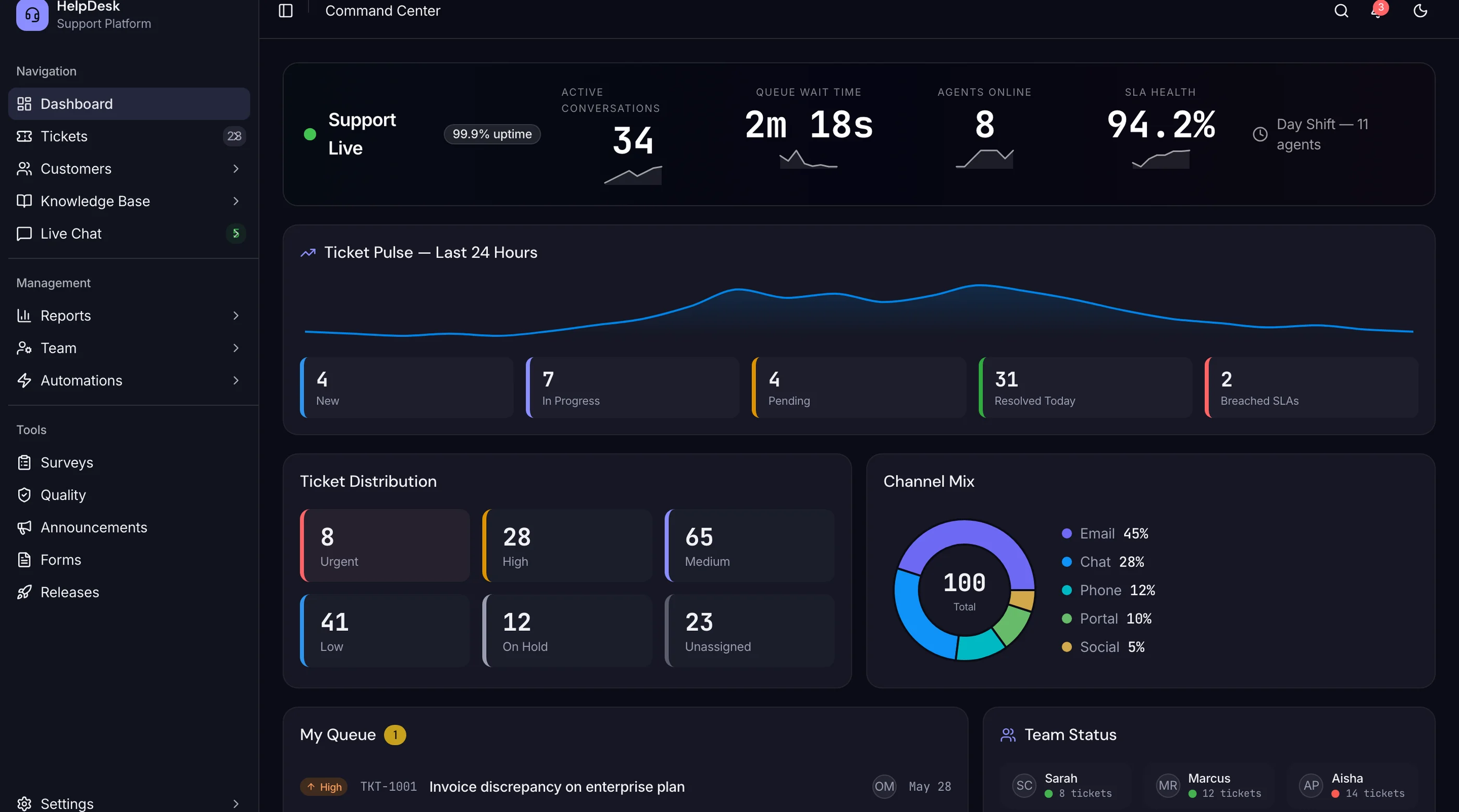
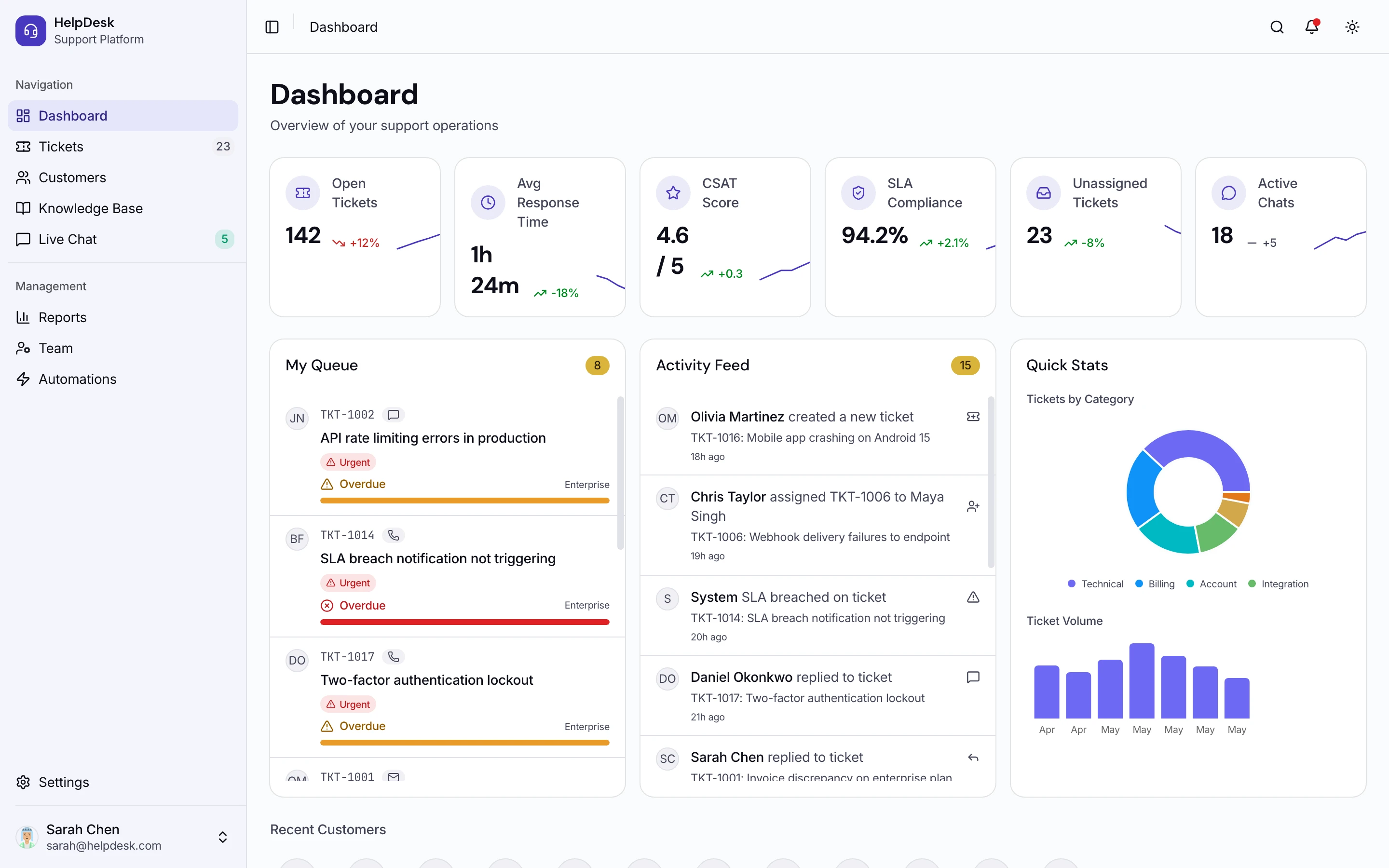
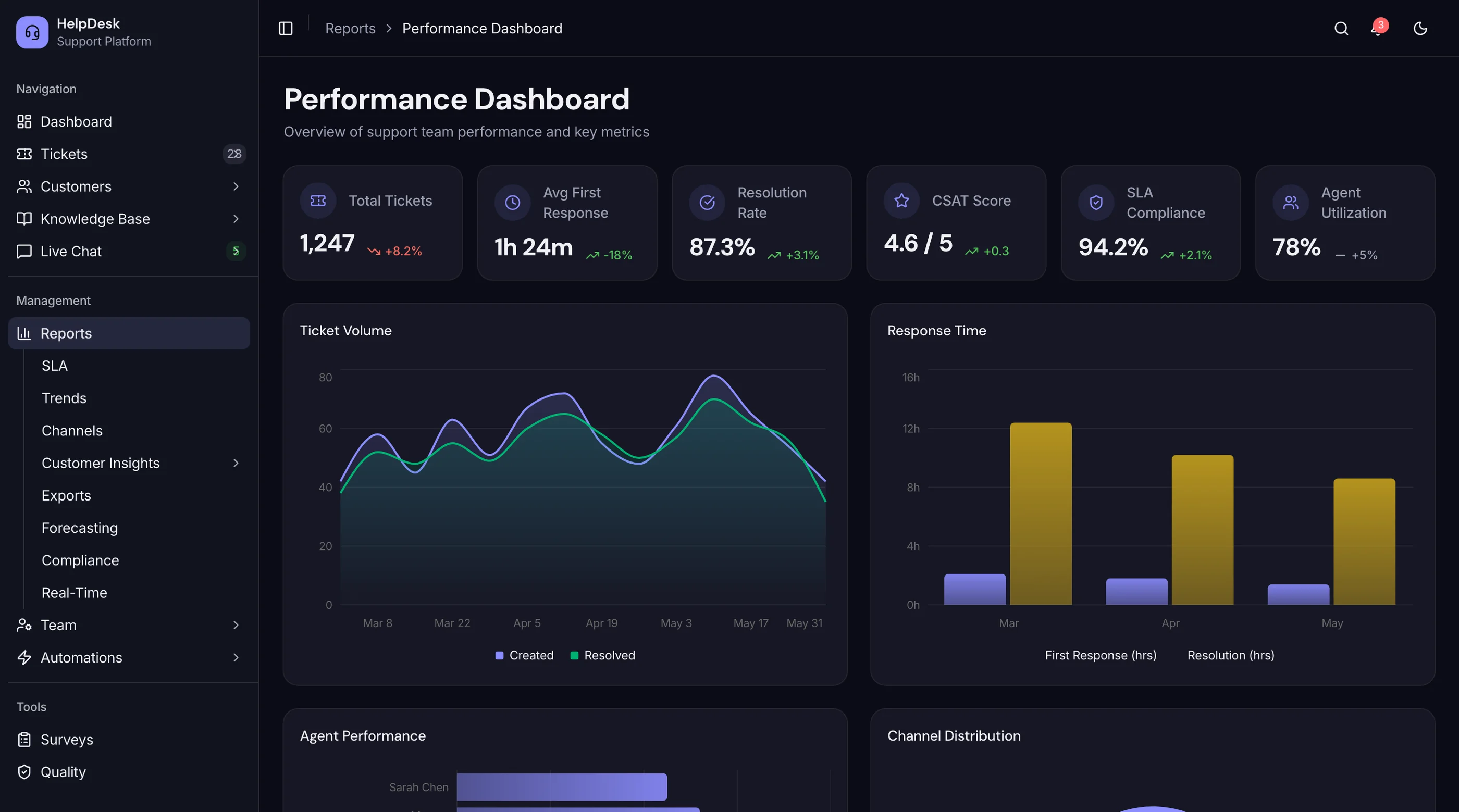
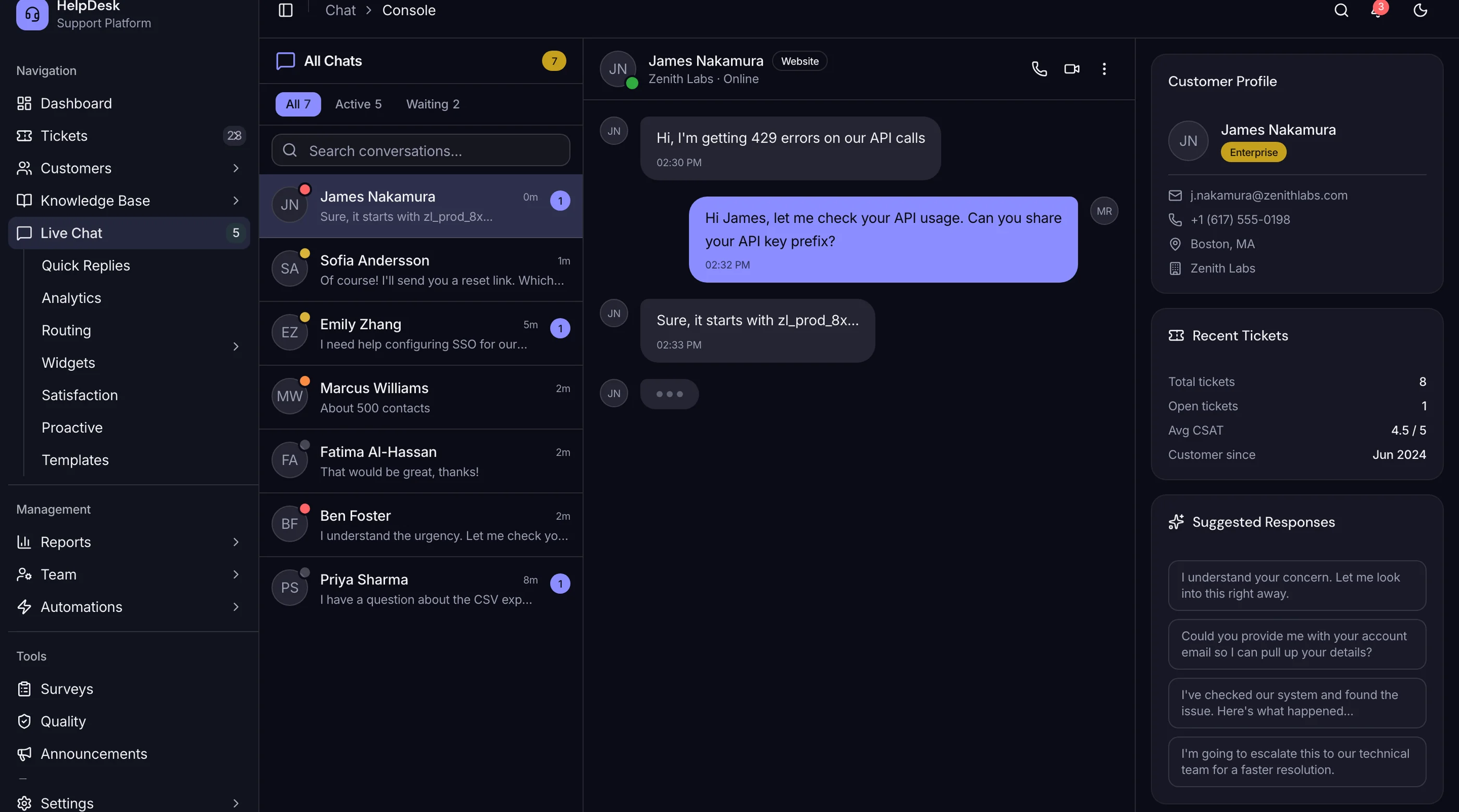
The Help Desk Kit is shipped: 110 screens with inbox + SLA tracking, ticket detail with internal notes separated from customer replies, knowledge base editor, automations in TypeScript (not admin-UI clicks), and reporting. Next.js + Tailwind + shadcn/ui. $131 solo, $199 team, $349 agency.
Get the Help Desk Kit → or get every kit (18 total) for $749 via All UI Kits →
TL;DR: Quick Picks for 2026
| Need | Top pick | Price |
|---|---|---|
| Open-source self-hosted | Zammad | Free |
| Free hosted-feel | FreeScout | Free + $50 modules |
| Omnichannel + chat | Chatwoot | Free / $19+/agent |
| Hosted, friendlier than Zendesk | Help Scout | $25+/user/mo |
| Direct Zendesk competitor | Freshdesk | $15+/agent/mo |
| Embedded in your Next.js app | thefrontkit Help Desk Kit | $131+ |
Why G2 Scores Are Useless Here
The usual way to compare help desks is G2 ratings. It does not work for open source, and it is worth seeing why before you trust a roundup that leans on them. Captured 23 September 2026:
| Product | G2 rating | Reviews |
|---|---|---|
| Chatwoot | 4.5 | 16 |
| Zammad | 4.5 | 10 |
| Help Scout | 4.4 | 431 |
| Freshdesk | 4.4 | 3,771 |
| Zendesk | 4.3 | 7,078 |
| FreeScout | Not rated | "hasn't been reviewed yet" |
Chatwoot and Zammad technically outrank Zendesk. They also have 16 and 10 reviews against Zendesk's 7,078, and FreeScout has none at all. That is not a quality signal, it is an artifact: people who self-host a free tool do not go and write vendor reviews. Any list that ranks open source help desks by G2 score is measuring review-collection budgets.
What to look at instead
For software you are going to host yourself, the repository tells you what you actually need to know. Pulled from the GitHub API on 23 September 2026:
| Project | Stars | Open issues | Last push | Licence |
|---|---|---|---|---|
| Chatwoot | 37,070 | 1,459 | 22 Sep 2026 | MIT Expat, except enterprise/ |
| Zammad | 5,941 | 453 | 22 Sep 2026 | AGPL-3.0 |
| FreeScout | 4,549 | 27 | 22 Sep 2026 | AGPL-3.0 |
All three were pushed to the day before this was written, which is the single most useful fact on this page: none of them is quietly abandoned. Compare that with Peppermint, a Next.js help desk that still appears in 2026 roundups, whose repository was archived by its owner in July 2026 and is now read-only.
Two details worth carrying into your decision. FreeScout's 27 open issues against Zammad's 453 reflects scope rather than neglect, since Zammad does far more. And Chatwoot is open core rather than straightforwardly open source: everything outside the enterprise/ directory is MIT Expat, and that directory carries a separate commercial licence. Zammad and FreeScout are both clean AGPL-3.0, which matters if you intend to modify and redistribute.
What Zendesk Actually Does Well
Worth saying clearly: Zendesk is the most-featured help desk on the market. Their SLA tracking, automation rules, knowledge base, and reporting are best-in-category. If your support team is 50+ agents and you have a Salesforce-style integration footprint, Zendesk earns its price.
For teams under 25 agents, you're paying for features you don't use. That's where alternatives win.
When to Leave Zendesk
Three signals:
- Per-agent pricing crosses 2% of support revenue contribution. Translation: it's now a budget line, not a tool.
- You want the help desk inside your product so customers don't bounce to a Zendesk subdomain.
- Data residency matters (EU customers, healthcare, fintech) and Zendesk's options don't fit.
1. Zammad
Open-source help desk that competes feature-for-feature with paid alternatives.
Strengths:
- Genuinely full-featured: SLA tracking, knowledge base, customer portal
- Multi-channel: email, Twitter, Telegram, SMS, Facebook
- Self-hosted and free, under AGPL-3.0
- Active development as of 2026
Weaknesses:
- Ruby on Rails stack (so DevOps lift if your team is JS-only)
- UI is functional but looks dated next to modern SaaS
- Mobile experience is weak
Best for: Teams that want the most feature coverage from an open-source option and don't mind running a Rails app.
2. FreeScout
Free, PHP-based, designed as a Help Scout clone. The lightest-weight serious option.
Strengths:
- Free core product
- Easy to deploy on cheap shared hosting
- Email-first inbox, clean UI
- Modules for SLA, automation, satisfaction surveys ($50 one-time each)
Weaknesses:
- PHP stack (LAMP-style hosting)
- Some essential features are paid modules
- Smaller community than Zammad or Chatwoot
Best for: Solo founders or small support teams who want a clean email-first help desk and don't need omnichannel.
3. Chatwoot
Open-source omnichannel customer engagement. Closer to Intercom than to Zendesk.
Strengths:
- Live chat, email, WhatsApp, Instagram, Facebook in one inbox
- Self-hostable, also cloud-hosted ($19+/agent)
- API-first, easy to extend
- Active product, strong roadmap
Weaknesses:
- Knowledge base is basic compared to Zendesk
- SLA tracking exists but is less mature
- Self-hosting needs Redis, Postgres, Sidekiq (real DevOps lift)
Best for: Teams whose support is more chat-driven than email-driven, and who want one inbox across web, WhatsApp, and social.
4. Help Scout
Hosted, paid, deliberately simpler than Zendesk. Often the "we're tired of Zendesk" landing spot.
Strengths:
- Significantly cleaner UI than Zendesk
- Email-first design, conversation feels human
- Solid knowledge base and beacon (in-app help widget)
- Pricing tops out around $50/user, no enterprise tier upsell
Weaknesses:
- Still hosted (same data ownership question)
- Per-user pricing still scales with team size
- Less automation depth than Zendesk
Best for: Teams who want hosted simplicity and are willing to pay for it, but not Zendesk prices.
5. Freshdesk
Freshworks' direct Zendesk competitor. Same model, lower price. (Comparing from the other side? See our Freshdesk alternatives guide.)
Strengths:
- $19/agent Growth through $89/agent Enterprise, billed annually, still under Zendesk at the entry tier
- Feature parity with Zendesk on basics
- Strong automation and SLA tooling
- Mobile app is genuinely usable
Weaknesses:
- UI is busier than Help Scout, similar density to Zendesk
- Some upsells feel pushy (Freshworks ecosystem cross-sells)
- Reporting is good, not best-in-class
Best for: Teams that want Zendesk-style features at lower cost without changing the workflow model.
6. Build Your Own in Next.js
The build path is real now. Postmark or AWS SES for inbound email, Postgres for tickets, a Next.js dashboard for agents, shadcn/ui for the inbox. Our How to Build a Help Desk in Next.js guide walks through the data model and email parsing.
What you get:
- Inbox lives inside your product (no Zendesk subdomain)
- Full control over assignment rules, SLA logic, canned responses
- Customer portal that matches your brand
- No per-agent fees ever
What it costs:
- 4-6 weeks for a real first version (inbox, assignment, SLA, knowledge base)
- Ongoing maintenance: email deliverability, spam filtering, the inevitable edge cases
- Engineering time to keep the inbox fast as ticket volume grows
For a 10-agent team paying $89/agent on Zendesk Growth ($10,680/year), the build pays back in year one and compounds.
Skip the Build: Help Desk Kit
The Help Desk Kit is shipped. 110 screens, Next.js + Tailwind + shadcn/ui. Inbox with SLA tracking, ticket detail with internal notes visually separated from customer replies, live chat, knowledge base editor, automations as TypeScript files (the routing-as-code pattern from our self-hosted help desks failure analysis), and reporting designed to hold up at scale.
Frontend kit. You bring your own email infrastructure (Postmark or SES recommended) and database. $131 solo, $199 team, $349 agency. Or get every kit (18 total) for $749 via All UI Kits.
Get the Help Desk Kit → or See All UI Kits →
Recommendation by Team Size
| Team | Pick |
|---|---|
| Solo founder | FreeScout (free) or build it |
| 2-5 agents, email-only | Help Scout or Zammad |
| 5-15 agents, omnichannel | Chatwoot or Freshdesk |
| 15+ agents, complex workflows | Freshdesk or stay on Zendesk |
| Product-embedded support | Build it, or start from the Help Desk Kit |
The honest take: most teams under 15 agents are over-paying Zendesk for features they barely touch. Switch to Chatwoot or Freshdesk and pocket the difference, or build it and own the inbox forever.
Picking Between the Open Source Help Desks
Three of the six above are genuinely open source, meaning you can read the code, self-host it, and pay nothing to licence it. They are not interchangeable.
| Zammad | FreeScout | Chatwoot | |
|---|---|---|---|
| Best at | Full-featured ticketing | Lightweight shared inbox | Omnichannel and live chat |
| Stack | Ruby on Rails | PHP (Laravel) | Ruby on Rails |
| Channels | Email, chat, social, SMS | Email, chat, social, WhatsApp | |
| Knowledge base | Yes | Paid module | Yes |
| SLA tracking | Yes | Paid module | Basic |
| Customer portal | Yes | No | No |
| Hosting effort | Moderate to high | Low | Moderate |
| Licence | AGPL-3.0 | AGPL-3.0 | MIT, open core |
Pick Zammad if you want the closest open-source equivalent to Zendesk and have someone who can run Rails. Pick FreeScout if you want a shared inbox that runs on cheap PHP hosting and will not fight you. Pick Chatwoot if live chat and social channels matter more than formal ticketing.
The cost that surprises people is not the licence, since that is zero. It is the hosting, the upgrades, the backups, and the person who owns all three. Budget a few hours a month at minimum, and more in the first quarter. We wrote about how that goes wrong in Why Self-Hosted Help Desks Stall.
Frequently Asked Questions
Which open source help desk is most actively maintained?
All three of the serious ones are healthy. Chatwoot, Zammad and FreeScout were each pushed to on 22 September 2026, the day before this was last updated. By size of community, Chatwoot leads with 37,070 GitHub stars, ahead of Zammad's 5,941 and FreeScout's 4,549. The one to avoid is Peppermint, which still appears in 2026 roundups despite its repository being archived and made read-only in July 2026.
Is Zendesk open source?
No. Zendesk is proprietary, closed-source software. You cannot read or modify its code, and there is no community edition. Searches for "Zendesk open source" are usually looking for an open source help desk that does what Zendesk does, which is Zammad, FreeScout or Chatwoot.
Can you self-host Zendesk?
No. Zendesk is cloud-only and has no on-premise or self-hosted edition, so your ticket data lives on Zendesk's infrastructure. If self-hosting is the requirement, whether for data residency, cost, or control, you need a different product rather than a different Zendesk plan.
What is the best open source help desk?
Zammad, for most teams. It is the closest open-source equivalent to Zendesk, covering ticketing, SLAs, a knowledge base, a customer portal, and multi-channel ingestion, and it is free to licence. FreeScout is the better pick if you want a lightweight shared inbox on cheap hosting, and Chatwoot if live chat and social channels matter more than formal ticketing.
Is there a free alternative to Zendesk?
Several. Zammad, FreeScout, and Chatwoot are all free to licence and self-hostable, so your only cost is hosting and the time to run them. If you would rather not run infrastructure at all, Zoho Desk has a free edition for 3 users and HubSpot Service has free tools for 2, though HubSpot requires its branding on the free tier. Freshdesk no longer has a permanent free plan.
What is the cheapest Zendesk alternative?
Self-hosted FreeScout, which runs on inexpensive shared PHP hosting and costs nothing to licence. Among hosted options, Zoho Desk and Freshdesk have the lowest entry pricing. The real comparison is per-agent fees forever against hosting plus your own time.
Can I self-host a help desk without a DevOps team?
FreeScout, yes. It runs on standard PHP hosting and installs like a normal web app. Zammad and Chatwoot are Rails applications with more moving parts, so plan on Docker and someone who is comfortable with it. If nobody on the team wants that job, a hosted tier is cheaper than it looks.
How much does it cost to run an open source help desk?
The licence is free. Realistic hosting for a small team is $20 to $60 a month, more if you want redundancy and managed backups. The larger cost is attention: upgrades, deliverability, and the person who owns it. Most teams underestimate that part, which is why self-hosted desks stall rather than fail.
Want it shipped without hiring a developer?
The build path above assumes you have engineers. If you don't, the team behind thefrontkit does done-for-you launches: we deploy the kit, apply your branding, and wire it to your stack. Fixed quotes, most builds ship in 2-4 weeks, from $1999.