SendGrid Alternatives: 13 Email APIs for Developers (2026)
SendGrid Alternatives: 13 Options Compared for 2026
Short answer: if you want the best developer experience, Resend. If you want the best deliverability on transactional mail, Postmark. If you want the lowest possible cost at volume, Amazon SES. If you need marketing and transactional on one bill, Brevo. And if what you are actually building is the marketing interface on top of a sending API, that is a different problem, covered at the end.
SendGrid is the incumbent, and for high-volume senders it still works. The API is stable, it scales to millions of messages, and Twilio's ownership means it is not going anywhere. Plenty of infrastructure runs on it quietly and successfully.
Three things push developers to look around.
The free tier became a trial. Twilio retired SendGrid's free plans starting May 27, 2025. What used to be 100 emails a day forever is now a 60-day trial at the same volume, which changed the calculus for side projects and small apps overnight.
The pricing has drifted upward. Email API Essentials starts around $19.95/month and Pro around $89.95, and the shared-IP tiers have a reputation for inconsistent deliverability that improves mainly when you pay for a dedicated IP.
The developer experience has aged. The SDKs, the docs and the dashboard all predate the current generation of API design, and the difference is obvious the first time you use Resend or Postmark.
Thirteen alternatives worth comparing, all priced from the vendors' own pages in September 2026.
Building the marketing layer, not just sending?
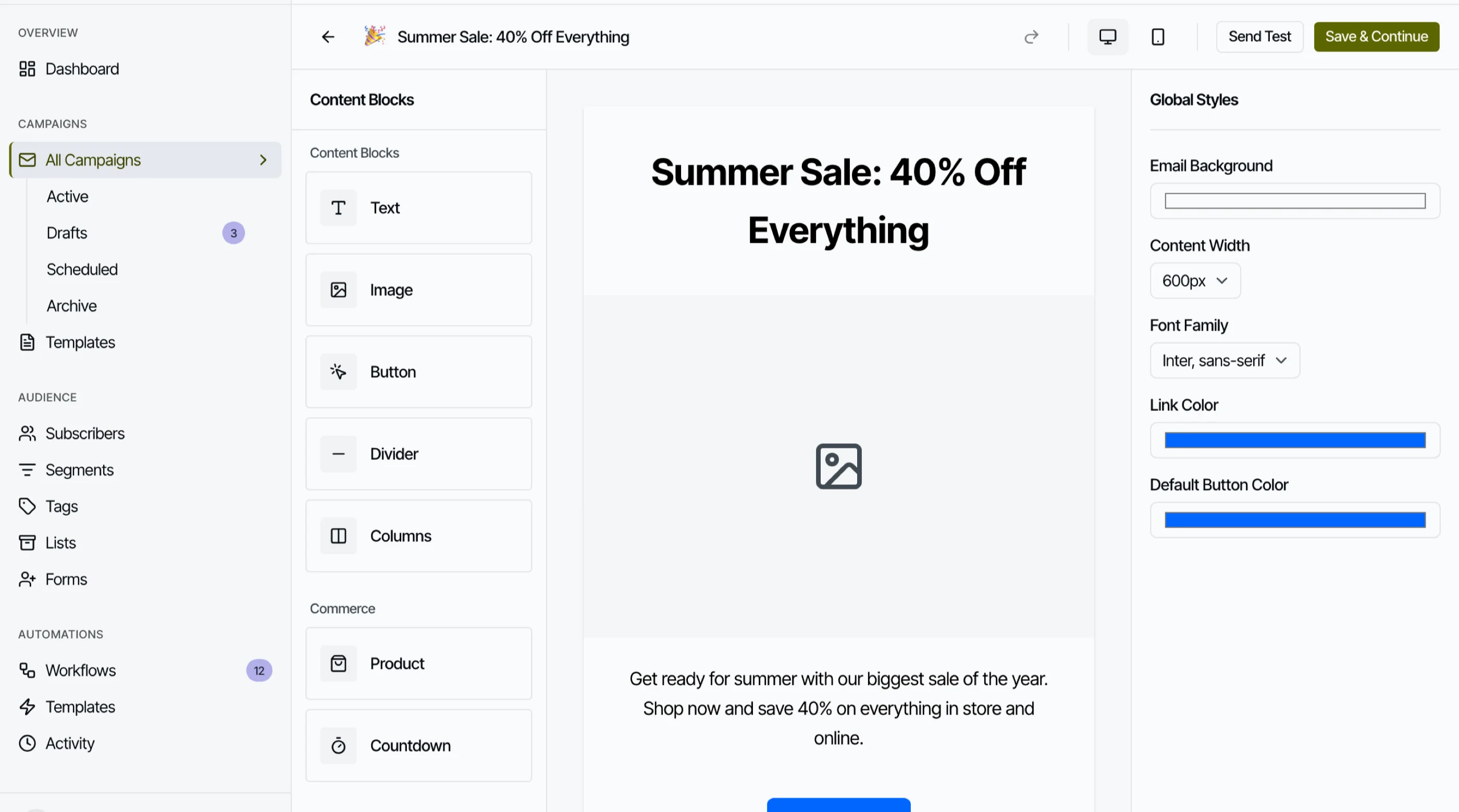
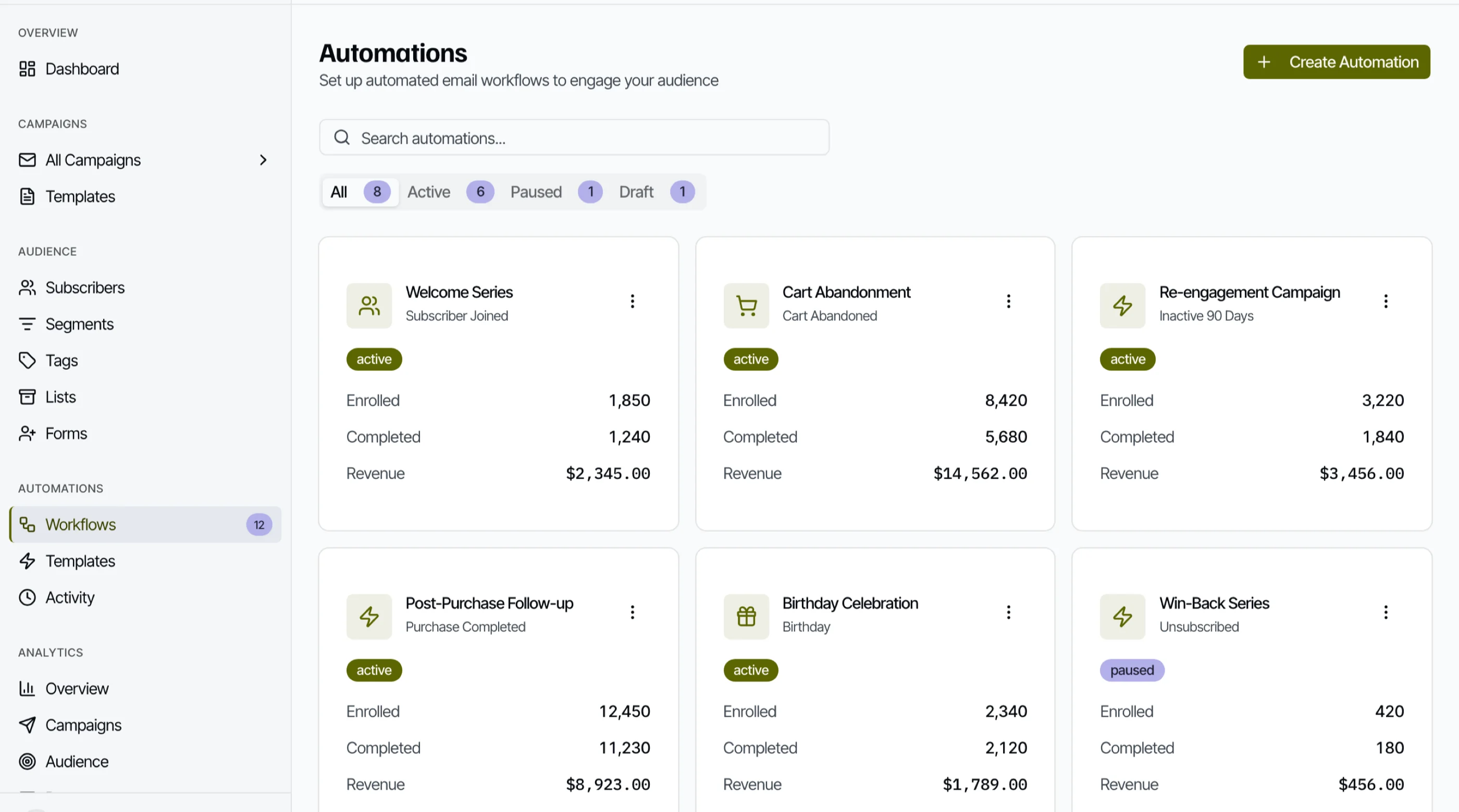
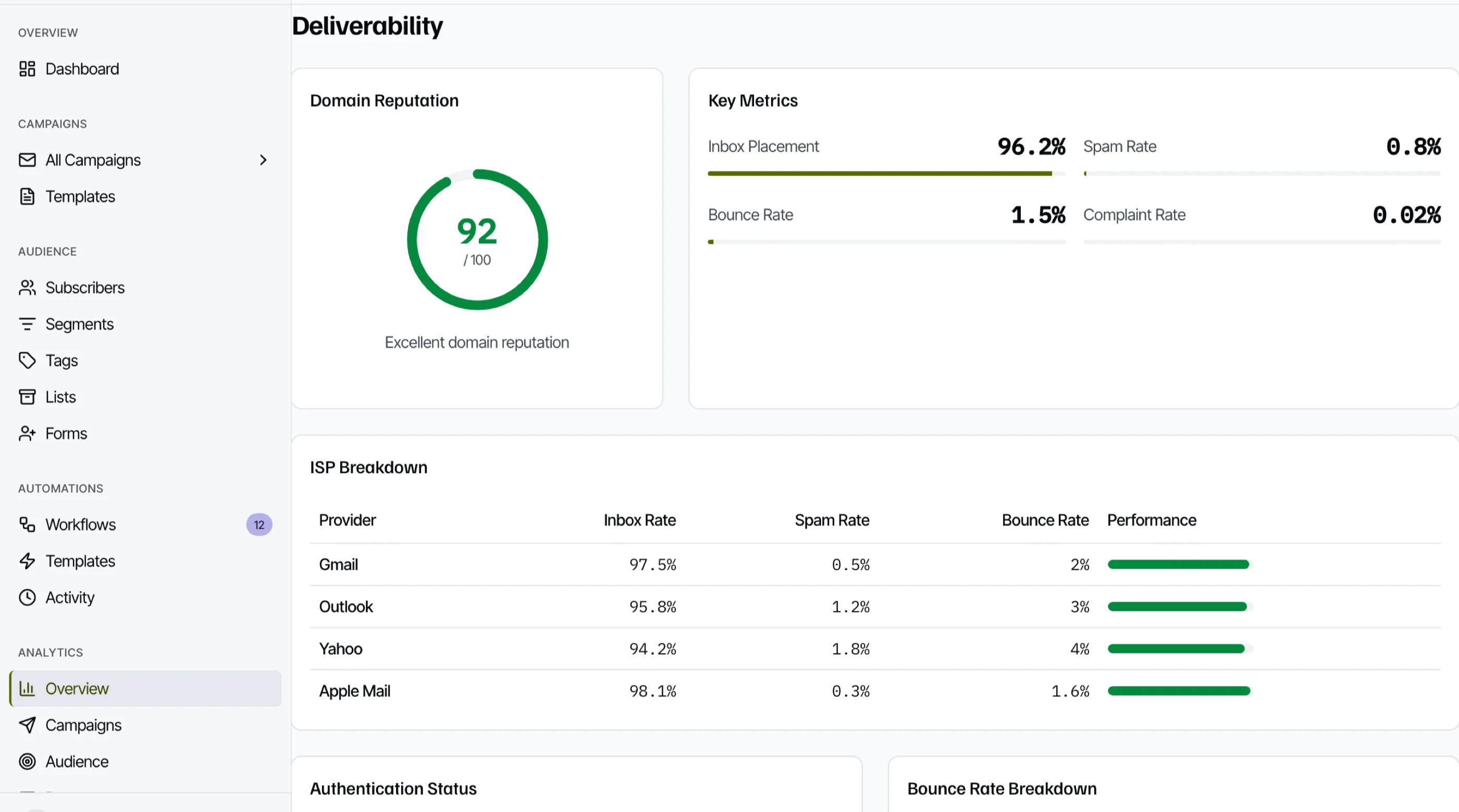
The Email Marketing Kit is the interface that sits on top of whichever API you pick: 38 screens covering a block-based email editor, a node-graph automation canvas, subscriber management, A/B testing, and a deliverability dashboard. Next.js + Tailwind + shadcn/ui. It is a frontend, so you keep your sending provider underneath. $149 solo, $249 team, $399 agency.
Get the Email Marketing Kit → or get every kit (18 total) for $749 via All UI Kits →
TL;DR: Quick Picks for 2026
| Need | Top pick | Price |
|---|---|---|
| Best developer experience | Resend | Free 3,000/mo, paid from roughly $20/mo |
| Best transactional deliverability | Postmark | From roughly $15/mo, then per 1,000 |
| Cheapest at volume | Amazon SES | Roughly $0.10 per 1,000 emails |
| Established, high volume | Mailgun | Foundation from roughly $35/mo for 50,000 |
| Marketing and transactional together | Brevo | Free 300/day, paid from roughly $9/mo |
| Product email for SaaS | Loops | From roughly $49/mo |
| Cheap entry with marketing features | MailerSend | Free 500/mo, from $7/mo |
| Generous free tier plus testing tools | Mailtrap | Free 4,000/mo, from $15/mo |
| Transactional only, pay as you go | ZeptoMail | About $2.50 per 10,000 |
| Open source, self-hosted | Plunk or useSend | Free (AGPL) |
| The marketing UI on top | thefrontkit Email Marketing Kit | $149+ one-time |
Separate the two jobs before comparing. Transactional email (receipts, password resets, alerts) and marketing email (campaigns, newsletters, sequences) have different requirements, and mixing them on one IP reputation is how transactional mail starts landing in spam.
What SendGrid Actually Does Well
Worth being clear about. At genuinely high volume, millions of messages a month, SendGrid remains a sensible default. The infrastructure is proven, the API is stable enough that integrations written in 2018 still run, and enterprise features like subusers, IP pools and dedicated IPs are mature. Twilio ownership also means procurement teams recognise the name, which matters more than developers like to admit.
The case for alternatives is rarely about scale. It is about cost at the low end, developer experience, and deliverability on shared IPs.
When to Leave SendGrid
Three signals:
- Your free tier expired. The 60-day trial ends and a side project suddenly has a $19.95 monthly floor. Resend's 3,000 free monthly emails or SES's per-message pricing usually cost less.
- Transactional mail is landing in spam. Shared-IP reputation is the usual cause. Postmark separates transactional streams by design and is the standard fix.
- You are writing HTML email by hand. If your templates live in a vendor dashboard rather than in your repository, you have a review and versioning problem that React Email solves.
1. Resend
The developer-experience pick, and the default recommendation for most new projects.
Strengths:
- Best-in-class TypeScript SDK and documentation, built by people who clearly resented the old ones
- React Email lets you write templates as components, versioned in your repo and reviewed in pull requests
- Free tier covers 3,000 emails a month, paid from roughly $20/month
- Clean, fast dashboard with useful logs
Weaknesses:
- Younger company with a shorter deliverability track record than Postmark
- Fewer enterprise controls, IP pools and subuser management are thinner
- Marketing features are basic, this is primarily a sending API
- Not the cheapest at very high volume
Best for: Next.js and TypeScript teams starting fresh, and anyone who wants email templates in version control.
2. Postmark
The deliverability pick, and the one to move to when receipts stop arriving.
Strengths:
- Best transactional deliverability in the category, and the fastest delivery times
- Separates transactional and broadcast message streams so reputations do not contaminate each other
- From roughly $15/month, then around $1.80 per additional 1,000 emails
- Excellent, detailed delivery logs and support that understands email
Weaknesses:
- More expensive per message than SES or Mailgun at volume
- Strict about what it will send, bulk marketing is actively discouraged on transactional streams
- Fewer marketing features than the all-in-one tools
- No generous free tier, only a trial
Best for: Applications where a password reset failing to arrive is a support ticket and a churn risk.
3. Amazon SES
The cheapest option by a wide margin, with the cost moved somewhere else.
Strengths:
- Roughly $0.10 per 1,000 emails, which is an order of magnitude below everything else here
- Scales effectively without limit, and integrates with the rest of AWS
- Fine deliverability once your domain and warm-up are done properly
- Pairs well with EmailOctopus or Listmonk as a front end
Weaknesses:
- Bare infrastructure, no templates, no analytics dashboard, no niceties
- Sandbox mode and production access approval trip up first-time users
- You own reputation management, bounce handling and complaint processing
- Engineering time to run it properly can exceed what you save
Best for: High-volume senders with AWS expertise on the team.
4. Mailgun
The other established API, and a reasonable like-for-like swap.
Strengths:
- Mature, proven at scale, with good routing and inbound parsing
- Foundation from roughly $35/month for 50,000 emails
- Strong validation and list-cleaning tooling
- Detailed logs and analytics
Weaknesses:
- Developer experience is dated in the same way SendGrid's is
- Pricing is not competitive at the low end
- Deliverability on shared IPs draws similar complaints
- Support quality varies by tier
Best for: Teams migrating off SendGrid who want an equivalent rather than a rethink.
5. Brevo
The one that covers both jobs on a single bill.
Strengths:
- Marketing campaigns and transactional sending on the same account
- Free tier allows 300 emails a day, roughly 9,000 a month
- Starter from roughly $9/month for 5,000 emails
- Includes SMS, and a usable campaign UI for non-technical colleagues
Weaknesses:
- API and SDKs are noticeably behind Resend and Postmark
- Shared-IP deliverability is inconsistent without a paid dedicated IP
- Mixing marketing and transactional on one reputation carries real risk
- Daily send caps on lower tiers
Best for: Small teams that need both jobs done and do not want two vendors. More options in Brevo Alternatives.
6. Loops
Purpose-built for product email, if that is the actual requirement.
Strengths:
- Designed for SaaS lifecycle email rather than generic transactional sending
- Clean modern API and a genuinely pleasant editor
- Combines broadcast, transactional and sequences in one product
- Good default templates for onboarding and activation
Weaknesses:
- From roughly $49/month, so the floor is higher than Resend's
- Smaller and younger than the alternatives here
- Fewer integrations
- Not intended for very high volume transactional sending
Best for: SaaS teams who want lifecycle email without assembling it from parts.
7. MailerSend
A modern SendGrid-style API with a cheap entry point.
Strengths:
- Free plan with 500 emails a month
- Hobby from $7/month ($5.60 billed yearly) for 5,000 emails; Starter $35 for 50,000
- Transactional and bulk marketing email in one product
- Clean dashboard, templates and inbound routing
Weaknesses:
- Dedicated IPs only on Enterprise (100,000+ a week)
- About $68/month at 100,000 emails on Starter, more than Resend or Mailgun
Best for: Small teams that want a SendGrid-like product with a lower floor.
8. Mailtrap
Sending plus the email testing tool many developers already use.
Strengths:
- The most generous free tier here: 4,000 emails a month (150 a day)
- Basic from $15/month for 10,000; about $30 for 100,000
- Separate transactional and bulk streams
- Built-in email testing sandbox for development and staging
Weaknesses:
- Dedicated IPs start on the Business plan
- Newer as a sending provider than as a testing tool
Best for: Teams that want testing and sending from one vendor.
9. SMTP2GO
Simple SMTP relay with a steady free plan.
Strengths:
- Free plan: 1,000 emails a month (200 a day), every month
- Professional about $75/month at 100,000, with a dedicated IP included from that tier
- Straightforward SMTP and API, good support reputation
Weaknesses:
- Its pricing page lists both $10 and $15 as the starting price, so check before you budget
- Fewer developer-experience niceties than Resend
Best for: Apps and agencies that want a dependable SMTP relay.
10. ZeptoMail (Zoho)
Transactional-only, pay as you go.
Strengths:
- Credit-based: about $2.50 per 10,000 emails, credits valid for 6 months
- No monthly subscription, so it's cheap for spiky or low volume
- Transactional only by design, which protects reputation
Weaknesses:
- No marketing email at all
- Zoho says new pricing applies to sign-ups from July 2026, so confirm the current rate
- Dedicated IPs ($30/month) only in some data centres
Best for: Low or irregular transactional volume, and Zoho shops.
11. Bird (formerly SparkPost)
SparkPost's email platform now lives under Bird.
Strengths:
- Free plan: 1,000 emails a month
- Startup from $15/month for 50,000; about $30 for 100,000
- Mature high-volume sending heritage from SparkPost
- Campaigns and broadcasts included
Weaknesses:
- sparkpost.com now redirects to Bird, and the product is part of a broader messaging platform
- Dedicated IPs ($24.95 each) only on Growth
Best for: Cost-conscious high-volume senders who liked SparkPost.
12. Plunk and useSend (open source)
Self-hosted email platforms that sit on top of Amazon SES.
Strengths:
- Plunk (about 5.5k stars) and useSend (formerly Unsend, about 4.7k stars) are both open source and actively maintained
- Give you a SendGrid-style dashboard, templates and campaigns while SES does the sending at SES prices
- Both offer hosted versions if you don't want to run them
Weaknesses:
- AGPL-3.0 licensed, which matters if you modify and offer them as a service
- You still need an SES account and to handle its setup
Best for: Developers who want SES pricing without building the dashboard.
13. Build the Marketing Layer with the Email Marketing Kit
Worth being precise here, because this is not a SendGrid replacement and pretending otherwise would be dishonest.
SendGrid does two separate jobs. It sends email through an API, and it offers a Marketing Campaigns interface on top. Everything above replaces the sending. Nothing above replaces the interface, and if you are building a product where your customers compose campaigns, manage subscribers and build automations, the interface is the part you actually have to build.
The Email Marketing Kit is that layer, and only that layer. It ships 38 screens: a block-based editor with content and commerce blocks, a node-graph automation canvas with triggers, waits and conditional splits, subscriber management with segments and tags, an A/B testing interface, a deliverability dashboard, click-map analytics, and a campaign template gallery. TypeScript throughout, Recharts for analytics, full dark mode.
It does not send email. There is no sending backend, no authentication, no database, and no real deliverability data in the box. You keep Resend, Postmark or SES underneath and wire the interface to it. The pairing that makes sense for most teams is Resend for sending plus this for the UI.
- Screens: 34+
- Editor: Block-based, with commerce blocks and global styles
- Automation: Node-graph canvas with triggers, waits and splits
- Analytics: Click maps, campaign reporting, deliverability monitoring
- Not included: Any sending capability, auth, database, real deliverability data
- Price: $149 solo / $249 team / $399 agency
Cost at 100,000 Emails a Month
From each vendor's pricing page in September 2026, monthly billing. Where a vendor doesn't list a 100k price directly, we've calculated it from their published rates.
| Provider | ~Cost for 100k/month | Free plan |
|---|---|---|
| Amazon SES | ~$10 (at $0.10 per 1,000) | No (AWS credits for new accounts) |
| ZeptoMail | ~$25 (10 credits) | 10,000 emails once |
| Mailtrap | ~$30 | 4,000/month |
| Bird | ~$30 | 1,000/month |
| SendGrid Essentials | $34.95 | No, 60-day trial |
| Resend | $35 | 3,000/month |
| MailerSend | ~$68 | 500/month |
| SMTP2GO | ~$75 | 1,000/month |
| Mailgun Scale | $90 | 100/day |
| Postmark | ~$126 to $177 depending on plan | 100/month |
Loops prices by contacts rather than sends ($49 for 5,000 contacts), and Brevo's 100k price sits behind a calculator, so neither fits this table.
Recommendation by Use Case
| You | Pick |
|---|---|
| New Next.js project, want good DX | Resend |
| Receipts and resets must arrive | Postmark |
| Millions of emails, AWS team | Amazon SES |
| Straight SendGrid swap | Mailgun |
| Need marketing and transactional | Brevo |
| SaaS lifecycle email | Loops |
| Generous free tier plus testing | Mailtrap |
| Low or irregular volume | ZeptoMail |
| SES prices with a dashboard, self-hosted | Plunk or useSend |
| Building a campaign UI for customers | Email Marketing Kit, on top of one of the above |
| Already at scale and it works | Stay on SendGrid |
Worth being clear about the split: everything above is a sending service, the pipe your email goes down. If what you actually need is the campaign and automation layer that sits on top of it, that is a different category, and we compared the self-hosted options in open source marketing automation.
Frequently Asked Questions
What is the best alternative to SendGrid?
Resend for most new projects, because the developer experience and React Email are a genuine step change. Postmark if transactional deliverability is the priority. Amazon SES if volume is high and you have AWS expertise to run it properly.
Is SendGrid still free?
No. Twilio retired SendGrid's free plans starting May 27, 2025. New accounts get a 60-day trial at 100 emails a day, then Essentials starts at $19.95/month. For a permanent free tier, Mailtrap (4,000 a month), Resend (3,000 a month) and SMTP2GO (1,000 a month) are the closest equivalents, and SES bills per message with no monthly floor.
Which has the best deliverability, SendGrid or Postmark?
Postmark, for transactional mail specifically, and it is not especially close. It separates transactional and broadcast streams so that a marketing campaign cannot damage the reputation your password resets depend on. SendGrid's shared IP pools are the source of most deliverability complaints, and improving them generally means paying for a dedicated IP.
What is the cheapest SendGrid alternative?
Amazon SES, at about $0.10 per 1,000 emails, if you can handle the setup. For a managed service, Mailtrap and Bird come in around $30 for 100,000 emails a month, and ZeptoMail's pay-as-you-go credits work out to about $25 for the same volume.
Should I use one provider for marketing and transactional email?
Generally no. They have different sending patterns and different reputation risks, and a bad campaign should not stop receipts arriving. The common setup is Postmark or Resend for transactional and something else for marketing. Brevo covers both if simplicity outweighs that risk.
Is Amazon SES really that much cheaper?
On paper, yes, roughly $0.10 per 1,000 emails against $19.95 a month floors elsewhere. In practice you take on bounce handling, complaint processing, reputation monitoring and templating, all of which SendGrid does for you. For a team without AWS experience, the engineering time usually costs more than the saving.
The Honest Take
If you are sending millions of messages and SendGrid works, stay. Migration risk on production email is real and the savings at that scale are modest.
For everyone else, the market moved. Resend and Postmark are better tools built more recently, at similar or lower prices, and the loss of SendGrid's permanent free tier removed the main reason small projects defaulted to it. Resend for new builds, Postmark when delivery genuinely matters, SES when volume justifies the operational work.
And separate the two jobs in your head. Replacing SendGrid's API is a solved problem with a dozen good answers. Replacing a campaign interface your customers use is not a vendor decision at all, it is something you build.
Related Guides
- Mailchimp Alternatives: 8 Cheaper Email Platforms for the marketing side of the split
- Brevo Alternatives: 7 Email Platforms if you want both jobs on one bill
- How to Build a SaaS in Next.js for the app the transactional email belongs to
Want it shipped without hiring a developer?
The build path above assumes you have engineers. If you don't, the team behind thefrontkit does done-for-you launches: we deploy the kit, apply your branding, and wire it to your stack. Fixed quotes, most builds ship in 2-4 weeks, from $1999.