Constant Contact Alternatives: 7 Cheaper Options 2026
Constant Contact Alternatives: 7 Options Compared for 2026
Short answer: if you are leaving on price, MailerLite and Moosend both do more for less. If your list is large and mailed rarely, Brevo. If you need integrations, Mailchimp. If you want the cheapest real free tier, EmailOctopus. And if email is part of the product you are building, own the interface.
Constant Contact has been around longer than most of its competitors and sells to a specific buyer: a small business owner who wants email to work without becoming a project. It does that well. There is real phone support, which almost nobody else in this category offers, plus event registration and survey tooling that suits local businesses, nonprofits and membership organisations.
The reason people leave is value rather than usability. At 500 contacts the plans run roughly $12/month for Lite, $35 for Standard and $80 for Premium, and those scale with contact count. There is no permanent free plan, only a trial. Lite is thin enough that most buyers end up on Standard, which puts you at $35/month for features that cost $9 to $12 elsewhere.
The automation gap is the sharper issue. Lite includes a single welcome automation. Pre-built automations, A/B testing and segmentation start at Standard. Custom automation paths and advanced segmentation are Premium. Competitors bundle most of that at their entry tier.
Seven alternatives worth comparing, from cheaper hosted tools to open source to owning the layer.
Or skip the build entirely: get the Email Marketing Kit
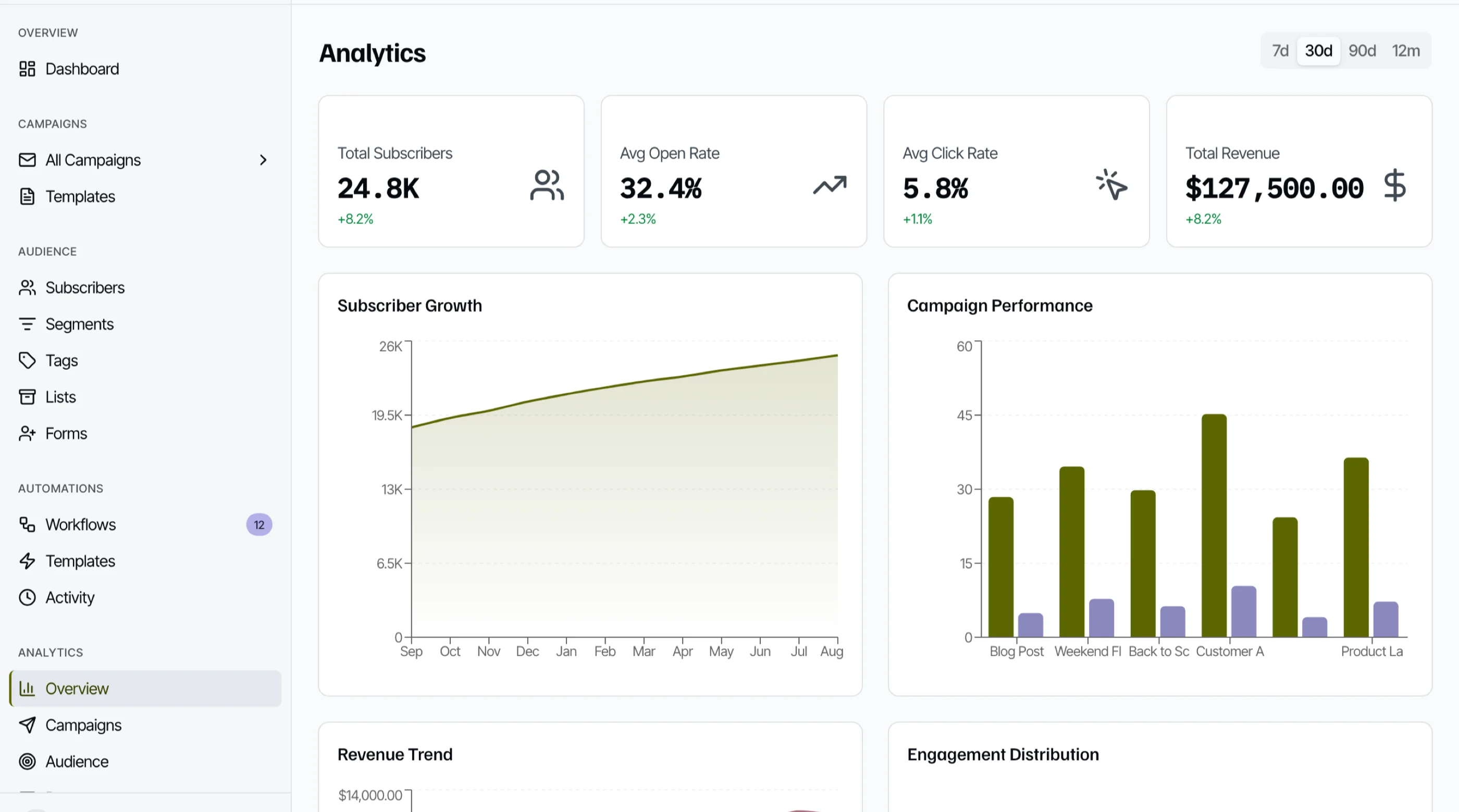
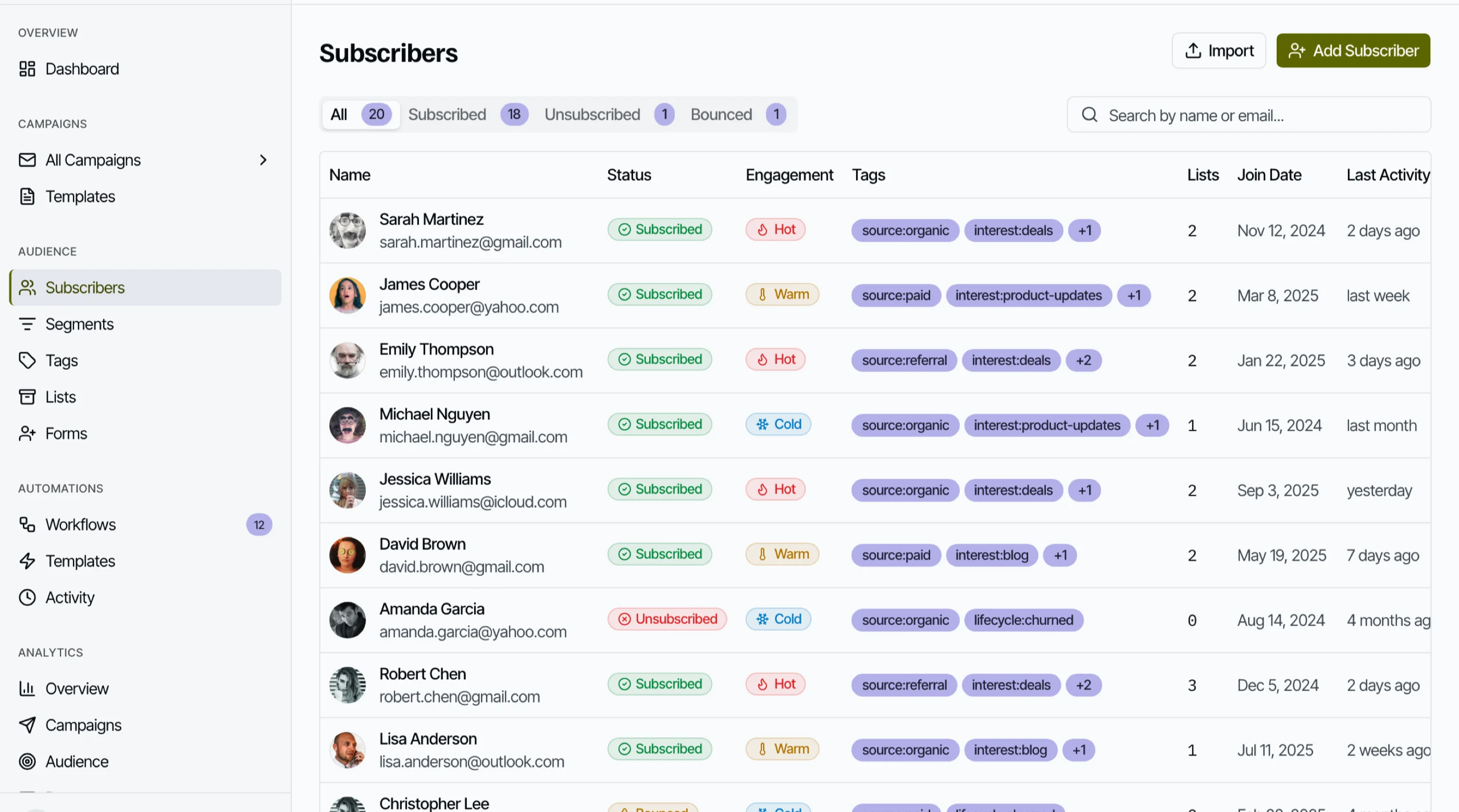
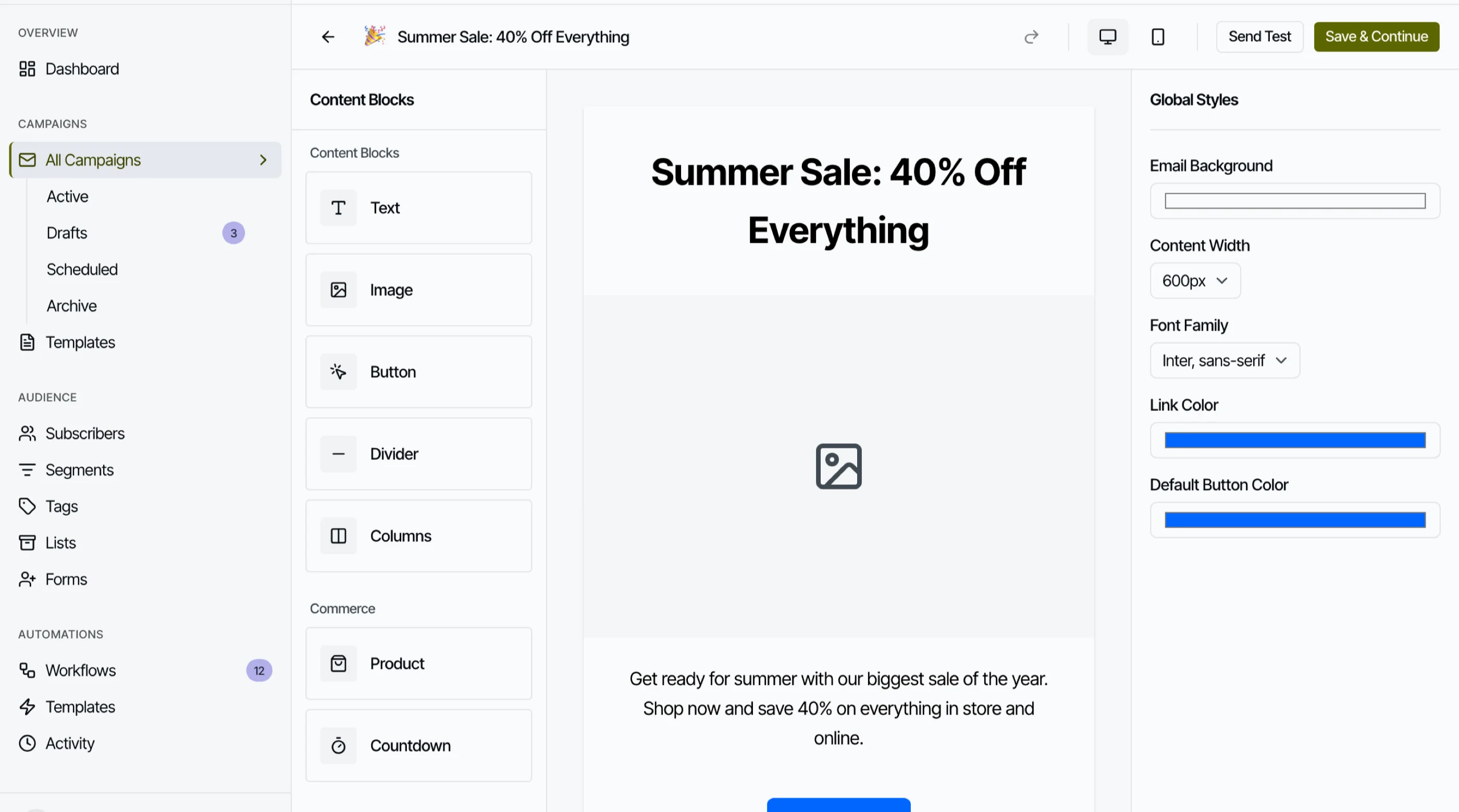
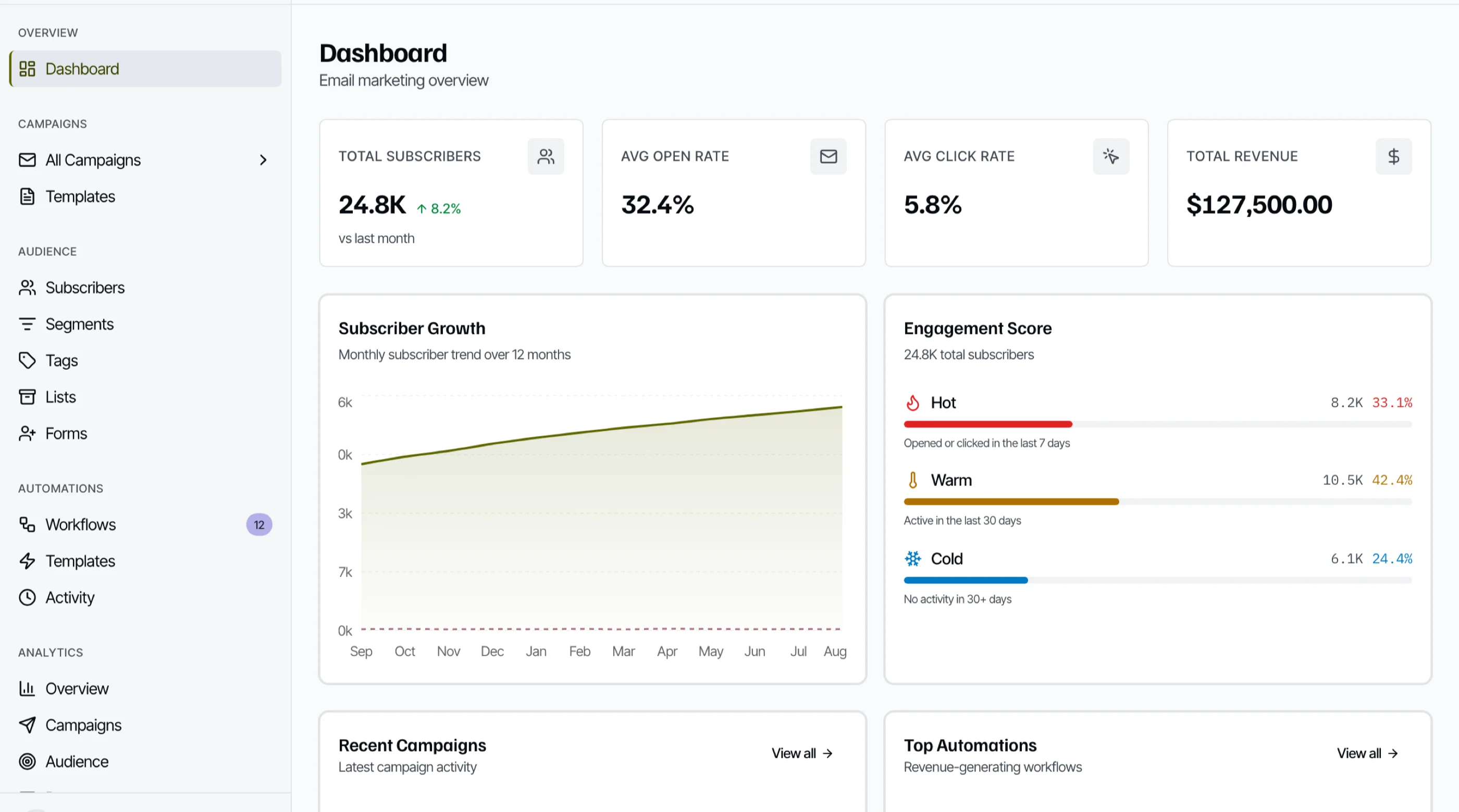
The Email Marketing Kit is shipped: 38 screens covering a block-based email editor, a node-graph automation canvas, subscriber management with segments and tags, A/B testing, deliverability monitoring, and click-map analytics. Next.js + Tailwind + shadcn/ui, dark mode throughout. $149 solo, $249 team, $399 agency.
Get the Email Marketing Kit → or get every kit (18 total) for $749 via All UI Kits →
TL;DR: Quick Picks for 2026
| Need | Top pick | Price |
|---|---|---|
| Best all-round replacement | MailerLite | Free tier, Comfort from roughly $12/mo |
| Big list, mailed occasionally | Brevo | Free 300/day, paid from roughly $9/mo |
| Integrations and familiarity | Mailchimp | From roughly $13/mo at 500 |
| Unlimited sending, cheap | Moosend | From roughly $9/mo at 500 |
| Genuinely free to start | EmailOctopus | Free to 2,500 subs |
| No licence fee at all | Listmonk | Free (self-host) |
| Email inside your own product | thefrontkit Email Marketing Kit | $149+ one-time |
If phone support is the reason you are still there, none of these replace it. Weigh that honestly before moving.
What Constant Contact Actually Does Well
Worth being fair about, because the alternatives mostly do not match it here. Real human support, including a phone number that gets answered, is genuinely rare in this category and worth money to a business without a marketing hire. The event registration and survey tools cover use cases that MailerLite and Brevo simply do not have. Deliverability is solid and has been for two decades. For a nonprofit running a gala or a gym running a member list, it is a defensible choice.
The case for alternatives is that you can get better email software for a third of the price, if you are willing to support yourself.
When to Leave Constant Contact
Three signals:
- You are on Standard or Premium for automation. Paying $35 or $80 a month to send a welcome sequence and segment a list is the clearest overpay in this category.
- You have never called support. The premium is largely for the phone line. If you have not used it in a year, you are not buying what you are paying for.
- Your list grew but your sending did not. Contact-based billing charges for storage, and Brevo's send-based model inverts that entirely.
1. MailerLite
The strongest all-round replacement, and the one most Constant Contact leavers should look at first.
Strengths:
- Comfort from roughly $12/month, with automations, landing pages and forms included
- Cleanest editor in the category, and easier to learn than Constant Contact's
- Free tier for 250 subscribers with 2,500 monthly sends
- Website and landing page builders in the box
Weaknesses:
- No phone support, help is email and chat
- Signup approval rejects some legitimate senders
- No event registration or survey tooling
- Subscriber-based billing, so list growth still moves the bill
Best for: Small businesses that want better software and will trade the phone line for it. More options in MailerLite Alternatives.
2. Brevo
The one that changes what you are billed for.
Strengths:
- Bills emails sent rather than contacts stored, with unlimited contacts on every tier
- Free plan allows 300 emails a day, roughly 9,000 a month
- Starter from roughly $9/month for 5,000 emails, Business from roughly $18
- SMS and transactional sending on the same account
Weaknesses:
- Editor is less polished than MailerLite or Constant Contact
- Daily send caps on lower tiers surprise people mid-campaign
- Shared-IP deliverability improves only on a paid dedicated IP
- Support is not a phone call
Best for: Organisations with a big membership list mailed monthly rather than weekly. More options in Brevo Alternatives.
3. Mailchimp
The obvious lateral move, and cheaper than Constant Contact at most tiers.
Strengths:
- Roughly $13/month at 500 contacts on Essentials, below Constant Contact's Lite equivalent in value
- Largest integration ecosystem in the category
- Deep template gallery and strong reporting
- Familiar to almost anyone you might hire
Weaknesses:
- Free plan is only 250 contacts and 500 monthly sends
- Contact-based billing, same structural problem
- Automation gated across tiers in a similar way
- Support is chat and email, not phone, except at the top tier
Best for: Businesses whose blocker is a missing integration. More options in Mailchimp Alternatives.
4. Moosend
The budget pick that does not feel stripped down.
Strengths:
- From roughly $9/month at 500 subscribers, with unlimited emails on every plan
- Automation builder is better than the price implies
- 30-day trial without a card
- Around $315/month at 50,000, which stays reasonable as you grow
Weaknesses:
- Small ecosystem and few integrations
- Dated templates
- Email-first support with slower response times
- Little brand recognition
Best for: Businesses that mail frequently and want the send limits gone.
5. EmailOctopus
The cheapest way to keep a list alive.
Strengths:
- Free to 2,500 subscribers and 10,000 monthly emails, comfortably the most generous starting point here
- Paid plans from roughly $9/month
- Can run on Amazon SES, making high volume very cheap
- Simple and fast, with no upsell pressure
Weaknesses:
- Automation is basic, broadcast and simple sequences only
- No landing pages, events or surveys
- Minimal reporting
- The SES route needs AWS comfort
Best for: Nonprofits and small organisations whose need is a newsletter, not a marketing suite.
6. Listmonk
The option that removes the subscription entirely.
Strengths:
- Free and open source, written in Go, very fast at large list sizes
- No per-contact or per-send licence, you pay only your sending provider
- Handles multi-million row lists on modest hardware
- Single binary, straightforward to deploy
Weaknesses:
- You own deliverability, which is the genuinely hard part
- Broadcast and scheduled sending, no automation canvas
- Admin UI is functional rather than friendly
- Needs a technical owner permanently, which is the opposite of why you bought Constant Contact
Best for: Organisations with technical staff and a large list. A poor fit for the typical Constant Contact buyer.
7. Build It with the Email Marketing Kit
The option worth considering when email is part of the product rather than a channel pointed at it.
If you are building software where your customers send email, a membership platform, an events tool, an association management system, then embedding an ESP means their branding and their limits inside your product. The interface is also the expensive part to build and the part your users judge.
The Email Marketing Kit ships 38 screens for that layer: a block-based editor with content and commerce blocks, a node-graph automation canvas with triggers, waits and conditional splits, subscriber management with segments and tags, an A/B testing interface, a deliverability dashboard, click-map analytics, and a campaign template gallery. TypeScript throughout, Recharts for analytics, full dark mode.
Be clear about the boundary. It is the frontend. There is no sending backend, no authentication, no database, and no real deliverability data in the box. You wire it to your own infrastructure, typically Resend, Postmark or SES. There is no per-contact fee, because there is no vendor.
- Screens: 34+
- Editor: Block-based, with commerce blocks and global styles
- Automation: Node-graph canvas with triggers, waits and splits
- Analytics: Click maps, campaign reporting, deliverability monitoring
- Not included: Sending backend, auth, database, real deliverability data
- Price: $149 solo / $249 team / $399 agency
Recommendation by Organisation Profile
| You | Pick |
|---|---|
| Small business, want better software | MailerLite |
| Large membership list, monthly send | Brevo |
| Blocked by a missing integration | Mailchimp |
| Mail frequently, watch the budget | Moosend |
| Nonprofit, newsletter only | EmailOctopus |
| Technical staff, big list | Listmonk |
| Building email into your own product | Email Marketing Kit |
| Rely on phone support, run events | Stay on Constant Contact |
Frequently Asked Questions
What is the best alternative to Constant Contact?
MailerLite for most small businesses, because it offers better software with automations included at roughly a third of the Standard price. Brevo if your list is large and mailed infrequently. Mailchimp if a specific integration is what keeps you tied to a hosted tool.
Is there a free alternative to Constant Contact?
Yes, and this matters because Constant Contact has no permanent free plan. EmailOctopus is free to 2,500 subscribers, Brevo's free tier allows 300 emails a day with unlimited contacts, and MailerLite covers 250 subscribers. Listmonk is free to licence if you can self-host.
Is Constant Contact expensive?
Relative to the category, yes. Roughly $12, $35 and $80 a month at 500 contacts for Lite, Standard and Premium, and most buyers need Standard because Lite includes only one automation. MailerLite and Moosend both start around $9 to $12 with more automation included.
Which alternative has the best support?
None of them match Constant Contact's phone support, which is the honest answer. MailerLite offers 24/7 live chat on its Power plan and email support below that, which is the closest thing here. If a phone line is genuinely part of why you bought it, that premium may be rational.
Can I move my contacts and templates?
Contacts export cleanly as CSV everywhere, so the list moves without difficulty. Templates do not transfer between platforms and will need rebuilding, which is usually an afternoon rather than a project. Automations also need rebuilding, though most Constant Contact accounts have few enough that this is not the obstacle people expect.
The Honest Take
Constant Contact sells support and simplicity, and there is a real customer for that. A nonprofit running events with a volunteer managing the list is not well served by being told to self-host Listmonk.
But most accounts are paying Standard pricing for a newsletter and a welcome email. MailerLite does that better for a third of the cost, and Brevo does it for less again if the list is large and quiet. The premium only makes sense if you are using the phone line and the event tooling, and most people have not called in a year.
If email is something your product does rather than something you do to your customers, none of these fit, and you will end up building the interface anyway. Worth deciding that deliberately rather than after two years of fighting an embed.
Related Guides
- Mailchimp Alternatives: 8 Cheaper Email Platforms for the broader value comparison
- MailerLite Alternatives: 7 Email Platforms if MailerLite is where you are heading
- Brevo Alternatives: 7 Email Platforms if send-based billing suits your list better
Want it shipped without hiring a developer?
The build path above assumes you have engineers. If you don't, the team behind thefrontkit does done-for-you launches: we deploy the kit, apply your branding, and wire it to your stack. Fixed quotes, most builds ship in 2-4 weeks, from $1999.