MailerLite Alternatives: 7 Email Platforms Compared 2026
MailerLite Alternatives: 7 Options Compared for 2026
Short answer: if you were rejected at signup, Brevo or Moosend will almost certainly take you. If you want to stop paying for stored subscribers, Brevo. If you want the cheapest credible tool, EmailOctopus or Moosend. If you need integrations, Mailchimp. And if email is part of the product you are building, own the interface.
MailerLite is usually the answer to "what is cheaper than Mailchimp", and it deserves that reputation. The editor is cleaner than most, the automations are capable, and the pricing is genuinely lower at the same list size. Comfort starts around $12/month and Power around $25.
People leave for three reasons that have nothing to do with price.
The first is the approval process. MailerLite reviews accounts and rejects a meaningful number of legitimate senders, often with little explanation and often after you have already imported a list. Affiliate marketing, some finance and crypto niches, and anything that looks like a bought list get declined. If that has happened to you, no amount of feature comparison matters.
The second is that the free plan is smaller than its reputation suggests. It is 250 subscribers and 2,500 monthly emails, which is the same subscriber ceiling Mailchimp now uses.
The third is the billing model. MailerLite charges on subscribers stored, so the problem people left Mailchimp to escape follows them across.
Seven alternatives worth comparing, from send-based pricing to open source to owning the layer.
Or skip the build entirely: get the Email Marketing Kit
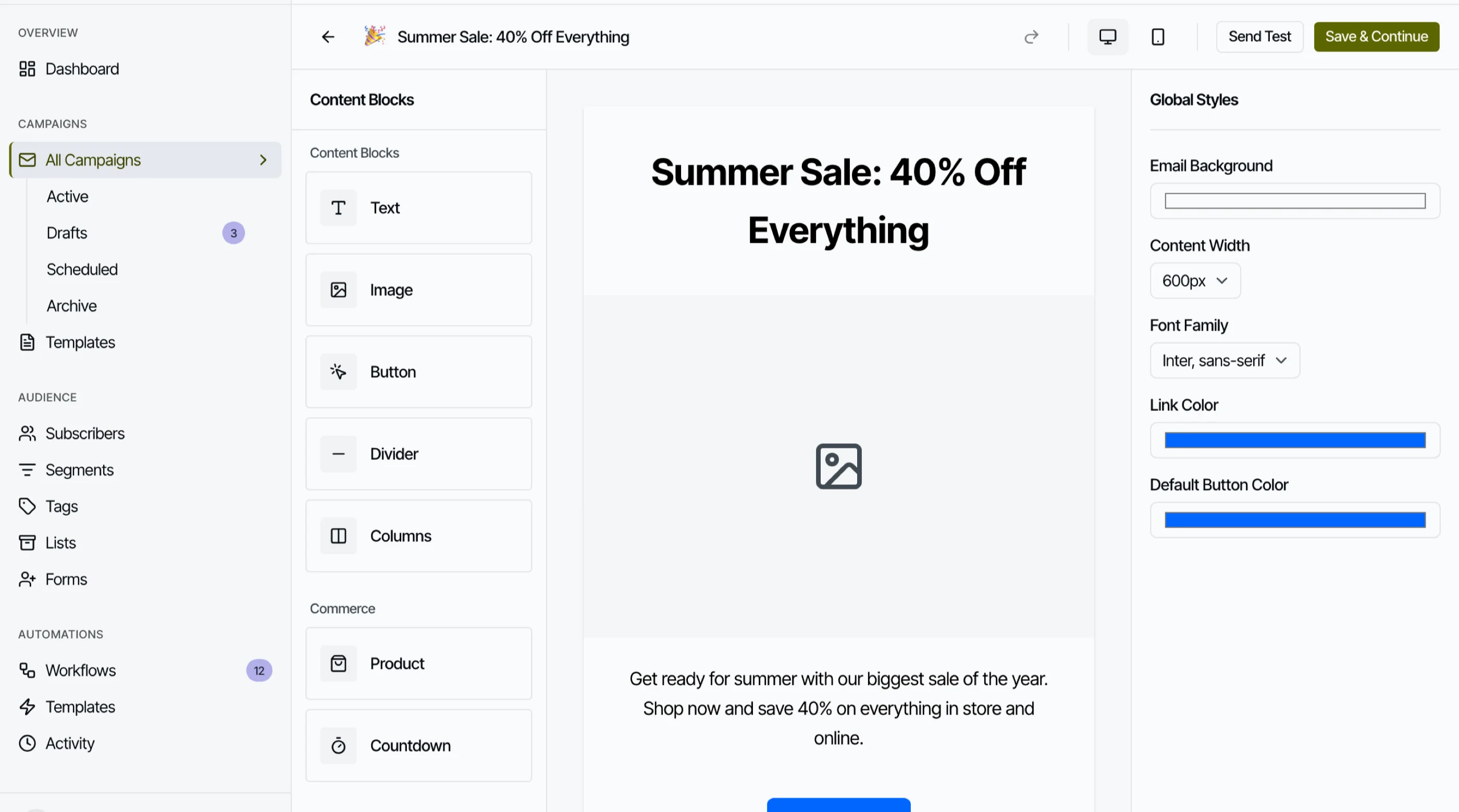
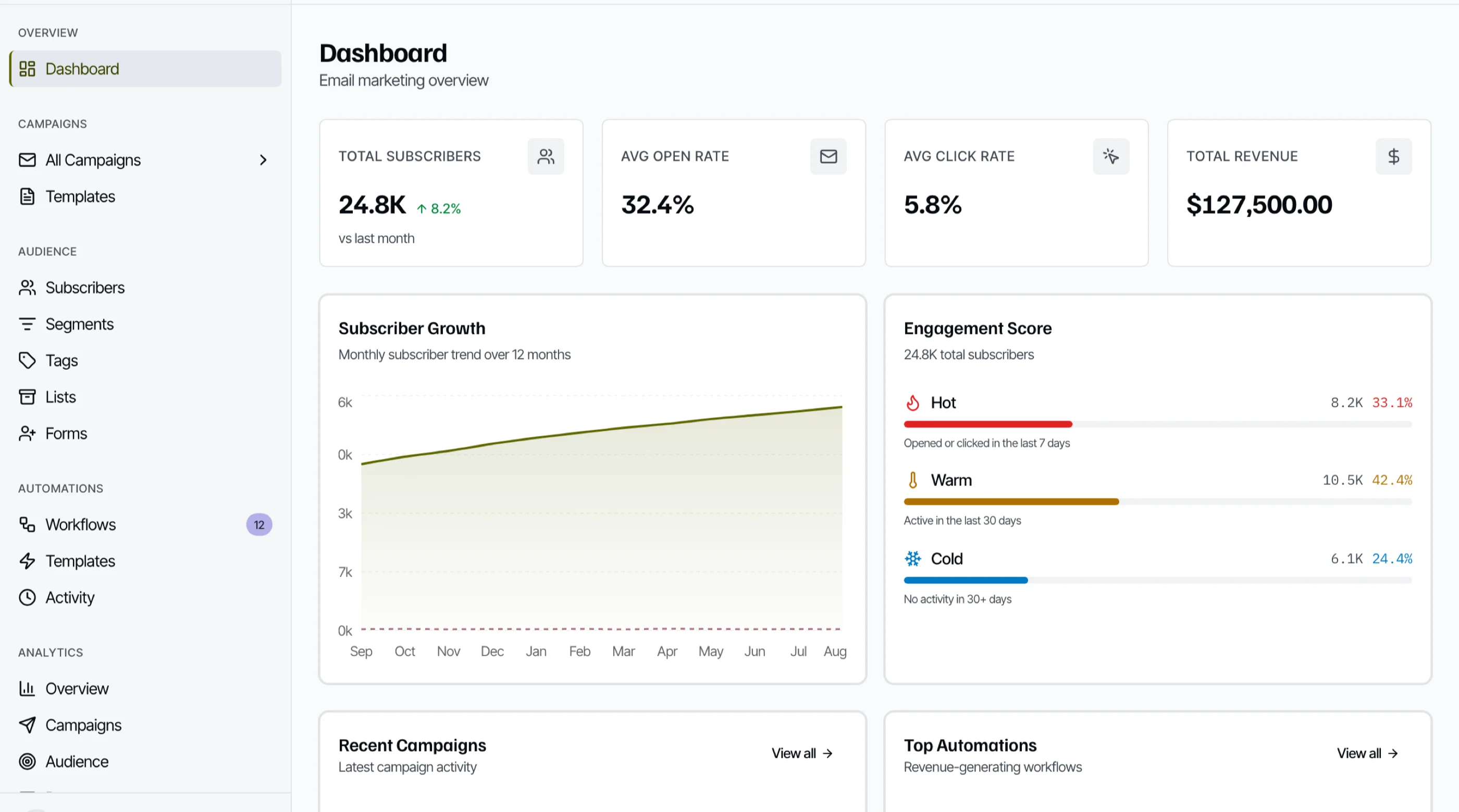
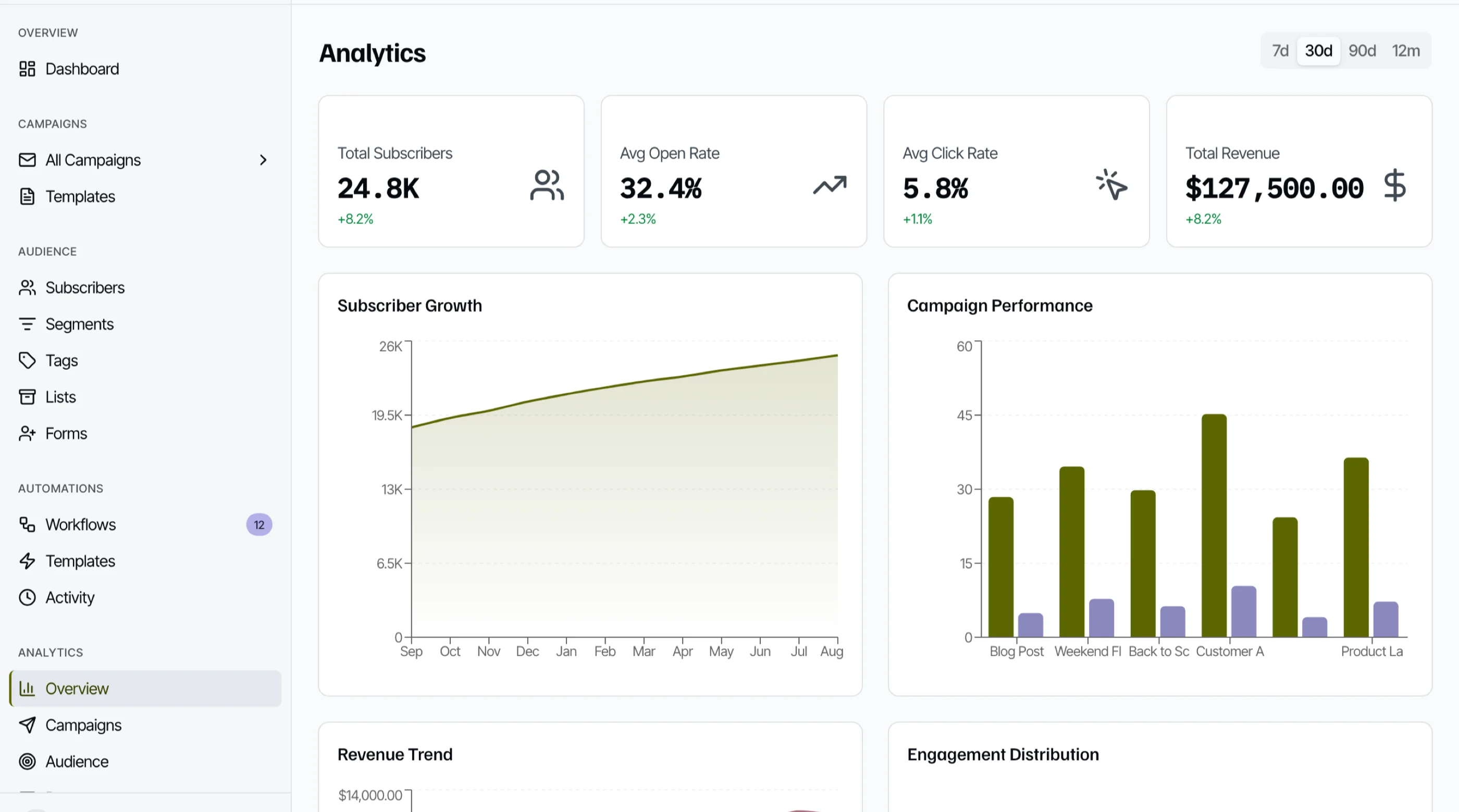
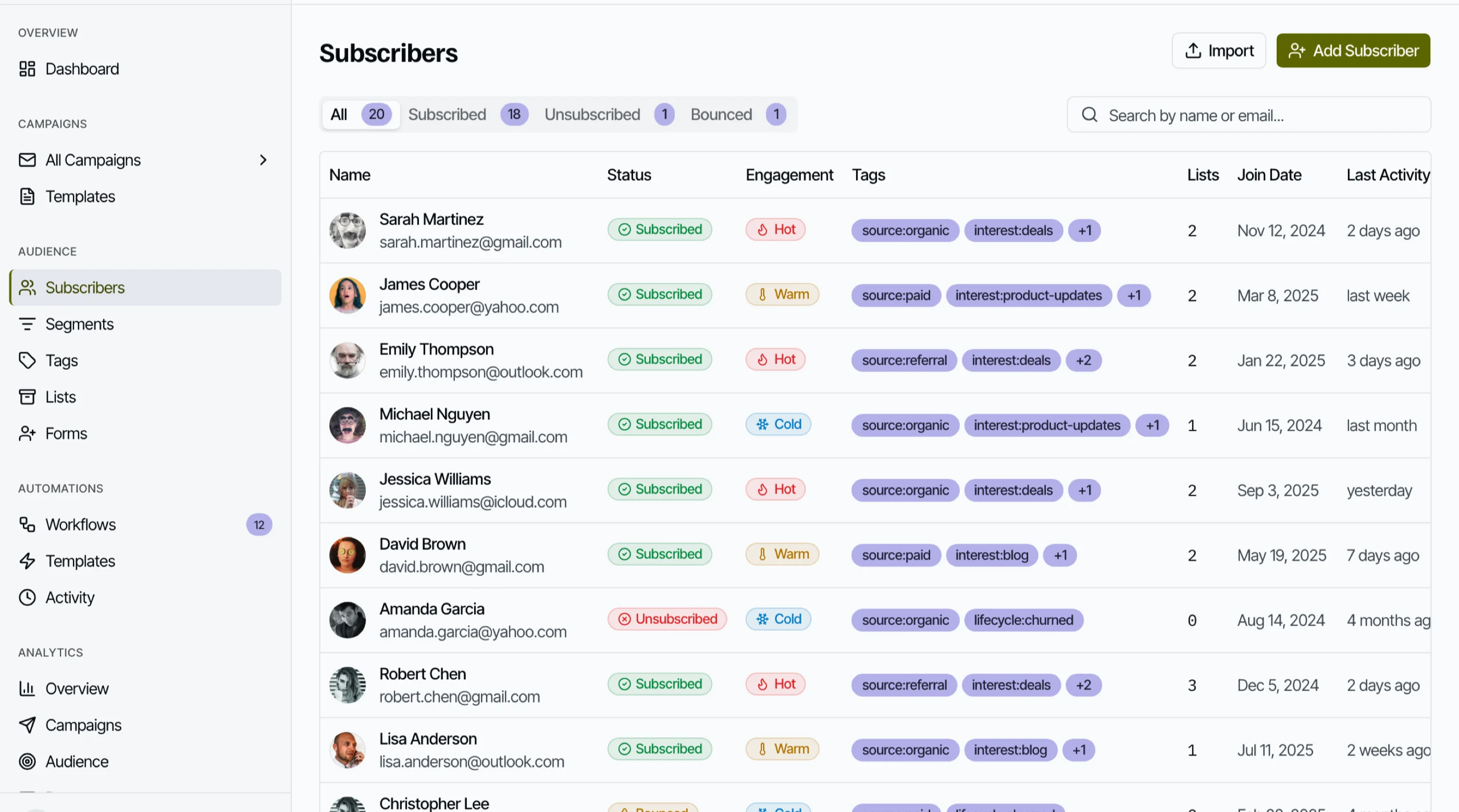
The Email Marketing Kit is shipped: 38 screens covering a block-based email editor, a node-graph automation canvas, subscriber management with segments and tags, A/B testing, deliverability monitoring, and click-map analytics. Next.js + Tailwind + shadcn/ui, dark mode throughout. $149 solo, $249 team, $399 agency.
Get the Email Marketing Kit → or get every kit (18 total) for $749 via All UI Kits →
TL;DR: Quick Picks for 2026
| Need | Top pick | Price |
|---|---|---|
| Pay for sends, not subscribers | Brevo | Free 300/day, paid from roughly $9/mo |
| Unlimited sending, cheap | Moosend | From roughly $9/mo at 500 |
| Cheapest usable free tier | EmailOctopus | Free to 2,500 subs, paid from roughly $9/mo |
| Integrations and ecosystem | Mailchimp | From roughly $13/mo at 500 |
| Newsletters and creators | Kit | Free to 10,000 subs, Creator from $33/mo |
| No licence fee at all | Listmonk | Free (self-host) |
| Email inside your own product | thefrontkit Email Marketing Kit | $149+ one-time |
If you are leaving over an account rejection rather than over price, skip to Brevo and Moosend. Both are markedly more permissive about who they onboard.
What MailerLite Actually Does Well
Worth being fair about, because most people who leave were happy with the software. The drag-and-drop editor is one of the best in the category and noticeably less cluttered than Mailchimp's. Automations, landing pages, websites and signup forms are included rather than gated behind an upper tier, which is unusual at this price. Deliverability is strong, partly because of the strict approval process that annoys people at signup.
The case for alternatives is usually about who they will accept and what they bill you for, not about quality.
When to Leave MailerLite
Three signals:
- You were rejected or suspended. The approval process is a genuine filter and appeals rarely succeed. Move on rather than argue.
- Your list is large and you mail it rarely. Subscriber-based billing charges for storage. If you send monthly, send-based pricing is dramatically cheaper.
- You need an integration that does not exist. MailerLite's app directory is much shorter than Mailchimp's, and the gaps tend to be in niche CRMs and e-commerce platforms.
1. Brevo
The strongest all-round move, and the one that changes what you are billed for.
Strengths:
- Bills emails sent rather than subscribers stored, with unlimited contacts on every tier
- Free plan allows 300 emails a day, roughly 9,000 a month, which beats most free tiers
- Starter from roughly $9/month for 5,000 emails, $29 for 20,000, $69 for 100,000
- Far more permissive at signup, and includes SMS and transactional sending
Weaknesses:
- The editor is a step down from MailerLite's
- Daily send caps on lower tiers catch people mid-campaign
- Shared-IP deliverability is inconsistent until you pay for a dedicated IP
- Broad rather than deep, nothing here is best in class
Best for: Large lists mailed occasionally, and anyone whose MailerLite bill is mostly storage. More options in Brevo Alternatives.
2. Moosend
The one that removes send limits from the equation entirely.
Strengths:
- Unlimited emails on every plan, so the only variable is subscriber count
- From roughly $9/month at 500 subscribers, and around $315 at 50,000
- 30-day trial with no card required
- Automation builder is better than the price suggests
Weaknesses:
- Smaller company, smaller ecosystem, fewer integrations
- Template gallery is dated
- Support is email-first and slower than the majors
- Brand recognition is low, which matters if you have to justify the choice internally
Best for: High send frequency on a modest list, where unlimited sending is worth more than polish.
3. EmailOctopus
The budget option that does not feel like one.
Strengths:
- Free plan covers 2,500 subscribers and 10,000 monthly emails, far past MailerLite's free tier
- Paid plans from roughly $9/month
- Can run on top of Amazon SES, which makes high volume very cheap
- Simple, fast, and does not try to be a marketing suite
Weaknesses:
- Automation is basic, this is broadcast and simple sequences
- No landing pages or website builder
- Reporting is minimal
- The SES route needs someone comfortable with AWS
Best for: Newsletters and small businesses that want low cost without self-hosting.
4. Mailchimp
Going back up the price ladder, but for a reason.
Strengths:
- The largest integration ecosystem in the category by a wide margin
- Deep template gallery and the most familiar interface for new hires
- Strong reporting and a mature e-commerce integration set
- Rarely rejects accounts the way MailerLite does
Weaknesses:
- More expensive at every list size, roughly $13/month at 500 on Essentials
- Free plan is 250 contacts and only 500 monthly sends
- Still subscriber-based billing
- You are paying a premium for being the default
Best for: Teams whose blocker is a missing integration rather than a bill. More options in Mailchimp Alternatives.
5. Kit (formerly ConvertKit)
A different shape of tool, if what you actually run is a publication.
Strengths:
- Free to 10,000 subscribers, which is the most generous free tier here by a distance
- Tagging and sequences fit newsletters better than lists and campaigns
- Creator network and recommendations drive genuine subscriber growth
- Plain-text-first emails tend to land in the primary tab
Weaknesses:
- Creator is $33/month and Pro $66, expensive once you pass the free ceiling
- Deliberately minimal design tooling, which frustrates brand-led teams
- Weak for e-commerce and transactional email
- Reporting is basic
Best for: Newsletters, courses and audiences. More options in ConvertKit Alternatives.
6. Listmonk
The option that removes the subscription line entirely.
Strengths:
- Free and open source, written in Go, fast at very large list sizes
- No per-subscriber or per-send licence, you pay only your sending provider
- Nobody can reject or suspend your account
- Single binary, straightforward to deploy and back up
Weaknesses:
- You own deliverability, which is the hard part
- No automation canvas, this is broadcast and scheduled sending
- Admin UI is functional rather than pleasant
- Needs someone technical to own it permanently
Best for: Technical teams sending at volume, and anyone who wants to be un-rejectable.
7. Build It with the Email Marketing Kit
The option worth considering when email is part of the product rather than a channel pointed at it.
If your customers send email through your platform, an agency dashboard, a creator tool, a SaaS with campaign features, then embedding an ESP means their branding and their approval policy sitting inside your product. Their signup filter becomes your churn.
The Email Marketing Kit ships 38 screens for that layer: a block-based editor with content and commerce blocks, a node-graph automation canvas with triggers, waits and conditional splits, subscriber management with segments and tags, an A/B testing interface, a deliverability dashboard, click-map analytics, and a campaign template gallery. TypeScript throughout, Recharts for analytics, full dark mode.
Be clear about the boundary. It is the frontend. There is no sending backend, no authentication, no database, and no real deliverability data in the box. You wire it to your own infrastructure, typically Resend, Postmark or SES. There is no per-subscriber fee, because there is no vendor.
- Screens: 34+
- Editor: Block-based, with commerce blocks and global styles
- Automation: Node-graph canvas with triggers, waits and splits
- Analytics: Click maps, campaign reporting, deliverability monitoring
- Not included: Sending backend, auth, database, real deliverability data
- Price: $149 solo / $249 team / $399 agency
Recommendation by Team Profile
| You | Pick |
|---|---|
| Rejected at signup | Brevo or Moosend |
| Big list, mailed monthly | Brevo |
| Small list, mailed constantly | Moosend |
| Want the cheapest real free tier | EmailOctopus |
| Blocked by a missing integration | Mailchimp |
| Running a newsletter or course | Kit |
| Technical, high volume | Listmonk |
| Building email into your own product | Email Marketing Kit |
| Happy, under 1,000 subscribers | Stay on MailerLite |
Frequently Asked Questions
What is the best alternative to MailerLite?
Brevo for most teams, because it bills sends rather than stored subscribers and is far more permissive at signup. Moosend if you send frequently to a small list, since every plan includes unlimited emails. EmailOctopus if the goal is simply to spend less.
Why did MailerLite reject or suspend my account?
MailerLite manually reviews accounts and declines senders it judges to be higher risk, which in practice catches affiliate marketing, parts of finance and crypto, and any list that looks purchased or imported without clear consent. Appeals rarely succeed. Brevo and Moosend both onboard more readily, and self-hosting with Listmonk removes the question entirely.
Is MailerLite's free plan really free?
Yes, but it is smaller than its reputation. It covers 250 subscribers and 2,500 monthly emails with three automations. EmailOctopus is free to 2,500 subscribers and Kit to 10,000, both considerably more generous.
Is there a cheaper alternative to MailerLite?
EmailOctopus and Moosend both start around $9/month and undercut MailerLite at most list sizes. Brevo is cheaper again if your list is large but mailed infrequently, because it charges for sends rather than storage. Listmonk removes the licence cost altogether if you can self-host.
Should I switch if I am happy with MailerLite?
Probably not. If you are under 1,000 subscribers, sending regularly and have never had an account problem, the savings on offer are small and migration costs you a working setup. The reasons to move are structural: a rejection, a large dormant list, or a missing integration.
The Honest Take
MailerLite is good software at a fair price, and most people reading this are not leaving because of the product. They are leaving because they got rejected, or because they finally noticed they are paying to store 40,000 subscribers they mail four times a year.
Both problems have the same answer, which is to stop being billed for storage by a company that gets to decide whether you are allowed to be a customer. Brevo does that commercially. Listmonk does it structurally.
If email is something your product does rather than something you do to your customers, the last option is the one worth thinking hardest about. No ESP's approval policy should be able to break your product.
Related Guides
- Mailchimp Alternatives: 8 Cheaper Email Platforms if you arrived at MailerLite from Mailchimp
- Brevo Alternatives: 7 Email Platforms if send-based billing is where you are heading
- ConvertKit Alternatives: 7 Creator Platforms if what you run is really a publication
Want it shipped without hiring a developer?
The build path above assumes you have engineers. If you don't, the team behind thefrontkit does done-for-you launches: we deploy the kit, apply your branding, and wire it to your stack. Fixed quotes, most builds ship in 2-4 weeks, from $1999.