Accessibility Conformance Report (ACR): How to Read and Write One
Accessibility Conformance Report: What It Is and How Buyers Read It
An accessibility conformance report (ACR) is a document that explains, criterion by criterion, how well a digital product supports an accessibility standard such as WCAG, the Revised Section 508 Standards or EN 301 549. You make one by filling in the VPAT, a free template from the Information Technology Industry Council (ITI). The blank form is the VPAT. The finished document is the ACR.
This guide is for both sides of the table. If you sell software, it shows what goes into a credible report. If you buy software, it shows how to read one in about fifteen minutes and which lines deserve a follow-up question. If you're brand new to the topic, start with our plain-language explainer, What Is a VPAT?, and come back here for the detail.
TL;DR
- An ACR is a completed VPAT. ITI says so directly: once the template is filled in for a specific product, the finished document is called an ACR.
- The current template is VPAT 2.5Rev, released by ITI in April 2025, in four editions: 508, EN 301 549, WCAG and INT.
- Every criterion gets one rating: Supports, Partially Supports, Does Not Support or Not Applicable. "Not Evaluated" is allowed only for WCAG Level AAA.
- There is no certification. ITI doesn't review, approve or certify ACRs, and there's no pass or fail score.
- Buyers read three things first: the scope, the evaluation methods and the remarks on anything below Supports.
- An ACR is a snapshot. It needs an update when the product or the standard changes.
What an Accessibility Conformance Report Is (and What It Isn't)
ITI describes the VPAT as a tool to help companies explain how their technology products and services support accessibility standards. The ACR is the output: a consistent, comparable statement a buyer can put side by side with a competitor's.
Section508.gov, the US government's guidance site run by the General Services Administration, describes the ACR as a document that explains how ICT products such as software, hardware, electronic content and support documentation meet the Revised 508 Standards. It also says ACRs help federal contracting officials assess products during market research and when they evaluate proposals.
A few things an ACR is not:
- It isn't a certificate. ITI's FAQ states there's no official VPAT or ACR certification, approval or pass/fail rating.
- It isn't a legal shield. An ACR describes conformance. It doesn't make a product compliant with any law, and a report with gaps is still a valid report.
- It isn't proof of testing on its own. Anyone can fill in the template. The evaluation methods section is where a report earns trust, or loses it.
- It isn't permanent. It describes one version of one product on one date.
Who Asks for an ACR, and Why
The request usually arrives in a procurement questionnaire, often next to security and privacy questions. Three groups send most of them:
- US federal agencies and their contractors. Section 508 requires agencies to buy accessible ICT, and Section508.gov recommends that vendors produce an ACR for any ICT they plan to market to the federal government.
- Universities, state agencies and other public bodies. Many have their own accessibility purchasing policies and ask for the same document.
- Large companies. Some enterprise procurement teams include accessibility questions in their vendor reviews.
ITI's FAQ adds that a VPAT may be requested or required as part of a procurement process, and that a customer or agency may require an independent review as part of a contract. So the document you need depends on who's asking and what the contract says.
The Four VPAT 2.5Rev Editions
ITI publishes four editions of VPAT 2.5Rev, all dated April 2025. Pick the edition by the standard your buyer cares about.
| Edition | Standard it reports against | Typical buyer |
|---|---|---|
| 508 | Revised Section 508 Standards | US federal agencies and contractors |
| EN 301 549 | The European standard for ICT accessibility | EU public sector buyers |
| WCAG | WCAG 2.x success criteria | Commercial and enterprise buyers |
| INT | All three of the above | Vendors who sell in several markets |
If you sell in more than one market, the INT edition saves you from keeping three reports in sync. It's longer to fill in, but one accurate document beats three that slowly drift apart.
Section508.gov's own guide says any VPAT 2.x is acceptable for building an ACR for federal buyers. Still, using the current 2.5Rev template avoids a question you don't need in a review.
What's Inside an ACR
Every edition follows the same basic layout. Section508.gov lists the fields that belong at the top of the report:
- Company or organization name
- Product name, and version number if it has one
- Report date (month and year)
- Product description
- Contact information
- Notes, if any
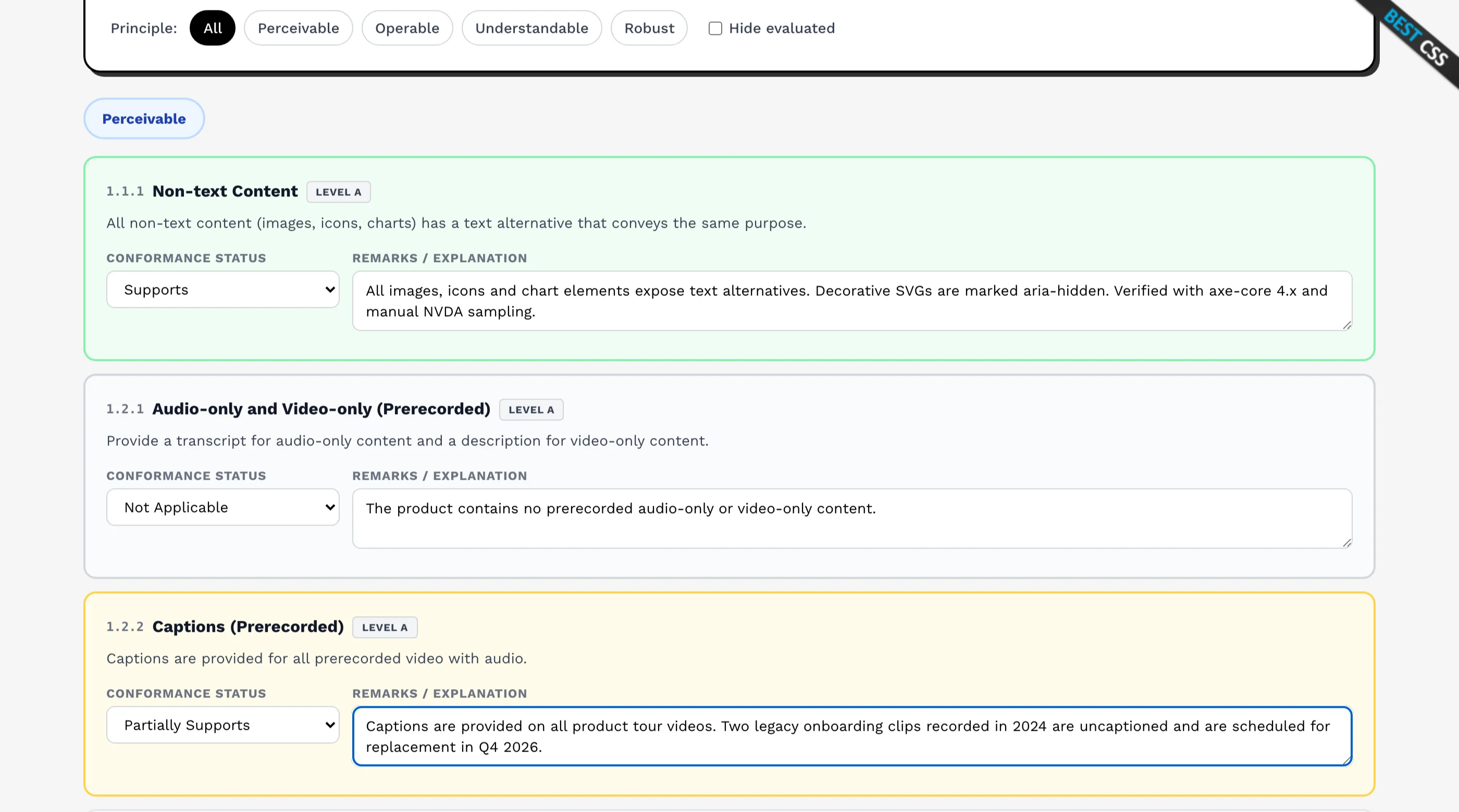
- Evaluation methods: how the product was tested (manual, automated or both) and which tools were used
Below that come the applicable standards (which standard and which levels the report covers) and then the conformance tables. Each table has three columns: the criterion, the conformance level, and remarks and explanations.
For WCAG, the tables are split by level. Table 1 holds Level A criteria, Table 2 holds Level AA and Table 3 holds Level AAA. Section508.gov notes that only Level A and AA are required in an ACR meant for US federal procurement. The 508 and EN 301 549 editions add more chapters. In the 508 edition, these are Chapter 3 (Functional Performance Criteria), Chapter 4 (Hardware), Chapter 5 (Software) and Chapter 6 (Support Documentation and Services). A web app will mark much of the hardware chapter Not Applicable, and that's expected.
One small detail people miss: the VPAT template starts with several pages of instructions. Section508.gov tells vendors to remove those pages from the final ACR.
How to Read the Conformance Levels
These are the definitions from the VPAT template:
| Rating | What it means |
|---|---|
| Supports | The product has at least one method that meets the criterion without known defects, or meets it with equivalent facilitation |
| Partially Supports | Some functionality of the product does not meet the criterion |
| Does Not Support | The majority of product functionality does not meet the criterion |
| Not Applicable | The criterion is not relevant to the product |
| Not Evaluated | The product was not evaluated against the criterion. Allowed only for WCAG Level AAA |
Two rules matter more than the rest. First, remarks are required whenever the rating is Partially Supports or Does Not Support, and encouraged for Supports. Second, "Supports" means no known defects. That's only as strong as the testing behind it, which is why the evaluation methods section carries so much weight.
When you read a report, treat Partially Supports as normal. Almost every real product has a few. A report where every row says Supports usually means thin testing, or a narrow scope. It rarely means a perfect product.
What Buyers Check First: A 15-Minute Review
If you're on the buying side, you don't need to read all fifty-plus rows on the first pass. Work through these in order.
1. Product, version and date
Does the report name the product and version you're actually buying? Is the date recent? ITI recommends updating an ACR when the product changes in ways that could affect accessibility, or when the relevant standards change. A report that's several years old describes software that has shipped many releases since.
2. Scope
Look in the notes for what was tested. Many vendors test their marketing site, or one module, and leave the logged-in product out. If your staff will use the admin console every day and the report only covers the end-user screens, that gap matters more than any single rating.
3. Evaluation methods
This is where you decide how much to trust the rest. Strong reports name the automated tool and its version, the browsers, the screen readers used, and whether keyboard-only testing was done. A line like "the product was tested for accessibility" tells you almost nothing.
4. Applicable standards
Check that the report covers the standard your policy requires. A WCAG 2.0 report doesn't answer a WCAG 2.2 requirement, and a WCAG-only report may not satisfy a buyer who asked for the 508 edition.
5. The spread of ratings
Scan the conformance column. A realistic mix of Supports and Partially Supports, with clear remarks, reads as honest. All Supports reads as untested.
6. Remarks on the gaps
Read every Partially Supports and Does Not Support row. Good remarks say what fails, where it fails and, ideally, when it will be fixed. Weak remarks repeat the criterion name or say "minor issues may exist."
7. Who wrote it
ITI notes that the company that knows the product best, usually the manufacturer or product owner, is generally best placed to complete the VPAT, and that resellers can complete one too. A report from an independent evaluator isn't required, but it gives you a second opinion on the vendor's claims.
A Strong Remark vs a Weak One
Here's a real row from our sample ACR, written for a fictional company called Acme Data:
| Criteria | Conformance Level | Remarks and Explanations |
|---|---|---|
| 1.1.1 Non-text Content (Level A) | Partially Supports | All 119 content images on the site have an alt attribute; 40 of them are decorative and correctly use empty alternative text, and decorative icons are hidden from assistive technology. Exception: on 7 of the 9 articles the lead image has a file name such as "alert_night.png" as its alternative text (F-06). |
And here's the weak version buyers see far too often:
| Criteria | Conformance Level | Remarks and Explanations |
|---|---|---|
| 1.1.1 Non-text Content (Level A) | Supports | Images have alt text. |
The first row has a lower rating and is a far better document. It shows the evaluator counted, found the exact failure, and linked it to a finding number with steps to reproduce. The second row gives a buyer nothing to check.
How Vendors Produce an ACR
If you're the one being asked, here's the order that keeps the document honest.
- Confirm the edition. Ask the buyer which standard they need, or pick INT if you sell in several markets.
- Define the scope. Write down which product, which version, and which screens or flows are covered. Include the logged-in product, since that's what buyers use.
- Test before you write. Run automated checks, then test by keyboard and with at least one screen reader. Automated tools only find part of the problems, so a report built on scanner output alone won't hold up. Our WCAG AA checklist for web apps is a reasonable starting point.
- Record findings as you go. Note the page, the element and the criterion for each failure. You'll need these details for the remarks.
- Fill in the template. Download the current 2.5Rev edition from ITI, complete the header fields, the evaluation methods and every table row that applies.
- Write specific remarks. Every Partially Supports and Does Not Support row needs one. Say what fails, where, and when it'll be fixed if you know.
- Have someone else review it. Ideally a person who didn't do the testing.
- Make the report itself accessible. Section508.gov's checklist includes checking the final ACR for accessibility. A PDF with no headings or tags undercuts the whole document.
- Publish it where buyers can find it. Section508.gov suggests linking to it from your product page. ITI notes you can also send it directly or include it in procurement responses.
Section508.gov also runs an ACR Editor that builds reports in OpenACR, a machine-readable format. It's worth a look if you need to maintain several reports, or if a federal buyer asks for one.
What Breaks ACRs in Practice
Most rejected or distrusted reports fail for the same handful of reasons:
- Claiming Supports across the board. It's the first thing an experienced reviewer looks for.
- Blank remarks on gaps. The template requires them, and a reviewer will send the report back.
- The wrong edition. A WCAG report sent to a buyer who asked for the 508 edition means doing the work twice.
- A scope that hides the product. Testing only the homepage and calling it the product.
- Stale reports. A three-year-old ACR attached to a product that has been redesigned since.
- Instruction pages left in. A small thing, but it signals the template was filled in quickly.
- "Compliant" language. An ACR describes conformance against criteria. Phrases like "fully compliant" or "certified" don't belong in it, since there's no such certification.
ACR Checklist
Use this before you send a report, or before you accept one.
- Product name, version and a month-and-year report date are filled in
- Scope is stated, including what was left out
- Evaluation methods name the tools, browsers and assistive technology used
- The edition matches what the buyer asked for
- The applicable standards and levels are listed
- Every criterion has one of the defined ratings
- "Not Evaluated" appears only in the Level AAA table
- Every Partially Supports and Does Not Support row has a specific remark
- The ITI instruction pages are removed
- The ACR file itself is accessible
- There's a plan to update it when the product or standard changes
Frequently Asked Questions
What is an accessibility conformance report?
An accessibility conformance report is a completed VPAT. It lists each criterion in an accessibility standard, rates how well a product supports it, and explains any gaps. Buyers use it to compare products during procurement.
What is the difference between a VPAT and an ACR?
The VPAT is the blank template that ITI publishes. Once it's filled in for a specific product, the finished document is the ACR. People often say "VPAT" when they mean the completed report.
Is an accessibility conformance report the same as certification?
No. ITI states there's no official VPAT or ACR certification, approval or pass/fail rating. An ACR describes how a product performs against each criterion. It doesn't certify the product, and it doesn't make it compliant with any law.
Who can write an accessibility conformance report?
Anyone can complete one. ITI says the product's manufacturer or owner is usually best placed to do it accurately, and that resellers can complete one too. Third-party review is optional unless a buyer or contract requires it.
How often should an ACR be updated?
ITI recommends reviewing or updating it when the product changes in ways that could affect accessibility, or when the relevant standards change. For software that ships often, many teams review it at each major release.
Which ACR edition do I need?
Use the 508 edition for US federal buyers, EN 301 549 for EU public sector buyers, and WCAG for most commercial buyers. The INT edition covers all three in one document if you sell in several markets.
Need an ACR for a Deal?
The document is the easy part. The testing behind it is the work, and it's what a careful buyer checks first. If a procurement team is waiting on your report, our team can test your product and write the report through our VPAT and ACR service, with every Partially Supports row explained and linked to a finding you can fix. We don't promise a clean report. We promise an accurate one you can stand behind in a review.
Has a buyer asked for your VPAT?30% OFF
We test your product by hand with a keyboard and real screen readers, then write the ACR from what we found: WCAG, Section 508, EU or International edition. A retest after your fixes updates it. $4,130$5,900 fixed for up to 25 pages or templates.