Klaviyo Alternatives: 7 E-commerce Email Platforms 2026
Klaviyo Alternatives: 7 Options Compared for 2026
Short answer: if you are leaving Klaviyo on price, Omnisend and Brevo both cover the core flows for less. If you want flat pricing that ignores list size, Drip. If your triggers come from product events rather than store events, Customer.io. If you want no licence fee at all, Listmonk. And if email is part of the platform you are building, own the interface.
Klaviyo won e-commerce email by being genuinely good at the thing that matters: attributing revenue to individual flows. Abandoned cart, browse abandonment, post-purchase and win-back all ship as templates that work, the Shopify integration is deep, and the reporting tells you what each flow earned rather than what each campaign opened.
The reason stores look elsewhere is the billing. Klaviyo prices on active profiles, which since the February 2025 change means every contact eligible to be emailed, not just the ones you actually mail. A list you have stopped sending to still bills. The free tier stops at 250 active profiles and 500 monthly sends. From there it is roughly $20/month at 500 profiles, around $60 at 2,500, $100 at 5,000, $150 at 10,000, and around $720 by 50,000. Self-serve plans bill monthly with no annual prepay discount.
For a store with strong revenue per subscriber, that is money well spent. For a store with a large, cheap, weakly-converting list, it is a tax on hoarding.
Seven alternatives worth comparing, from direct competitors to event-driven tooling to owning the layer outright.
Or skip the build entirely: get the Email Marketing Kit
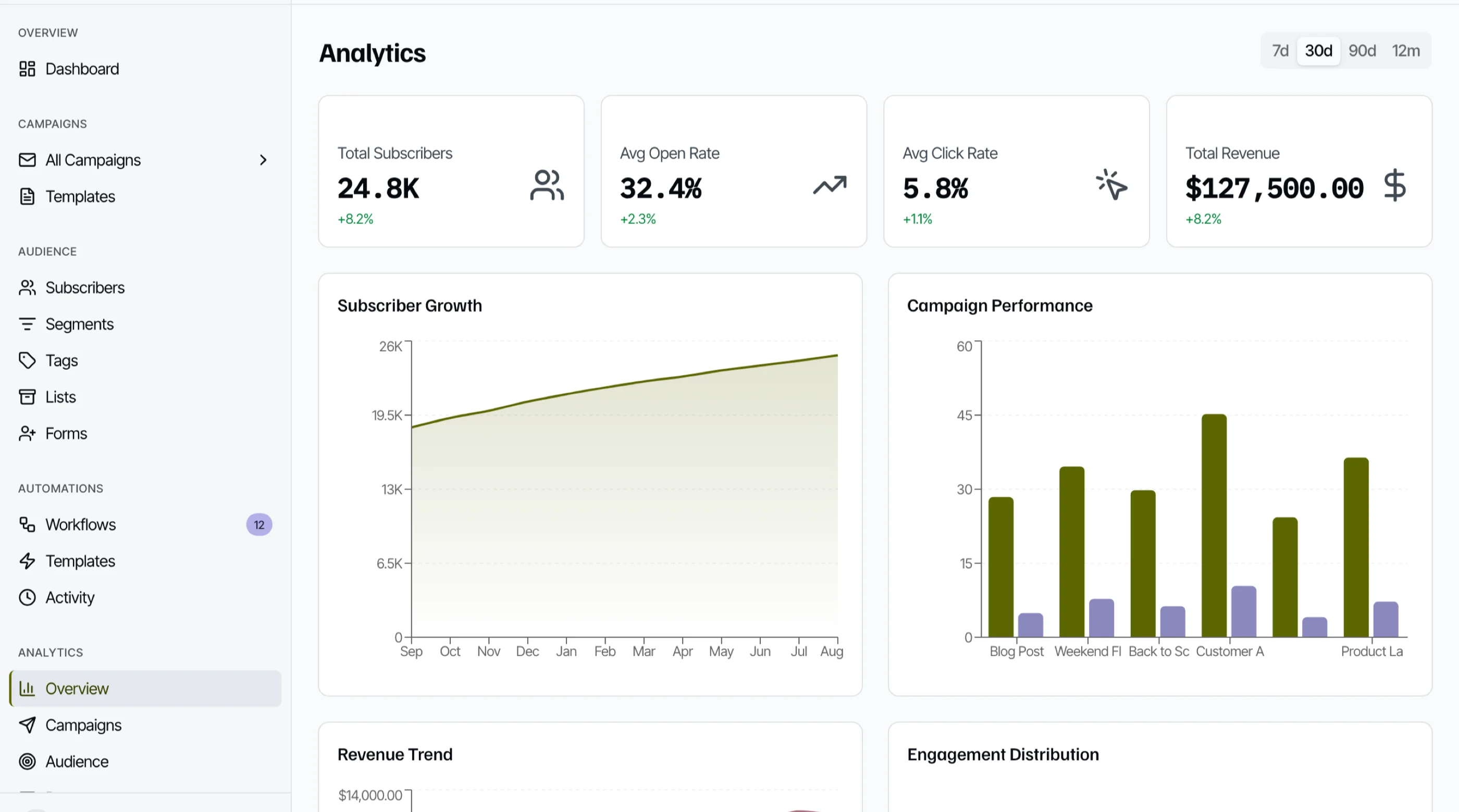
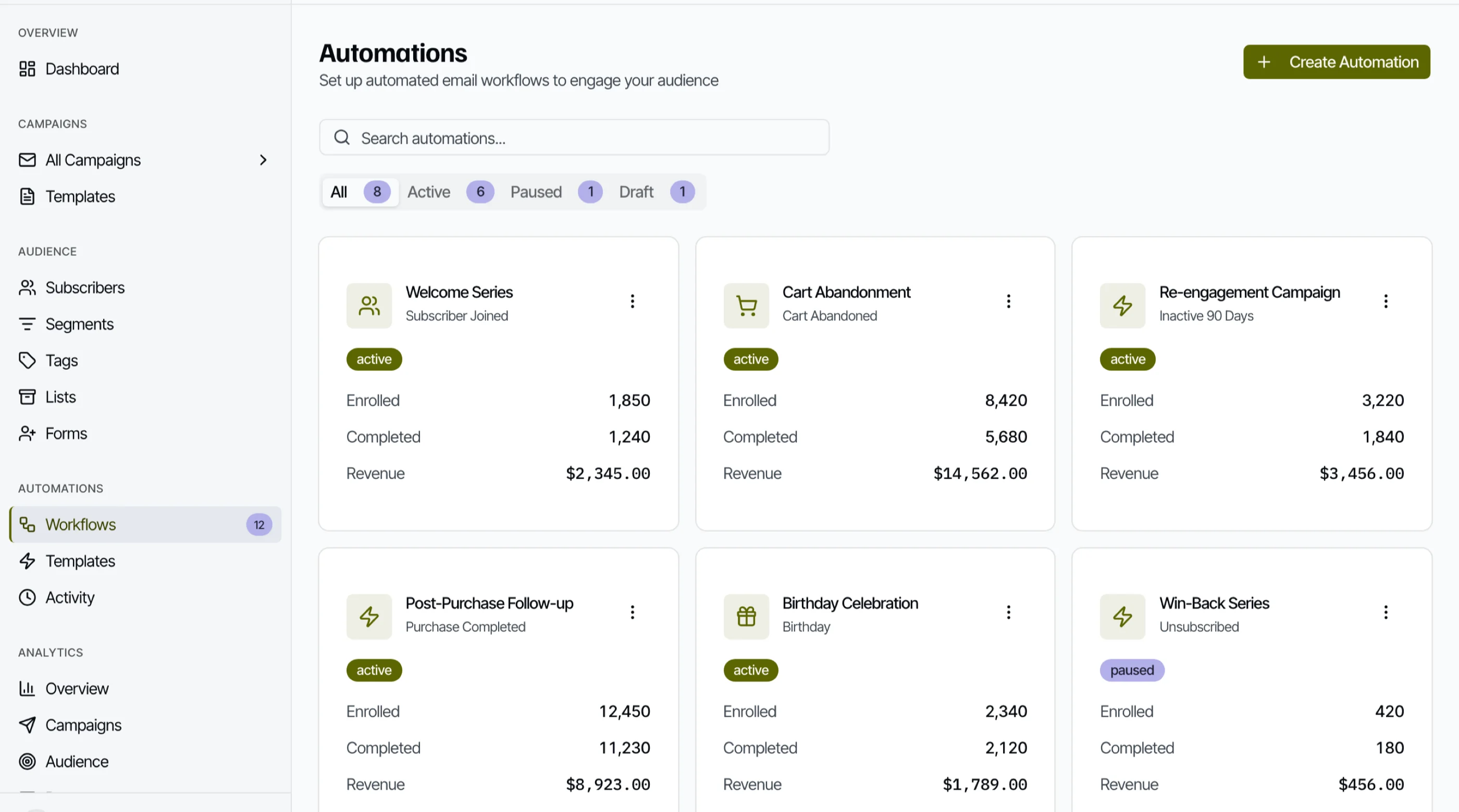
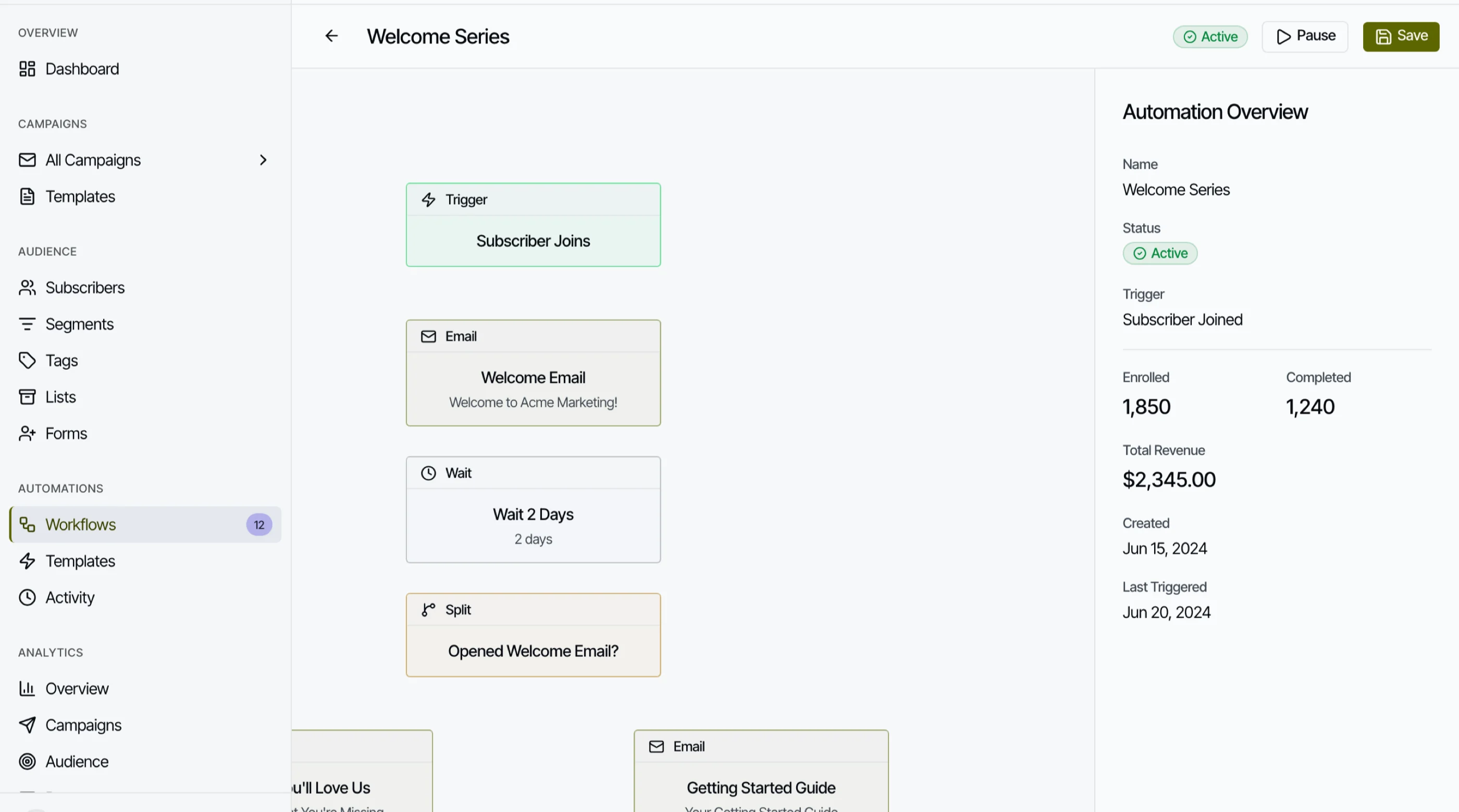
The Email Marketing Kit is shipped: 38 screens covering a block-based email editor with commerce blocks, a node-graph automation canvas, subscriber management with segments and tags, A/B testing, deliverability monitoring, and click-map analytics. Next.js + Tailwind + shadcn/ui, dark mode throughout. $149 solo, $249 team, $399 agency.
Get the Email Marketing Kit → or get every kit (18 total) for $749 via All UI Kits →
TL;DR: Quick Picks for 2026
| Need | Top pick | Price |
|---|---|---|
| Closest e-commerce like-for-like | Omnisend | Free tier, from roughly $16/mo at 500 |
| Cheapest broad replacement | Mailchimp | From roughly $13/mo at 500 |
| Pay for sends, not profiles | Brevo | Free tier, paid from roughly $9/mo |
| Flat pricing, every feature included | Drip | From roughly $39/mo to 2,500 |
| Product events, not just store events | Customer.io | From roughly $100/mo to 5,000 |
| No licence fee at all | Listmonk | Free (self-host) |
| Email inside your own platform | thefrontkit Email Marketing Kit | $149+ one-time |
The billing models differ more than the feature lists do. Compare on your actual profile count and send frequency, not on headline rates.
What Klaviyo Actually Does Well
Worth being clear about, because most of this list does not match it. Revenue attribution per flow is the product. Knowing that your browse-abandonment sequence earned a specific amount last month, broken down by variant, is what justifies the price for stores doing real volume. The Shopify integration goes deeper than the alternatives, predictive analytics like expected date of next order are genuinely useful at scale, and the flow library means a competent operator is live in a week.
The case for alternatives is rarely that Klaviyo is worse. It is that active-profile billing does not suit every store's list economics.
When to Leave Klaviyo
Three signals:
- Your profile count is growing faster than revenue per profile. Active-profile billing charges for reach you are not converting, and suppressing contacts becomes a cost-control exercise.
- You use maybe four flows. Cart, welcome, post-purchase and win-back are table stakes now. If that is your whole programme, you are paying for depth you never open.
- Your triggers are product events, not store events. If the meaningful signal is in-app behaviour rather than orders, a store-shaped tool is the wrong shape.
1. Omnisend
The most direct swap, built for the same buyer.
Strengths:
- Purpose-built for e-commerce with the same core flows and a similar setup path
- Cheaper at comparable list sizes, from roughly $16/month at 500 contacts
- Free tier is usable for small stores
- Strong Shopify and WooCommerce integrations
Weaknesses:
- Revenue reporting is shallower than Klaviyo's, which is the main thing you are giving up
- As of May 2026 SMS was pulled from lower tiers for new customers, so check what your plan includes
- Segmentation is capable but less flexible at the edges
- Pro tier jumps to roughly $59/month at 2,500 contacts
Best for: Small and mid-size stores that want Klaviyo's flows without Klaviyo's bill.
2. Mailchimp
The generalist, and cheaper if e-commerce depth is not the point.
Strengths:
- Roughly $13/month at 500 contacts on Essentials, well below Klaviyo
- Enormous integration ecosystem and the most familiar editor in the category
- Fine for broadcast campaigns and basic automation
- Easiest handover to a non-technical colleague
Weaknesses:
- E-commerce automation is noticeably weaker, and revenue attribution barely comparable
- Bills on total contacts, so the storage problem persists in a different form
- Free tier is now only 250 contacts and 500 sends a month
- Not a serious option for a store running sophisticated flows
Best for: Stores where email is a newsletter with a discount code attached. More options in Mailchimp Alternatives.
3. Brevo
The one that changes what you are billed for.
Strengths:
- Bills emails sent rather than profiles stored, so a large dormant list costs nothing to keep
- Unlimited contacts on every tier, paid plans from roughly $9/month
- SMS and transactional sending on the same account
- Genuinely cheap for stores that mail monthly rather than weekly
Weaknesses:
- E-commerce flows are basic next to Klaviyo or Omnisend
- Revenue attribution is limited
- Shared-IP deliverability is inconsistent until you pay for a dedicated IP
- Daily send caps on lower tiers surprise people
Best for: Stores with big lists and low send frequency, where Klaviyo is mostly charging for storage.
4. Drip
The flat-rate option, and the one that stops punishing list growth.
Strengths:
- Every feature included on every plan, no capability gating
- From roughly $39/month for up to 2,500 people
- Solid visual workflow builder aimed squarely at e-commerce
- Straightforward migration path from Klaviyo
Weaknesses:
- Gets expensive at larger list sizes, where the flat-rate advantage inverts
- Smaller ecosystem and integration list
- Reporting is decent but not Klaviyo-grade
- SMS support is weaker than Omnisend's
Best for: Mid-size stores that want predictable billing and use most of the feature set.
5. Customer.io
The right answer when the trigger is in your product, not in the store.
Strengths:
- Event-driven from the ground up, you send it behaviour and it decides who gets what
- Very strong for subscription, marketplace and SaaS-adjacent commerce
- From roughly $100/month for up to 5,000 profiles, including generous send volume
- Liquid templating and a real API make it comfortable for engineers
Weaknesses:
- Higher floor than everything else on this list
- Expects engineering involvement, marketers cannot run it alone
- No native storefront integration in the Klaviyo sense
- Overkill for a store that just needs four flows
Best for: Teams whose meaningful signals are product events rather than orders.
6. Listmonk
The option that removes the subscription line entirely.
Strengths:
- Free and open source, written in Go, fast at very large list sizes
- No per-profile or per-send licence, you pay only your sending provider
- Single binary, straightforward to deploy and back up
- Comfortable with multi-million row lists on modest hardware
Weaknesses:
- No e-commerce flows, no revenue attribution, no store integration
- Broadcast and scheduled sending rather than triggered automation
- You own deliverability, which is the hard part
- Needs someone technical to own it permanently
Best for: Technical teams sending newsletters at volume who want SES rates instead of Klaviyo rates. Not a flow engine.
7. Build It with the Email Marketing Kit
The option worth considering when email is part of the platform rather than a channel pointed at it.
If you are building something where your customers send email, a multi-vendor marketplace, an agency dashboard, a creator platform, embedding an ESP means their branding and their limits sitting inside your product. The interface is also the expensive part: a block editor and an automation canvas are each a serious project on their own, and they are the parts users judge.
The Email Marketing Kit ships 38 screens for that layer: a block-based editor with commerce blocks including product and countdown, a node-graph automation canvas with triggers, waits and conditional splits, subscriber management with segments and tags, an A/B testing interface, a deliverability dashboard, click-map analytics, and a campaign template gallery. TypeScript throughout, Recharts for analytics, full dark mode.
Be clear about the boundary. It is the frontend. There is no sending backend, no authentication, no database, and no real deliverability data in the box. You wire it to your own infrastructure, typically Resend, Postmark or SES. Revenue attribution is your own to build, because it depends on order data you already hold.
- Screens: 34+
- Editor: Block-based, with product and countdown commerce blocks
- Automation: Node-graph canvas with triggers, waits and splits
- Analytics: Click maps, campaign reporting, deliverability monitoring
- Not included: Sending backend, auth, database, real deliverability data
- Price: $149 solo / $249 team / $399 agency
Recommendation by Store Profile
| You | Pick |
|---|---|
| Small Shopify store, price sensitive | Omnisend |
| Email is a newsletter with a code | Mailchimp |
| Large list, mailed monthly | Brevo |
| Mid-size, want predictable billing | Drip |
| Triggers are product events | Customer.io |
| Technical, high volume, broadcast only | Listmonk |
| Building email into your own platform | Email Marketing Kit |
| High revenue per subscriber, flows working | Stay on Klaviyo |
Frequently Asked Questions
What is the best alternative to Klaviyo?
Omnisend for most stores, because it is built for the same job and costs less. Brevo if your list is large and mailed infrequently, since it bills sends rather than profiles. Customer.io if your triggers are product events rather than orders.
Is there a free alternative to Klaviyo?
Klaviyo's own free tier stops at 250 active profiles and 500 monthly sends. Omnisend, Brevo and Mailchimp all have free plans in a similar range. Listmonk is free to licence entirely if you can self-host, though it has no e-commerce flows.
What are active profiles in Klaviyo billing?
Every contact eligible to receive marketing email, not just the ones you actually mailed that month. Klaviyo moved to this model in February 2025, bringing it in line with most of the category. The practical effect is that suppressing or deleting unengaged contacts is now a direct cost lever.
Which Klaviyo alternative has the best Shopify integration?
Omnisend, comfortably. Drip is also purpose-built for e-commerce and integrates well. Mailchimp and Brevo both connect but treat store data more shallowly, and nothing on this list matches Klaviyo's depth on revenue attribution, which is the honest trade.
Should I self-host e-commerce email?
Only for broadcast. Listmonk will send your newsletter cheaply and reliably, but it has no flow engine, no store integration and no revenue reporting, so you would be running it alongside something else rather than instead of Klaviyo. Deliverability also becomes your problem, and for a store that is revenue risk rather than an infrastructure hobby.
The Honest Take
Klaviyo is the right tool for a store where email is a serious revenue channel and someone owns it properly. The attribution reporting is the product, and no cheaper option on this list replaces it. Switching to save subscription cost can easily cost more in lost flow revenue than it saves.
The alternatives win on model rather than features: the same flows for less (Omnisend), billing by sends instead of profiles (Brevo), flat pricing that ignores list growth (Drip), event-driven triggers from your own product (Customer.io), or no licence at all (Listmonk).
If you are building a platform rather than running a store, the last option deserves more thought than it usually gets. You already hold the order data that makes attribution work, which is the one advantage Klaviyo charges you for.
Related Guides
- Mailchimp Alternatives: 8 Cheaper Email Platforms if list price matters more than store integration
- How to Build an E-commerce Site in Next.js for the storefront behind the flows
- Shopify Alternatives if you are reconsidering the platform underneath
Want it shipped without hiring a developer?
The build path above assumes you have engineers. If you don't, the team behind thefrontkit does done-for-you launches: we deploy the kit, apply your branding, and wire it to your stack. Fixed quotes, most builds ship in 2-4 weeks, from $1999.