ConvertKit Alternatives: 7 Creator Platforms 2026
ConvertKit Alternatives: 7 Options Compared for 2026
Short answer: if you want growth tooling and a free tier that lasts, beehiiv. If you want to own the platform outright, Ghost. If you want zero setup and will pay for it later, Substack. If you just want cheap email, MailerLite or EmailOctopus. And if the newsletter is part of a product you are building, own the interface.
ConvertKit is now called Kit, and the rename came with a broader ambition than newsletters. The core model has not changed: subscribers carry tags, sequences fire off those tags, and emails are plain-text-first so they land in the primary tab rather than the promotions one. For a writer with an audience, that model is still one of the best in the category.
Two things push creators to look elsewhere.
The pricing cliff is steep. Free covers up to 10,000 subscribers, which is genuinely generous, but Creator is $33/month and Pro is $66, and the jump arrives exactly when you cross from hobby to small business. Annual billing softens it to $390 and $790 respectively.
The design tooling is deliberately minimal. That is a philosophy, not an oversight, and it is correct for plain-text newsletters. It is wrong for anyone who needs a branded, visually designed email, and no amount of workaround fixes it.
Seven alternatives worth comparing, from creator platforms to open source to owning the layer.
Or skip the build entirely: get the Email Marketing Kit
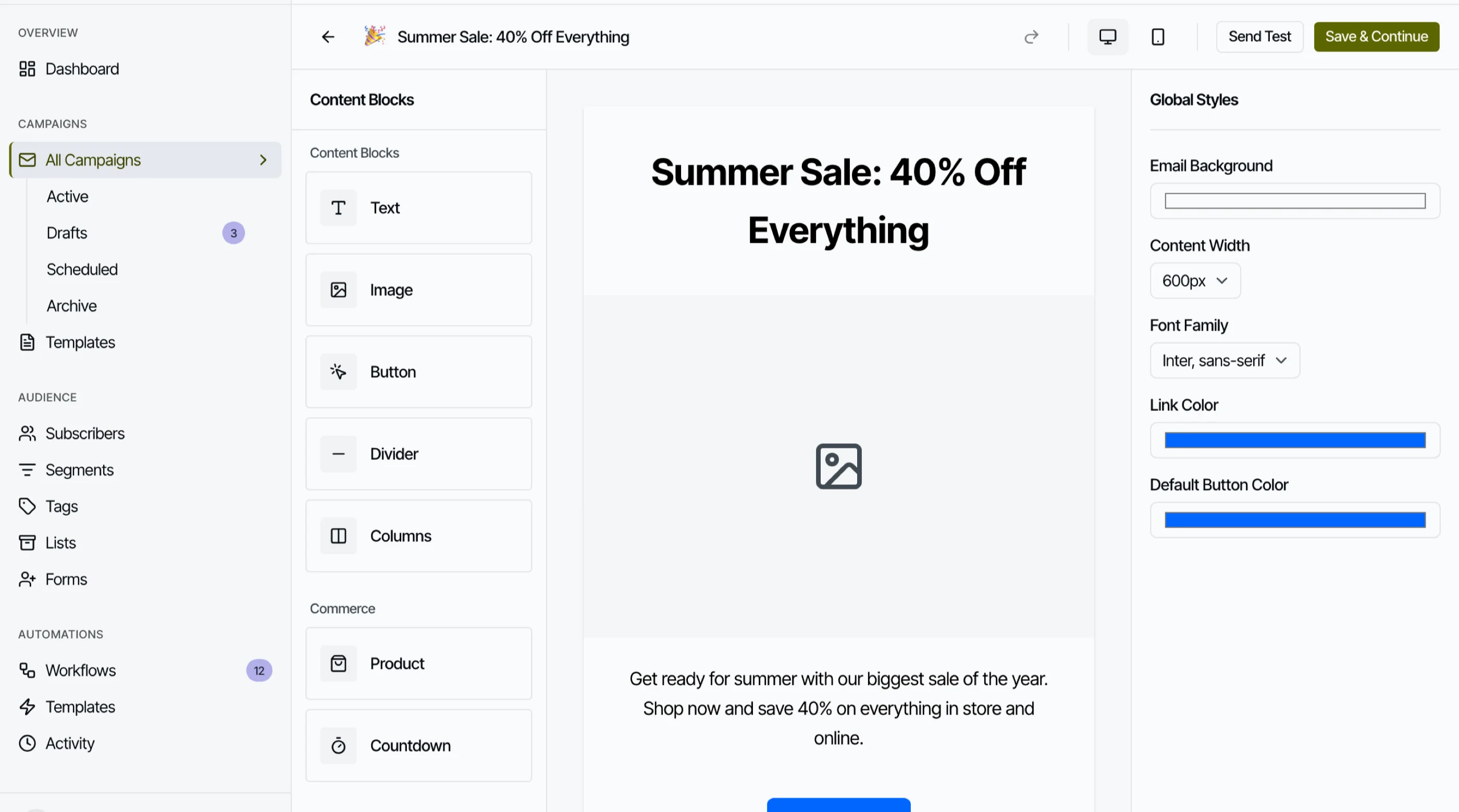
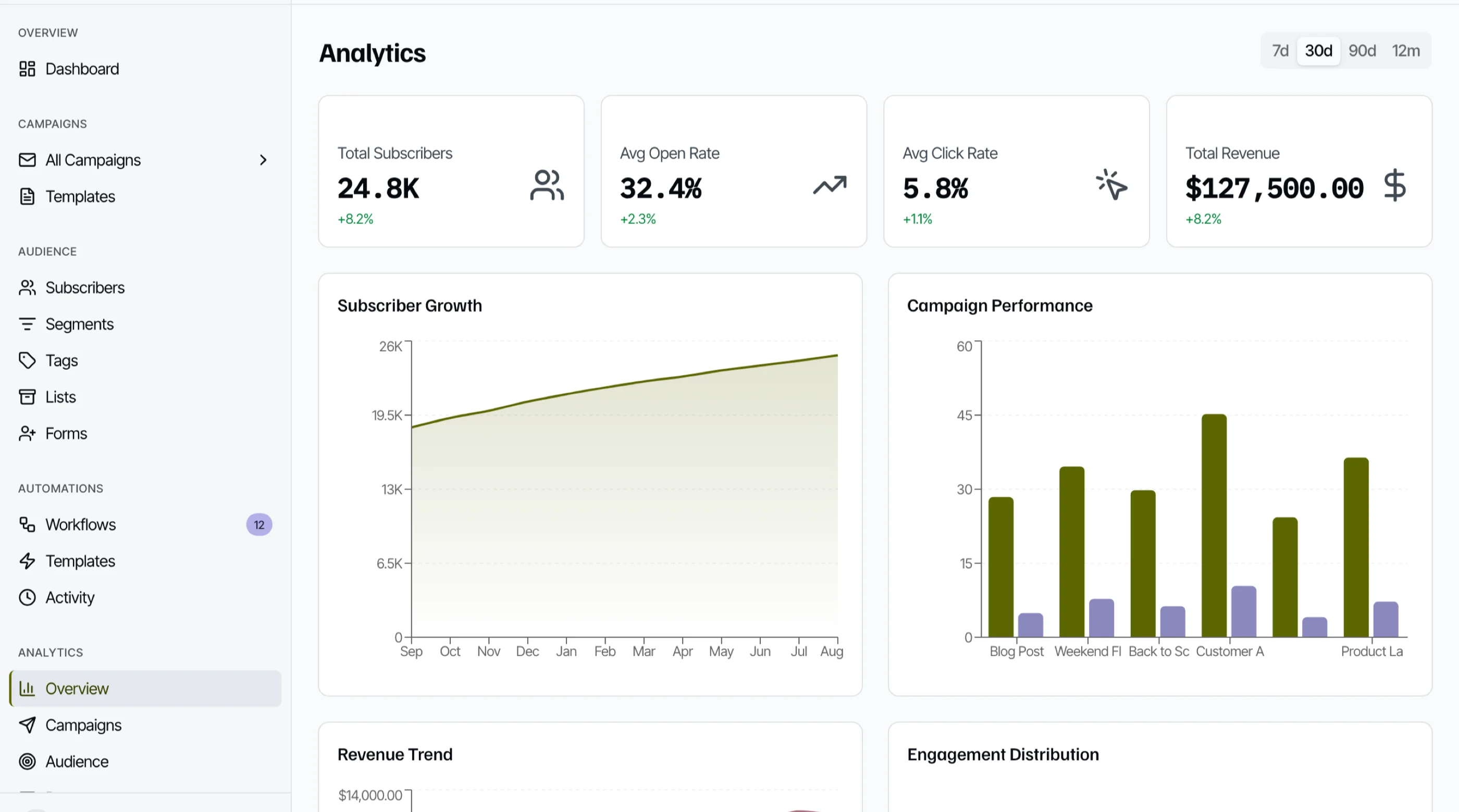
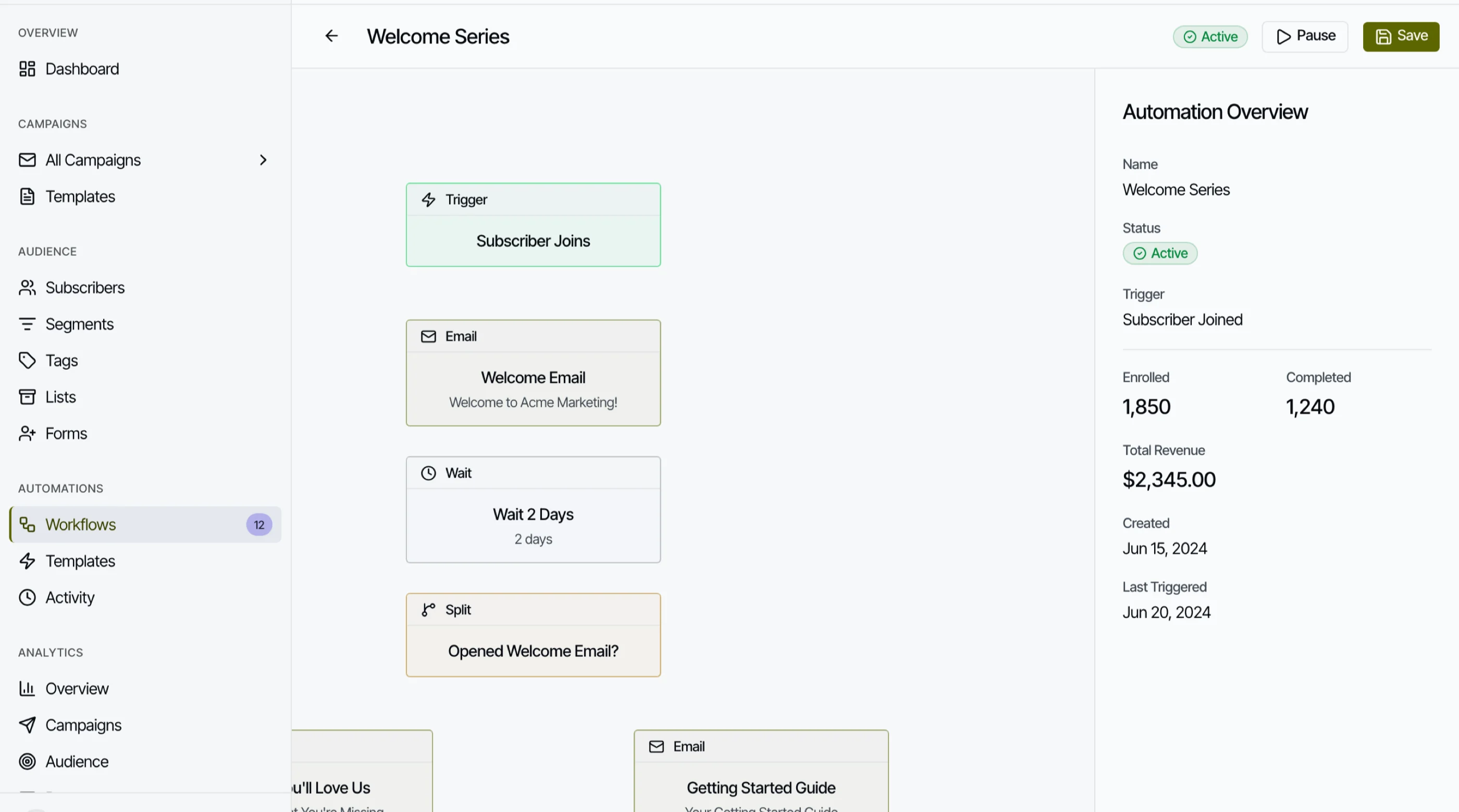
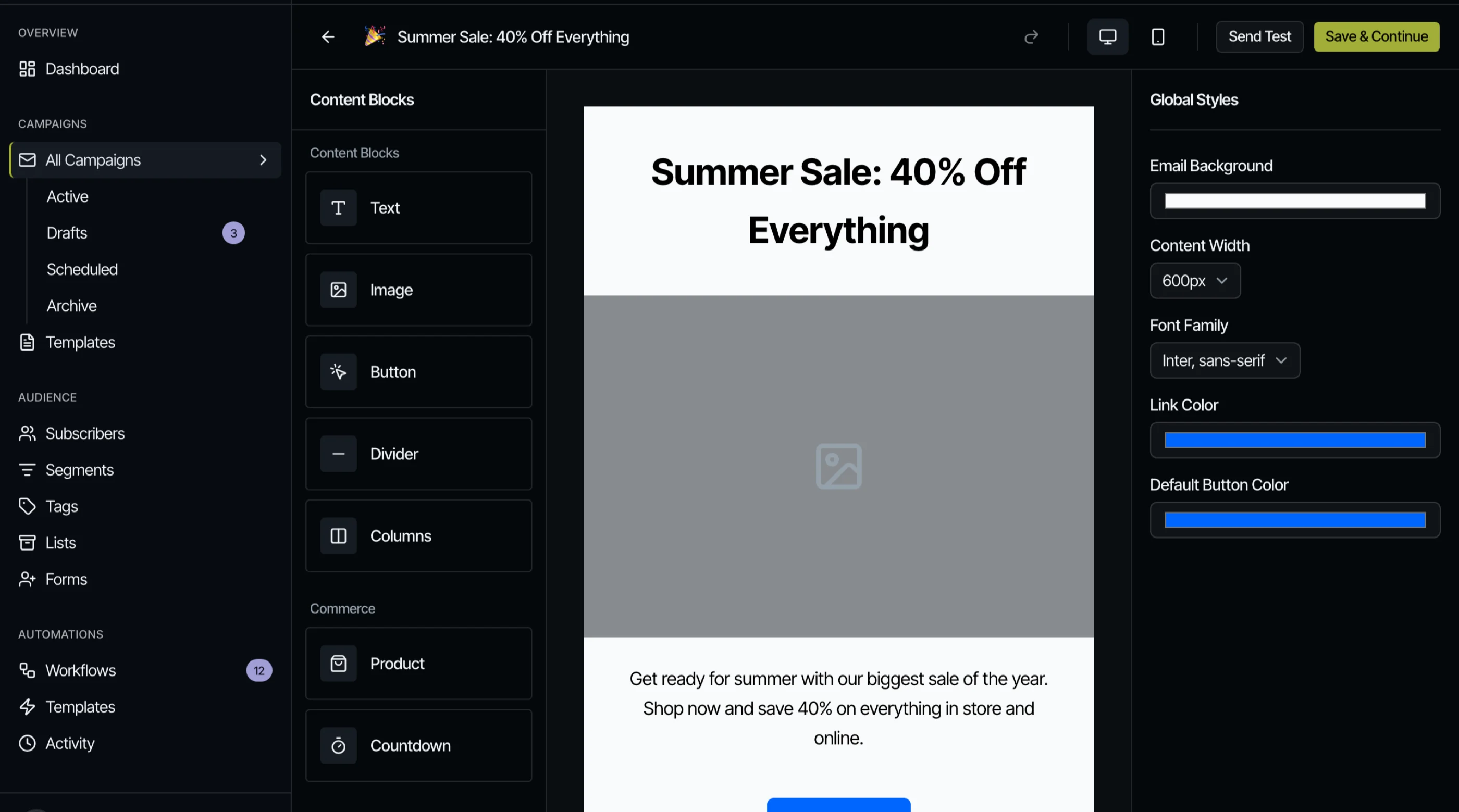
The Email Marketing Kit is shipped: 38 screens covering a block-based email editor, a node-graph automation canvas, subscriber management with segments and tags, A/B testing, deliverability monitoring, and click-map analytics. Next.js + Tailwind + shadcn/ui, dark mode throughout. $149 solo, $249 team, $399 agency.
Get the Email Marketing Kit → or get every kit (18 total) for $749 via All UI Kits →
TL;DR: Quick Picks for 2026
| Need | Top pick | Price |
|---|---|---|
| Growth tooling and monetisation | beehiiv | Free to 2,500 subs, Scale from roughly $43/mo |
| Own the platform and the CMS | Ghost | Self-host free, Ghost(Pro) from roughly $18/mo |
| Zero setup, start today | Substack | Free, 10% of paid subscription revenue |
| Cheap and capable | MailerLite | Free tier, Comfort from roughly $12/mo |
| Biggest free tier for a newsletter | EmailOctopus | Free to 2,500 subs |
| No licence fee at all | Listmonk | Free (self-host) |
| Newsletter inside your own product | thefrontkit Email Marketing Kit | $149+ one-time |
The important variable is not monthly price. It is what each platform takes when you start charging readers. Substack takes 10 percent of subscription revenue forever. beehiiv and Ghost take nothing.
What Kit Actually Does Well
Worth being fair about. The tagging and sequence model fits publishing better than the list-and-campaign model every general-purpose ESP uses, and once you have internalised it, going back feels clumsy. The Creator Network and recommendation system drive real subscriber growth rather than vanity numbers, which is a genuine distribution advantage no other tool here matches at the same scale. Deliverability is strong, helped by the plain-text bias. And the free tier to 10,000 subscribers is the most generous starting point in the category.
The case for alternatives is mostly about what happens after 10,000, and about whether you need design control.
When to Leave Kit
Three signals:
- You crossed 10,000 subscribers and the bill arrived. $33 or $66 a month is fine if the newsletter earns money and painful if it does not.
- You need the email to look like your brand. Kit's minimalism is a deliberate constraint, and fighting it wastes more time than switching.
- You want a website and a newsletter in one system. Kit does landing pages, not publishing. Ghost and beehiiv do both properly.
1. beehiiv
The most direct competitor, and the one built specifically to take Kit's customers.
Strengths:
- Free Launch plan covers up to 2,500 subscribers with unlimited sends
- Growth tooling built in: recommendations, referral programmes, boosts and an ad network
- Zero revenue share on paid subscriptions
- Scale from roughly $43/month, Max from roughly $96, with branding removal at the top
Weaknesses:
- Free tier ceiling is far lower than Kit's 10,000
- Automation is simpler than Kit's sequences
- Paid tiers get expensive as the list grows
- Newsletter-shaped, so a poor fit for product or e-commerce email
Best for: Newsletter operators who intend to monetise and want growth mechanics in the platform.
2. Ghost
The ownership option, and the only one here that is a full publishing platform.
Strengths:
- Open source, self-hostable for free if you can run a server
- Ghost(Pro) from roughly $18/month billed yearly for 1,000 members, Publisher around $29
- Zero revenue share on subscription income
- A real CMS, so the website and the newsletter are one system with one login
Weaknesses:
- Self-hosting means you own updates, backups and deliverability
- Email automation is basic compared with Kit's sequences
- Smaller integration ecosystem
- Themes need front-end skill to customise properly
Best for: Writers who want a website and a paid newsletter under one roof, and want to own it.
3. Substack
The zero-friction option, with the cost deferred.
Strengths:
- Genuinely free to start, with no monthly fee at any list size
- Built-in network effects through recommendations and the Substack app
- Publishing, payments and discovery handled entirely for you
- Fastest possible path from idea to first issue
Weaknesses:
- Takes 10 percent of gross paid subscription revenue, permanently
- You are building on their domain and inside their brand
- Almost no design control and minimal automation
- Exporting your list is possible, but your discovery advantage does not come with you
Best for: Writers testing whether an audience exists, before the 10 percent starts to matter.
4. MailerLite
The pragmatic choice if the newsletter is a channel rather than the business.
Strengths:
- Comfort from roughly $12/month, materially below Kit's Creator tier
- Best drag-and-drop editor here, so full design control if you want it
- Automations, landing pages and websites included
- Free tier for 250 subscribers with 2,500 monthly sends
Weaknesses:
- No creator network, no recommendations, no growth tooling
- No native paid-subscription handling in the Substack or Ghost sense
- Signup approval rejects some legitimate senders
- List-and-campaign model, which suits publishing less well than tagging
Best for: Businesses that publish a newsletter, rather than creators whose newsletter is the business. More options in MailerLite Alternatives.
5. EmailOctopus
The cheapest way to keep a large list alive.
Strengths:
- Free to 2,500 subscribers and 10,000 monthly emails
- Paid plans from roughly $9/month, well under Kit's Creator tier
- Can run on Amazon SES, which makes large lists very cheap
- Simple, fast and free of upsell pressure
Weaknesses:
- Basic automation, broadcast and simple sequences only
- No growth tooling or monetisation features
- Minimal reporting
- The SES route requires AWS comfort
Best for: Newsletters that are large, free and unlikely to be monetised.
6. Listmonk
The option that removes the subscription entirely.
Strengths:
- Free and open source, written in Go, very fast at large list sizes
- No per-subscriber licence, you pay only your sending provider
- Comfortable with multi-million row lists on modest hardware
- Nobody can suspend your account or change the pricing
Weaknesses:
- You own deliverability, which is the genuinely hard part
- No payments, no paid subscriptions, no growth tooling
- Broadcast and scheduled sending rather than sequences
- Needs a technical owner permanently
Best for: Technical writers with big free lists who resent paying per subscriber.
7. Build It with the Email Marketing Kit
The option worth considering when the newsletter is part of a product rather than the product itself.
If you are building a platform where your users publish, a creator tool, a community product, a membership site, then embedding Kit or Substack means their branding and their revenue share inside your product. Substack's 10 percent becomes a cut of your customers' income, taken through your app.
The Email Marketing Kit ships 38 screens for that layer: a block-based editor with content and commerce blocks, a node-graph automation canvas with triggers, waits and conditional splits, subscriber management with segments and tags, an A/B testing interface, a deliverability dashboard, click-map analytics, and a campaign template gallery. TypeScript throughout, Recharts for analytics, full dark mode.
Be clear about the boundary. It is the frontend. There is no sending backend, no authentication, no database, no payments and no real deliverability data in the box. You wire it to your own infrastructure, typically Resend, Postmark or SES, and to your own billing. There is no revenue share, because there is no vendor.
- Screens: 34+
- Editor: Block-based, with commerce blocks and global styles
- Automation: Node-graph canvas with triggers, waits and splits
- Analytics: Click maps, campaign reporting, deliverability monitoring
- Not included: Sending backend, payments, auth, database
- Price: $149 solo / $249 team / $399 agency
Recommendation by Creator Profile
| You | Pick |
|---|---|
| Monetising, want growth tooling | beehiiv |
| Want a website and newsletter you own | Ghost |
| Just starting, no audience yet | Substack |
| Newsletter supports a business | MailerLite |
| Big free list, tight budget | EmailOctopus |
| Technical, allergic to per-subscriber fees | Listmonk |
| Building publishing into your own product | Email Marketing Kit |
| Under 10,000 subs and happy | Stay on Kit, it is free |
Frequently Asked Questions
What is the best alternative to ConvertKit?
beehiiv for creators who intend to monetise, because the growth and referral tooling is built in and it takes no revenue share. Ghost if owning the platform matters and you want a website in the same system. MailerLite if the newsletter supports a business rather than being one.
Is Kit still free?
Yes, up to 10,000 subscribers, which remains the most generous free tier of any tool here. Creator is $33/month and Pro $66 above that, or $390 and $790 annually. If you are under the ceiling and content, there is little reason to move.
Which newsletter platform takes the smallest cut?
beehiiv, Ghost and Kit all take zero percent of subscription revenue. Substack takes 10 percent of gross, permanently, which is the single largest long-term cost in this comparison. On a newsletter earning $5,000 a month, that is $6,000 a year.
Can I move my subscribers off Kit?
Yes. Subscriber lists export as CSV and import cleanly everywhere. What does not transfer is the Creator Network recommendation flow that may be driving a share of your growth, so measure where new subscribers actually come from before assuming the list is the whole asset.
Should I self-host my newsletter?
Only if you are technical and the list is large. Ghost self-hosted and Listmonk both remove per-subscriber costs entirely, but you take on deliverability, upgrades and backups. For a paid newsletter, deliverability problems are revenue problems, so this is not a good place to learn.
The Honest Take
Kit's free tier to 10,000 subscribers is better than most people realise, and if you are under it the correct answer is usually to stay. The decision only becomes real at the point where the bill starts.
At that point, ask what you are buying. If it is growth, beehiiv's referral and recommendation tooling is more useful than Kit's sequences. If it is ownership, Ghost gives you a website and a newsletter you control, with no cut taken. If it is just email, MailerLite and EmailOctopus both cost less and do more design.
Substack deserves the warning it usually does not get. Free is not free when it is 10 percent of revenue forever, and the distribution advantage you are renting stays with them when you leave.
Related Guides
- Mailchimp Alternatives: 8 Cheaper Email Platforms if you need a general-purpose tool instead
- MailerLite Alternatives: 7 Email Platforms for the value end of the market
- Kajabi Alternatives if you are selling courses alongside the newsletter
Want it shipped without hiring a developer?
The build path above assumes you have engineers. If you don't, the team behind thefrontkit does done-for-you launches: we deploy the kit, apply your branding, and wire it to your stack. Fixed quotes, most builds ship in 2-4 weeks, from $1999.