Kajabi Alternatives: 8 Course Platforms for 2026
Kajabi Alternatives: 8 Options Compared for 2026
Short answer: if Kajabi is too expensive, Podia does the same all-in-one job for less. If you want the courses without the marketing suite, Thinkific is the cleanest swap. If you want your own branding and domain rather than a platform's, LearnWorlds goes furthest. If the community is the product, Circle. And if you're already running a website and just need the learning layer inside it, self-host or build it.
Kajabi starts at roughly $69/month and the tier most people actually end up on is $149 or $199. That buys courses, memberships, email marketing, funnels, a website builder, and payments in one system with no transaction fees on top.
The pitch is real: replacing five tools with one is worth money. The reason people leave is usually one of three. The price steps up faster than revenue does for creators still finding an audience. You're paying for the marketing suite even when you already have a site, a list, and a CRM. Or the platform owns the experience, and you want the course to look like your product rather than a Kajabi page.
Eight alternatives worth comparing, from cheaper all-in-ones to open source to building the learning layer into something you already run.
For what a course platform actually has to do, see our How to Build an LMS in Next.js guide, and for why most templates fall short, Why Most LMS Templates Fail Course Creators.
Or skip the build entirely: get the LMS Kit
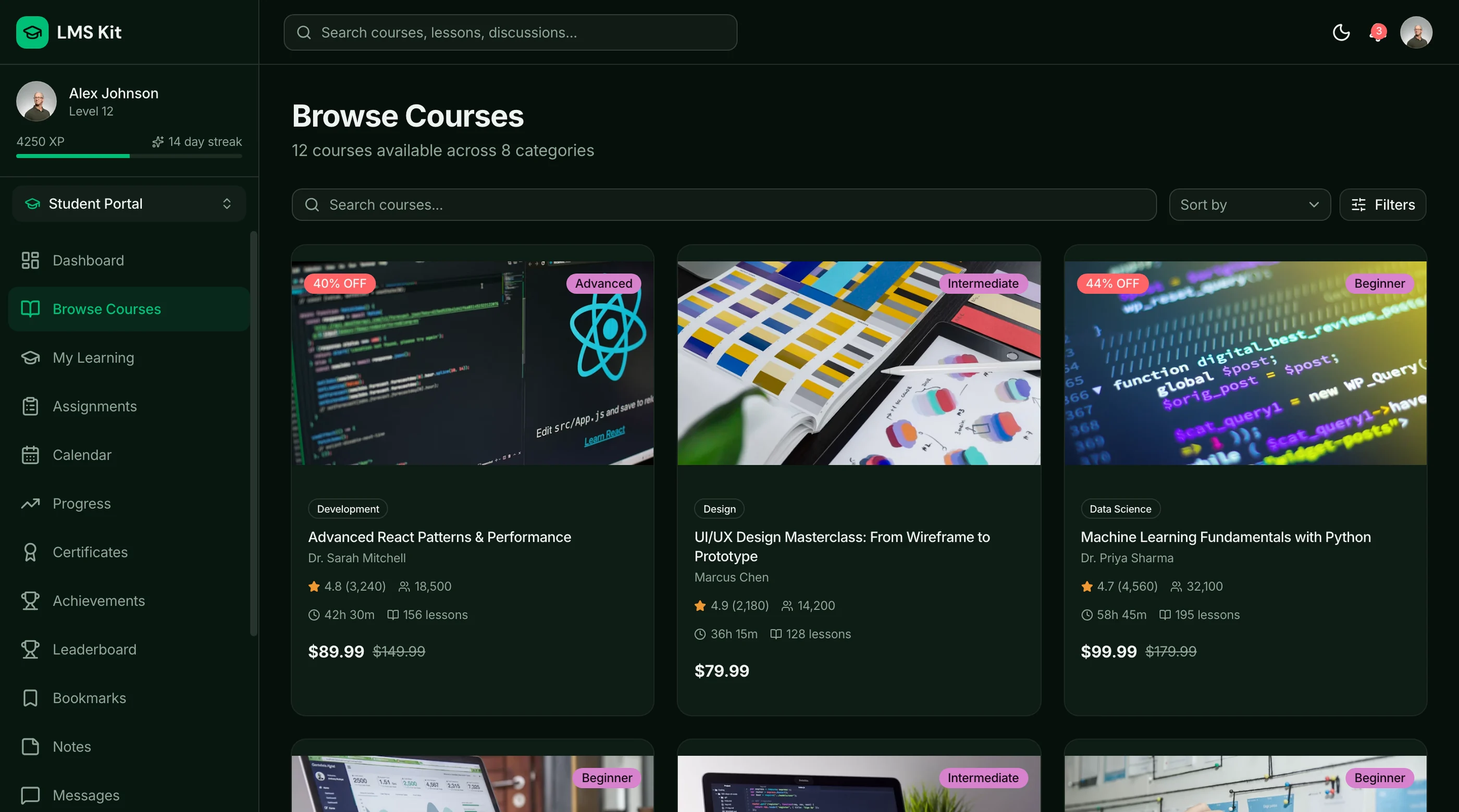
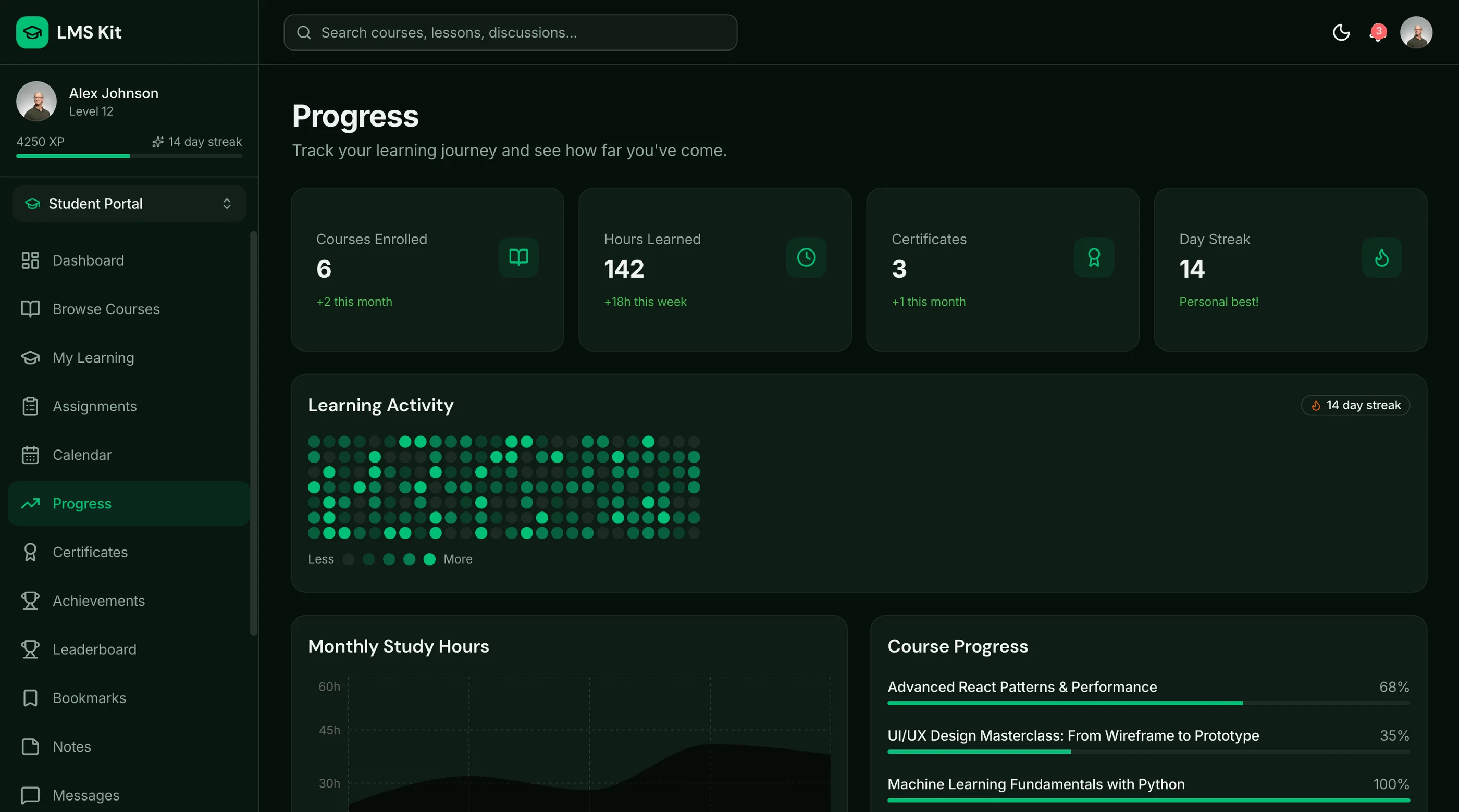
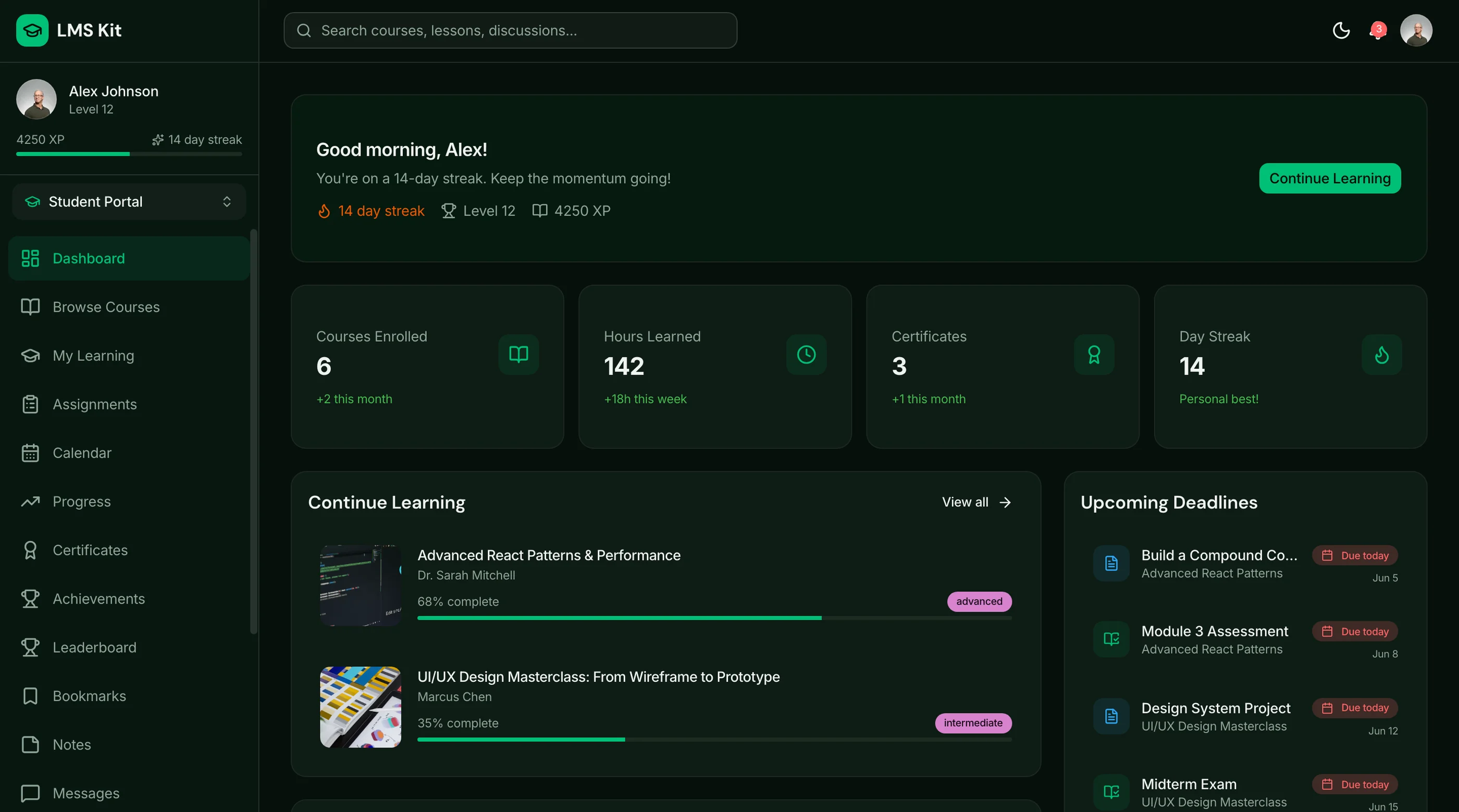
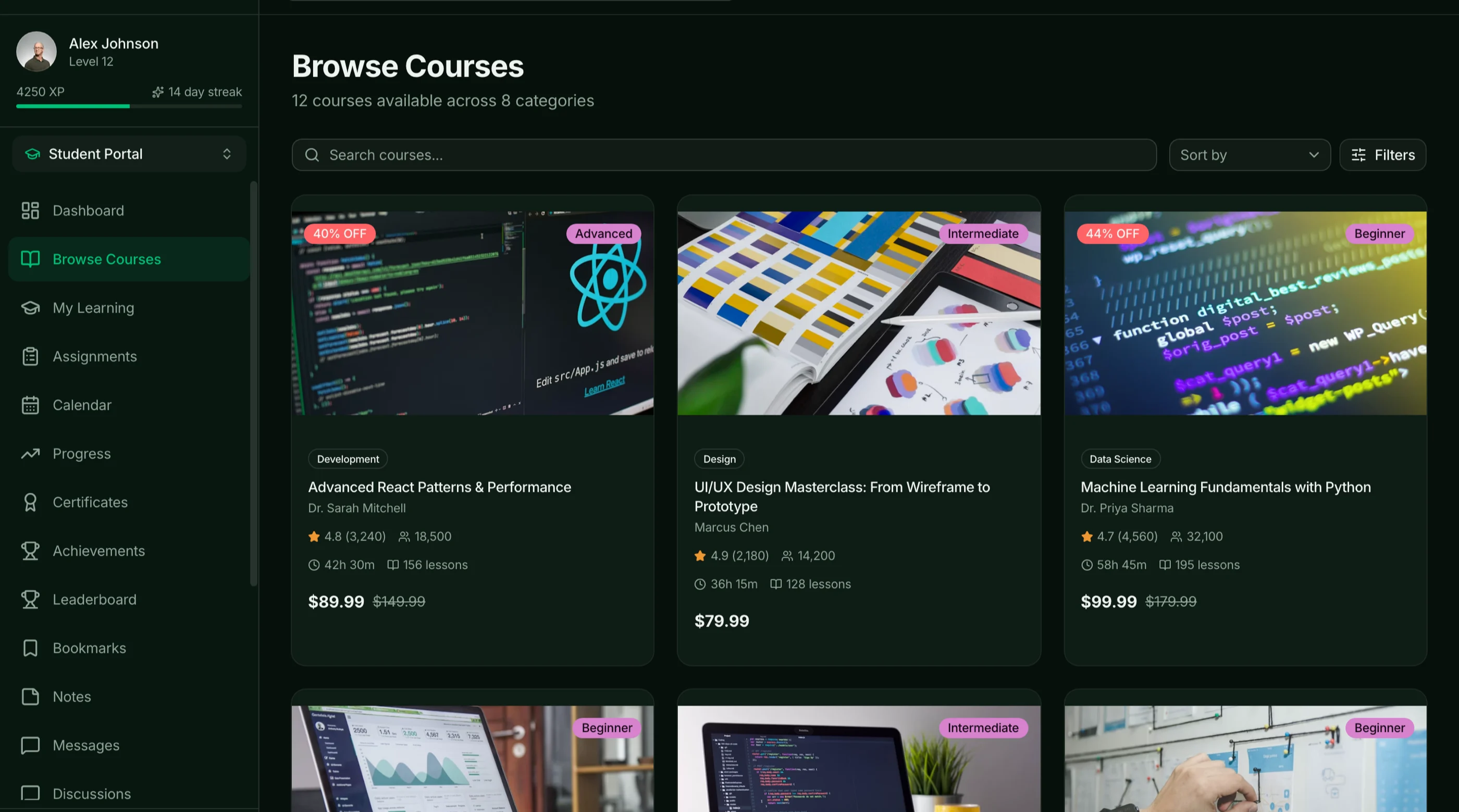
The LMS Kit is shipped: 39 screens covering the student dashboard, course catalog, lesson player with module navigation, a quiz engine with scoring, progress tracking, discussion forums, a drag-and-drop curriculum editor, and the instructor and admin panels. Next.js + Tailwind + shadcn/ui, WCAG AA. $131 solo, $199 team, $349 agency. Try the live demo.
Get the LMS Kit → or get every kit (18 total) for $749 via All UI Kits →
TL;DR: Quick Picks for 2026
| Need | Top pick | Price |
|---|---|---|
| Cheaper all-in-one, same job | Podia | From roughly $39/mo |
| Courses without the marketing suite | Thinkific | Free tier, from roughly $49/mo |
| Best-known name, easiest start | Teachable | Free tier with fees, from roughly $39/mo |
| White-label, your branding throughout | LearnWorlds | From roughly $29/mo |
| Community is the product | Circle | From roughly $49/mo |
| Cheapest all-in-one with funnels | Systeme.io | Generous free tier |
| Open source, self-hosted | Moodle | Free |
| Learning inside your own product | thefrontkit LMS Kit | $131+ one-time |
Course platform pricing changes often and most vendors run annual discounts. Treat these as directional.
What Kajabi Actually Does Well
Worth saying clearly. Kajabi is the most complete all-in-one in this category, and for a creator whose entire business runs on it, the consolidation is the product. Email, funnels, checkout, courses, and community in one place means one login, one support contact, and no integration glue. There are no transaction fees on any tier, which matters more than the sticker price once you're doing real volume.
The case for alternatives isn't that Kajabi is bad. It's that a lot of people buy the all-in-one and then use a third of it.
When to Leave Kajabi
Three signals:
- You already have the marketing stack. If you run your own site, your own email tool, and your own CRM, you're paying for duplicates.
- The tier jump outpaces revenue. Kajabi's steps are large. If an upgrade is triggered by a limit rather than by growth, the pricing model has stopped matching your business.
- The course should look like your product. Once branding and domain consistency matter, a hosted platform's constraints start to show.
1. Podia
The closest like-for-like swap, at a lower price.
Strengths:
- Courses, digital downloads, memberships, and email in one place
- Genuinely simple, very little setup friction
- No transaction fees on paid plans
- Includes email marketing, so it replaces more than the courses
Weaknesses:
- Less powerful than Kajabi on funnels and automation
- Customization is limited compared to LearnWorlds
- Reporting is basic
- Fewer integrations than the bigger platforms
Best for: Creators who want Kajabi's shape without Kajabi's price or complexity.
2. Thinkific
Course-first platform that stayed focused instead of becoming a marketing suite.
Strengths:
- Strong course-building experience with a usable free tier
- No transaction fees on paid plans
- Good quiz, assignment, and completion features
- App store for extending what the core doesn't do
Weaknesses:
- Email and funnels are not really included, so you keep those tools
- Design customization is decent but not white-label
- Community features are lighter than Circle's
- Costs add up once you add apps
Best for: People whose product is the course, who already have the marketing side handled elsewhere.
3. Teachable
The best-known course platform, and usually the first one creators try.
Strengths:
- Fast to launch, very low learning curve
- Large ecosystem and plenty of documentation
- Handles tax and payouts for you on some plans
- Free tier to validate an idea before paying
Weaknesses:
- Transaction fees on the free and lower tiers eat into revenue
- Students sit on Teachable's domain unless you upgrade
- Customization is limited
- The upgrade path gets expensive at scale
Best for: First-time course creators who want to launch this month and worry about ownership later. We go deeper on the self-hosted angle in Teachable Alternatives.
4. LearnWorlds
The white-label option, for people who want the platform to disappear.
Strengths:
- Deep customization, including your own branding throughout
- Interactive video, built-in assessments, and certificates
- Can produce a genuinely branded school rather than a hosted page
- Strong for selling to businesses rather than individuals
Weaknesses:
- Steeper learning curve than Podia or Teachable
- The entry tier adds a per-sale fee
- More configuration means more time before launch
- Overkill if you're selling one course
Best for: Established creators and small businesses who need the course to look like part of their brand.
5. Circle
Community platform that grew courses, rather than the reverse.
Strengths:
- Best-in-class community and discussion experience
- Courses, events, and spaces in one membership
- Strong engagement features that keep people coming back
- Modern interface people actually enjoy using
Weaknesses:
- Course-building is lighter than Thinkific or LearnWorlds
- Email and funnels are limited
- Priced per member tier, which can bite as you grow
- Not the right fit for a pure self-paced course library
Best for: Businesses where the ongoing community is the thing people pay for, and courses are the supporting material.
6. Systeme.io
The budget all-in-one, with a free tier that is unusually generous.
Strengths:
- Free plan includes courses, funnels, and email
- Very low cost even on paid tiers
- Covers the same categories as Kajabi at a fraction of the price
- Good for testing an offer before committing
Weaknesses:
- Interface and polish are well behind Kajabi
- Course delivery is functional rather than pleasant
- Support and ecosystem are smaller
- You will likely outgrow it if the business works
Best for: Validating a paid offer without spending anything, or running lean on purpose.
7. Moodle and Open edX
Open source, self-hosted, and free of per-student pricing entirely.
Strengths:
- No licence fees and no per-student cost
- Mature, with decades of features behind them
- Your data and your infrastructure
- Extremely configurable if you have the engineering time
Weaknesses:
- You own hosting, upgrades, and security
- Interfaces feel institutional rather than commercial
- Selling courses needs extra work, since these were built for education not e-commerce
- Real setup and maintenance cost in time
Best for: Institutions, or teams with engineering capacity who want to own the whole stack. More detail in Moodle Alternatives.
8. Build the Learning Layer with the LMS Kit
The option most people skip: put the course inside the product you already have.
If you already run a SaaS, a membership site, or a community, the course does not need to live on someone else's domain with someone else's checkout. What you actually need is the learning interface: a catalog, a lesson player, progress, quizzes, and an instructor view.
The LMS Kit ships 39 screens for exactly that. Students get a dashboard, course catalog and detail pages, a lesson player with module navigation and bookmarks, a quiz engine with a countdown timer and scored results, progress tracking with streaks and achievement badges, and threaded discussion forums. Instructors get a drag-and-drop curriculum editor, course management, and engagement analytics. Admins get platform metrics, user management, and a course approval queue. There are pricing and checkout screens too.
Be clear about what this is. It's the frontend. No backend, no database, no video hosting, no payment processing, and no email service in the box. You bring Mux or Cloudflare Stream for video, Stripe for payments, and your own auth. What you get is the twelve-to-sixteen weeks of interface work, already done, running on your domain and looking like your product.
- Screens: 39
- Student: Lesson player, quizzes, progress dashboard, discussion forums
- Instructor: Drag-and-drop curriculum editor, course analytics
- Admin: Platform metrics, user management, course approval queue
- Commerce: Pricing plans and checkout screens
- Not included: Backend, video hosting, payment processing, notifications
- Price: $131 solo / $199 team / $349 agency
Recommendation by Creator Profile
| You | Pick |
|---|---|
| Want Kajabi's shape, lower bill | Podia |
| Course is the product, marketing handled elsewhere | Thinkific |
| Launching a first course this month | Teachable |
| Need your own branding end to end | LearnWorlds |
| Community is what people pay for | Circle |
| Testing an offer with no budget | Systeme.io |
| Institution or engineering-heavy team | Moodle or Open edX |
| Already have a SaaS, want courses inside it | Build with the LMS Kit |
| Selling courses to businesses under your brand | Build with the LMS Kit |
| Genuinely use all of Kajabi's suite | Stay on Kajabi |
Pricing at a Glance (Annual, Mid Tier)
Directional. Most of these discount annual billing, and several add per-sale fees on entry tiers.
| Product | Typical mid tier | Rough annual cost |
|---|---|---|
| Kajabi | ~$149-$199/mo | ~$1,800-$2,400 |
| Podia | ~$39-$89/mo | ~$470-$1,070 |
| Thinkific | ~$49-$99/mo | ~$590-$1,190 |
| Teachable | ~$39-$119/mo | ~$470-$1,430 |
| LearnWorlds | ~$29-$99/mo | ~$350-$1,190 |
| Circle | ~$49-$99/mo | ~$590-$1,190 |
| Systeme.io | Free to ~$27/mo | $0-$330 |
| Moodle (self-hosted) | Free | Hosting and your time |
| LMS Kit + your stack | One-time | $131-$349 once, plus hosting |
The pattern: hosted platforms are cheap to start and compound with revenue and members. Self-hosting is free to licence and compounds with your time. A one-time UI layer does neither, but it also assumes you can wire up the backend.
Frequently Asked Questions
What is the best alternative to Kajabi?
Podia for most people, because it does the same all-in-one job at a lower price with less setup. Thinkific if you only want the course side and already have email and a website. LearnWorlds if branding and white-labelling matter more than simplicity. Circle if the community is the actual product rather than the courses.
Is there a free alternative to Kajabi?
Systeme.io has the most generous free tier, covering courses, funnels, and email at no cost. Thinkific and Teachable both have free plans, though Teachable charges transaction fees on its free tier. Moodle is free to licence if you can self-host it.
What is the cheapest Kajabi alternative?
Systeme.io, by a wide margin, and it is free to start. Beyond that, LearnWorlds and Podia have the lowest paid entry points. If you already run infrastructure, self-hosted Moodle costs only hosting.
Which Kajabi alternative has no transaction fees?
Podia and Thinkific charge no transaction fees on their paid plans, and Kajabi charges none on any tier. Teachable applies fees on its free and lower tiers, and LearnWorlds adds a per-sale fee on its entry plan. Always check the tier rather than the brand, since this varies within a single platform.
Can I add courses to a website I already have?
Yes, and it is often the cheaper answer. You can embed a membership layer, self-host an LMS on a subdomain, or build the learning interface directly into your app. That last option is the build path described above with the LMS Kit, which keeps students on your domain and inside your design.
How hard is it to migrate off Kajabi?
The content moves easily enough, since videos and documents are files you already own. The hard parts are the subscriber list, active subscriptions, and any funnels or automations, which have to be rebuilt rather than exported. Budget a few weeks, migrate before a launch rather than during one, and keep both running until renewals have cycled.
The Honest Take
Kajabi is the right answer for creators who genuinely use the whole suite, and consolidation has real value. The alternatives win at specific edges: price (Podia, Systeme.io), course depth (Thinkific), first launch (Teachable), branding (LearnWorlds), community (Circle), ownership (Moodle), or fitting the learning layer inside a product you already run.
The option most creators underweight is the last one. If you already have an audience, a domain, and a checkout, the course platform is mostly re-selling you things you have. What's left is the interface, and that is a build, not a subscription.
Want it shipped without hiring a developer?
The build path above assumes you have engineers. If you don't, the team behind thefrontkit does done-for-you launches: we deploy the kit, apply your branding, and wire it to your stack. Fixed quotes, most builds ship in 2-4 weeks, from $1999.