CRM Automation: What to Automate First and What Breaks
CRM Automation: Where to Start When Everything Looks Automatable
Most CRM automation guides give you a list of 20 things you could automate. The list is fine. The order is the problem. Teams build the fun automations first (AI lead scoring, nurture sequences) on top of messy data and manual assignment, and then spend months wondering why nothing downstream works.
This post gives you a build order. It's the sequence our team uses on client projects: fix what comes into the CRM, route it to the right person, make sure someone follows up, then connect the handoffs. For each step you'll get what it looks like in HubSpot, Salesforce, Pipedrive and Zoho, which plan you need, and what tends to break once it's live.
TL;DR
- CRM automation means the CRM does something on its own when a record changes: assigns an owner, creates a task, sends an email, updates a field or tells another tool.
- Build in this order: clean intake, lead routing, follow-up tasks, stage handoffs, enrichment, stale deal alerts. AI scoring and complex nurture come last.
- Check your plan before you design anything. HubSpot's lead rotation needs Sales Hub or Service Hub Professional. Pipedrive automations start on Growth. Zoho assignment rules start on Standard.
- Most failures are quiet. A rep leaves and leads keep going to their queue, or two automations update the same field back and forth. Put a monthly review on the calendar.
- Measure one number per automation, taken before and after. For routing, that's time from form fill to first touch.
CRM Automation, Defined in Plain Terms
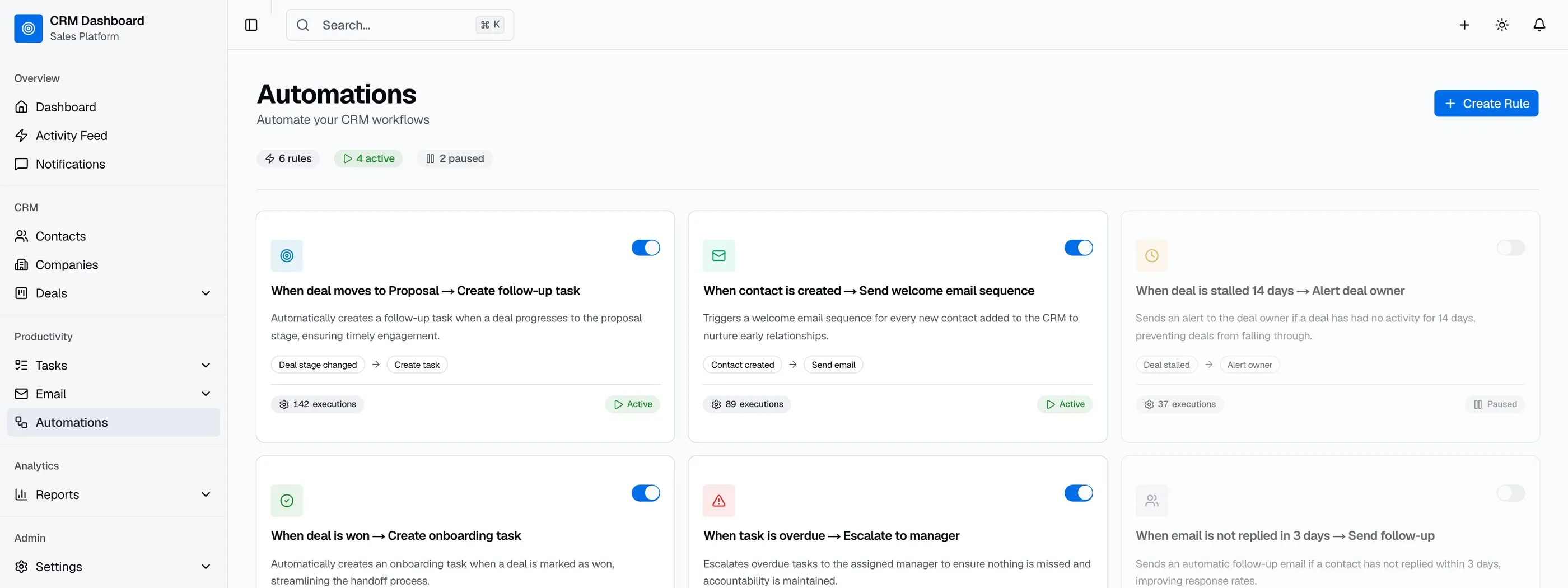
Every automation has three parts. A trigger (a form is submitted, a deal changes stage, a date arrives), optional conditions (the lead is from the US, the deal is over $10,000), and one or more actions (assign an owner, create a task, send an email, call a webhook).
Every major CRM ships its own builder for this. HubSpot calls them workflows. Salesforce uses Flow, and its older Workflow Rules and Process Builder now sit under legacy features, with a Migrate to Flow tool to move them over. Pipedrive calls them automations. Zoho has workflow rules.
When the builder can't reach a tool or can't express the logic, teams add Zapier, Make or n8n in between, or write code against the CRM's API. More on when that makes sense below.
The Build Order
| # | Automation | Why it comes here | What it depends on |
|---|---|---|---|
| 1 | Clean intake (required fields, duplicate checks) | Every later automation reads these fields | Nothing |
| 2 | Lead routing | Leads without an owner don't get worked | Clean country, company size and source fields |
| 3 | First-touch follow-up tasks | Routing is pointless if the owner never sees the lead | An owner on every lead |
| 4 | Stage handoffs (won deal to onboarding, billing) | Where deals stall between teams | Consistent pipeline stages |
| 5 | Enrichment | Better routing and scoring later | Clean intake, a data provider |
| 6 | Stale deal and task alerts | Keeps the pipeline honest | Stages and activity logging |
| 7 | Reporting snapshots | Numbers you can trust | All of the above |
| 8 | AI qualification and scoring | Needs clean history to be worth anything | Months of consistent data |
You don't need all eight. In our client work, small sales teams get most of the value from steps 1 to 4.
Step 1: Fix Intake Before You Route Anything
Routing rules read fields. If "Country" is a free-text box where people type "US", "USA" and "United States", your territory rule will miss two of the three. So the first automation work is boring on purpose:
- Make routing fields picklists. Country, company size and lead source should be dropdowns on every form that feeds the CRM.
- Set a default for missing values. A workflow that sets lead source to "Unknown" when it's blank beats a lead that matches no rule at all.
- Check for duplicates on the way in. Match on email first, then company domain. Decide what happens on a match: update the existing record, or create a task for the current owner.
- Stamp the entry date. A "Became a lead on" date field lets you measure response time later.
If you're pulling leads from several tools (website forms, a chat widget, event lists, a billing system), this is also where sync problems show up. Two tools creating the same contact with slightly different emails is one of the most common causes of duplicate records we find in CRM integration audits.
Step 2: Lead Routing
Lead routing decides who owns a new lead. Four methods cover nearly every team:
- Existing owner first. If the lead's company already has an account owner, the lead goes to them. This one prevents the most internal friction, so check it before any other rule.
- Territory. Region, country or state decides the team.
- Segment. Company size or deal potential decides between, say, an SMB rep pool and an enterprise AE.
- Round robin. Inside the right team, leads rotate evenly so no rep gets buried.
Then add the parts guides usually skip:
- A fallback owner. Every rule set needs a final "everything else" catch that goes to a named person or queue, never to nobody.
- Out-of-office handling. Rotation should skip people who are on leave. If your CRM can't do that natively, remove them from the rotation group while they're out, and make that part of your leave checklist.
- Working hours. A lead that comes in at 11pm on Friday shouldn't sit with one rep until Monday while their teammates in another time zone are online.
Lead Routing in HubSpot
HubSpot's Rotate record to owner workflow action splits records evenly across a team or a set of users. According to HubSpot's workflow actions documentation, it's available on Sales Hub and Service Hub Professional and Enterprise only, and it only rotates between activated, paid users.
On Sales Hub Starter, automation is limited to creating tasks and email notifications when deals change stage, so rules-based routing means Professional (from $90 per seat per month, plus a $1,500 onboarding fee) or an external tool. Sales Hub Professional includes up to 300 workflows and Enterprise up to 1,000.
A typical HubSpot routing workflow: trigger on form submission, branch on whether the associated company already has an owner, branch again on country, then rotate within the matching team.
Lead Routing in Salesforce
Salesforce handles this with lead assignment rules. Each rule holds ordered entries (criteria plus a user or queue), and the first entry that matches wins. Per Salesforce's assignment rule guidelines, rules apply whether leads are created by hand, come from Web-to-Lead forms, or arrive through the Data Import Wizard, and only one lead assignment rule can be active at a time.
That last point trips people up. You can't have one active rule for imports and a second active rule for web leads. Put both in the same rule as separate entries, ordered from most to least specific. Assignment to a queue plus Flow is the usual answer when you need rotation or logic that entry criteria can't express.
Lead Routing in Pipedrive
Pipedrive's workflow automations are on the Growth, Premium and Ultimate plans, per its plan features page. Automatic assignment for LeadBooster leads starts on Premium. Pipedrive's usage limits cap automations at 50 per company on Growth, 150 on Premium and 250 on Ultimate, with 3, 10 and 20 if/else conditions per automation respectively.
The Growth plan's three-condition limit matters for routing. "Existing owner, then region, then size, then rotate" can outgrow it, so either split the logic across automations or plan for Premium.
Lead Routing in Zoho CRM
Zoho's edition comparison puts assignment rules on Standard and above (10 rules per module on Standard, 20 on Professional, 50 on Enterprise and Ultimate). The Free edition has none. Assignment thresholds, which cap how many records one user gets, start on Professional.
Step 3: Follow-Ups That Fire on Their Own
An owner on every lead only helps if the owner acts. The second automation after routing should be simple:
- Create a "first touch" task due the same business day, assigned to the new owner.
- Notify the owner in the place they actually look. For many teams that's Slack.
- Escalate if nothing happens. If the task is still open after your target window, alert the team lead or reassign.
Pick the target window with your team and write it down. The exact number matters less than having one, because it turns "we're slow to follow up" into a measurable miss.
Keep automated emails to the lead themselves short and honest at this stage: a confirmation that you got their request and who will reach out. Full nurture sequences can wait until routing and follow-up are working.
Step 4: Handoffs Between Stages and Teams
Deals most often stall where one person hands work to another. The handoffs worth automating:
- Deal won → onboarding. Create the onboarding project or ticket, assign the customer success owner, and copy over what was promised in the deal.
- Deal won → billing. Create the customer and invoice in Stripe, QuickBooks or Xero. This usually runs through an integration, and it's where sync rules need the most care.
- Deal lost → nurture. Record the loss reason as a required picklist, then enroll the contact in a low-frequency follow-up.
- Proposal sent → reminder. A task for the owner if there's no activity after a set number of days.
If your CRM and billing tool already disagree about customer records, fix that before adding more automation on top of it. That's exactly what a CRM integration audit looks at.
Step 5 and Beyond: Enrichment, Alerts and Reporting
Enrichment fills in company size, industry and location from an email domain, which makes routing more accurate and forms shorter. Run it on creation, write only to empty fields, and never let it overwrite something a rep typed.
Stale deal alerts flag deals with no activity for a set period or deals past their expected close date. Send a weekly digest to each owner instead of an alert per deal, or people learn to ignore them.
Reporting snapshots store pipeline totals on a schedule so you can compare this month with last month without someone rebuilding a spreadsheet. We wrote about why sales dashboards get ignored in this post.
AI qualification goes last on purpose. A model that scores leads learns from your history. If that history has missing lead sources and deals that never got closed out, the scores will look precise and be wrong.
Plan Limits at a Glance
| CRM | Automation starts on | Routing feature | Documented limits |
|---|---|---|---|
| HubSpot Sales Hub | Professional for workflows (Starter: deal stage tasks and notifications) | Rotate record to owner, Professional and Enterprise | 300 workflows on Professional, 1,000 on Enterprise |
| Salesforce | Flow, plus lead assignment rules | Lead assignment rules | One active lead assignment rule at a time |
| Pipedrive | Growth | LeadBooster automatic assignment, Premium and up | 50 / 150 / 250 automations on Growth / Premium / Ultimate |
| Zoho CRM | Free (limited) | Assignment rules, Standard and up | 5 to 100 active workflow rules per module, by edition |
Limits and plan names change. Check the linked page before you buy a tier for one feature.
What Breaks After Go-Live
Automations rarely fail loudly. These are the problems we find most often when we review a CRM that's been running for a year or two:
- Leads routed to people who left. Rotation groups and assignment rule entries still name a deactivated user. HubSpot's rotation only includes activated paid users, but a hard-coded owner in a branch still points at the old one.
- Automations nobody owns. The admin who built them moved on, and nobody knows what "Workflow 14 (copy)" does. Pipedrive lets admins transfer automation ownership, and a transferred automation stays switched off until the new owner reviews it, so plan the handover instead of discovering it.
- Two automations fighting. One workflow sets lifecycle stage to "Customer" when a deal closes, another sets it back to "Lead" when a form is submitted. The record flips every time the contact downloads something.
- Double triggers from integrations. A sync tool updates a field, which re-triggers a workflow, which updates the field again. Watch for this whenever an integration and a native automation touch the same property.
- Rules that grew by accretion. Twenty exceptions added one at a time, in an order nobody can explain. In Salesforce, where entries are evaluated top to bottom, a broad entry placed too high silently swallows everything below it.
A 30-minute monthly review catches most of these. Go through the error or run history log for each automation, check the fallback owner's queue (if it's filling up, a rule is missing), and deactivate anything nobody can explain.
When Native Automation Isn't Enough
Start with the builder inside your CRM. It's already paid for, it shows up in the CRM's own history, and whoever inherits your CRM will look there first. Add another layer when you hit one of these:
- The tool you need isn't connected. Your CRM has no native connection to your billing, support or product database. Zapier or Make is the quick fix for low volume.
- The logic is too branchy. Routing that depends on data from outside the CRM (product usage, open support tickets) is easier in n8n or code than in nested branches.
- Volume or reliability matters. Once a failed step means a lost order or a wrong invoice, you want retries, logging and alerts. That usually means a small service that talks to the CRM's API directly.
- Your plan limit is the only blocker. Sometimes paying for the next tier is cheaper than maintaining a workaround. Sometimes it isn't. Price both before deciding.
If you're building a CRM rather than configuring one, automation hooks belong in the data model from day one. Our custom CRM development guide covers when that route makes sense, and the Full-Stack CRM Kit is a starting codebase with pipeline, contacts, deals and tasks already in place.
How to Tell Whether an Automation Worked
Pick one number per automation and record it for a few weeks before you switch the automation on.
| Automation | Number to track |
|---|---|
| Lead routing | Leads with no owner after one business day |
| First-touch tasks | Median time from lead creation to first logged activity |
| Stage handoffs | Days from deal won to onboarding kickoff |
| Enrichment | Share of new leads with company size filled in |
| Stale deal alerts | Deals past expected close date with no activity |
If the number doesn't move after a month, the automation either isn't firing or isn't the bottleneck. Both are worth knowing.
Build It Yourself or Bring In Help
If you have an admin who knows your CRM and a quiet afternoon, steps 1 to 3 are very doable in-house. Use the build order above, document each automation in one line (trigger, conditions, action, owner), and set the monthly review.
Bring in help when automations span several tools, when nobody on the team owns the CRM, or when existing workflows already conflict and you'd rather not untangle them live. Our team does this as fixed-scope automation projects: an ops diagnostic of where the hours go, then routing, follow-ups and handoffs built in the CRM you already use, documented and handed over. If the real problem is one broken sync between two tools, start with the $499 CRM integration audit instead.
Frequently Asked Questions
What is CRM automation?
CRM automation is when your CRM takes an action on its own after something happens to a record. A form submission assigns an owner, a deal moving to "Won" creates an onboarding task, or a missed follow-up alerts a manager. Each automation is a trigger, optional conditions and one or more actions.
What should I automate first in my CRM?
Start with clean intake (required picklist fields and duplicate checks), then lead routing, then first-touch follow-up tasks. Those three make every later automation more reliable. AI scoring and complex nurture sequences work best once you have months of clean data.
Does HubSpot Starter include workflows?
Sales Hub Starter includes automation that creates tasks and email notifications when deals change stage. Full workflows, including the Rotate record to owner action used for lead routing, need Sales Hub or Service Hub Professional or Enterprise, according to HubSpot's pricing and knowledge base pages.
How does lead routing work in Salesforce?
Salesforce uses lead assignment rules. A rule contains ordered entries, each with criteria and a user or queue, and the first matching entry assigns the lead. Only one lead assignment rule can be active at a time, so different cases (imports, web leads) go into the same rule as separate entries. Flow handles logic the entries can't express.
Do I need Zapier if my CRM has built-in automation?
Only when the built-in tool can't reach something you need. Use native automation for anything that stays inside the CRM. Add Zapier, Make or n8n when you need to connect a tool the CRM doesn't integrate with, and move to custom code when failures would cost money and you need retries and logging.
How much does CRM automation cost?
The software cost is the plan tier that includes the features you need, such as HubSpot Sales Hub Professional at $90 per seat per month plus a $1,500 onboarding fee, or Pipedrive's Growth plan ($24 per seat per month, billed annually) for automations. Setup cost depends on how many tools are involved. We quote automation projects as a fixed scope after a diagnostic, so the price is agreed before any work starts.
Want your routing and follow-ups built for you?
We start with an ops diagnostic of where your team's hours go, then build the automations that matter in the HubSpot, Salesforce or Pipedrive account you already run. Fixed-scope projects, documented and handed over.