Salesforce Alternatives: 8 CRM Options for 2026
Salesforce Alternatives: 8 Options Compared for 2026
Salesforce Starter is $25/user/month, which sounds reasonable until you meet the rest of the ladder: Pro Suite at $100, Enterprise at $165, Unlimited at $330, and Agentforce credits on top. Then the real costs arrive: the admin you hire to run it, the consultants who configure it, and the year of "implementation" before reps stop complaining. Industry lore says every Salesforce dollar buys a second dollar of services, and the lore is not wrong.
For enterprises with complex processes, that price buys unmatched power. For everyone else, it buys a system nobody fully uses. Eight alternatives worth comparing, from SMB-friendly SaaS to open-source self-hosted to owning the CRM frontend outright.
We've mapped this market from other angles too: the Pipedrive alternatives guide for pipeline-first teams and the HubSpot alternatives guide for the free-tier-cliff crowd.
Or skip the build entirely: get the CRM Dashboard Kit
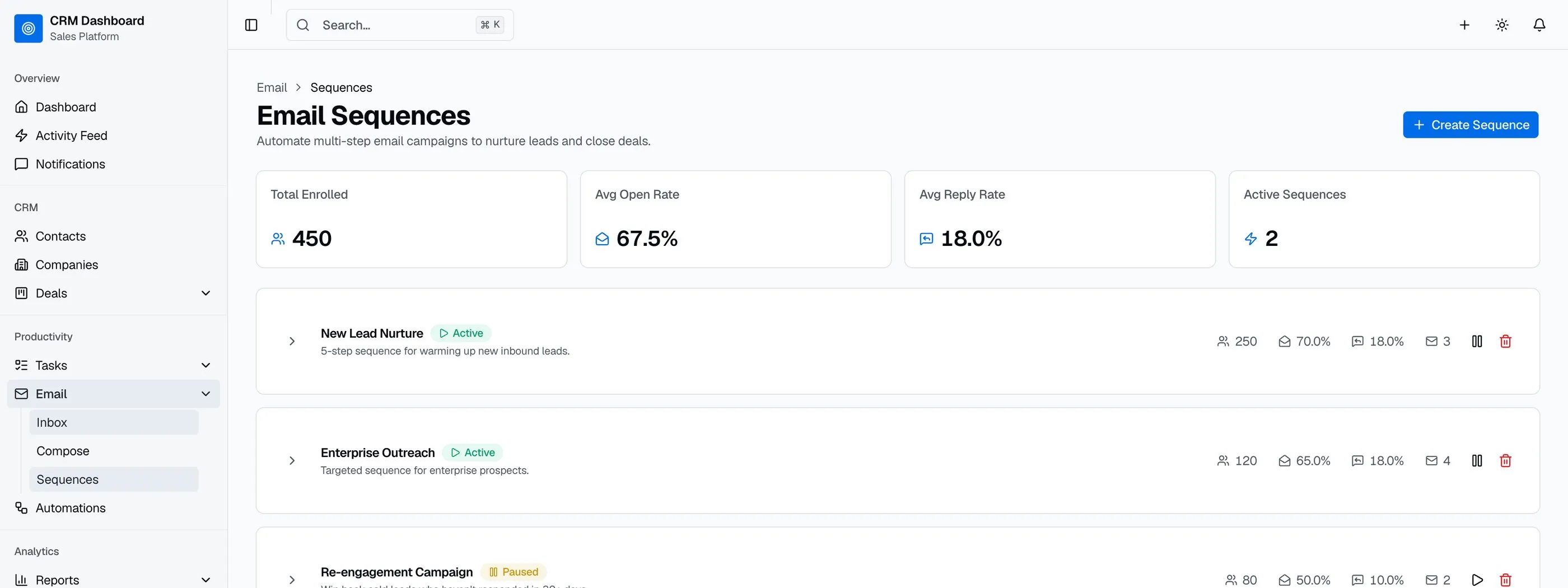
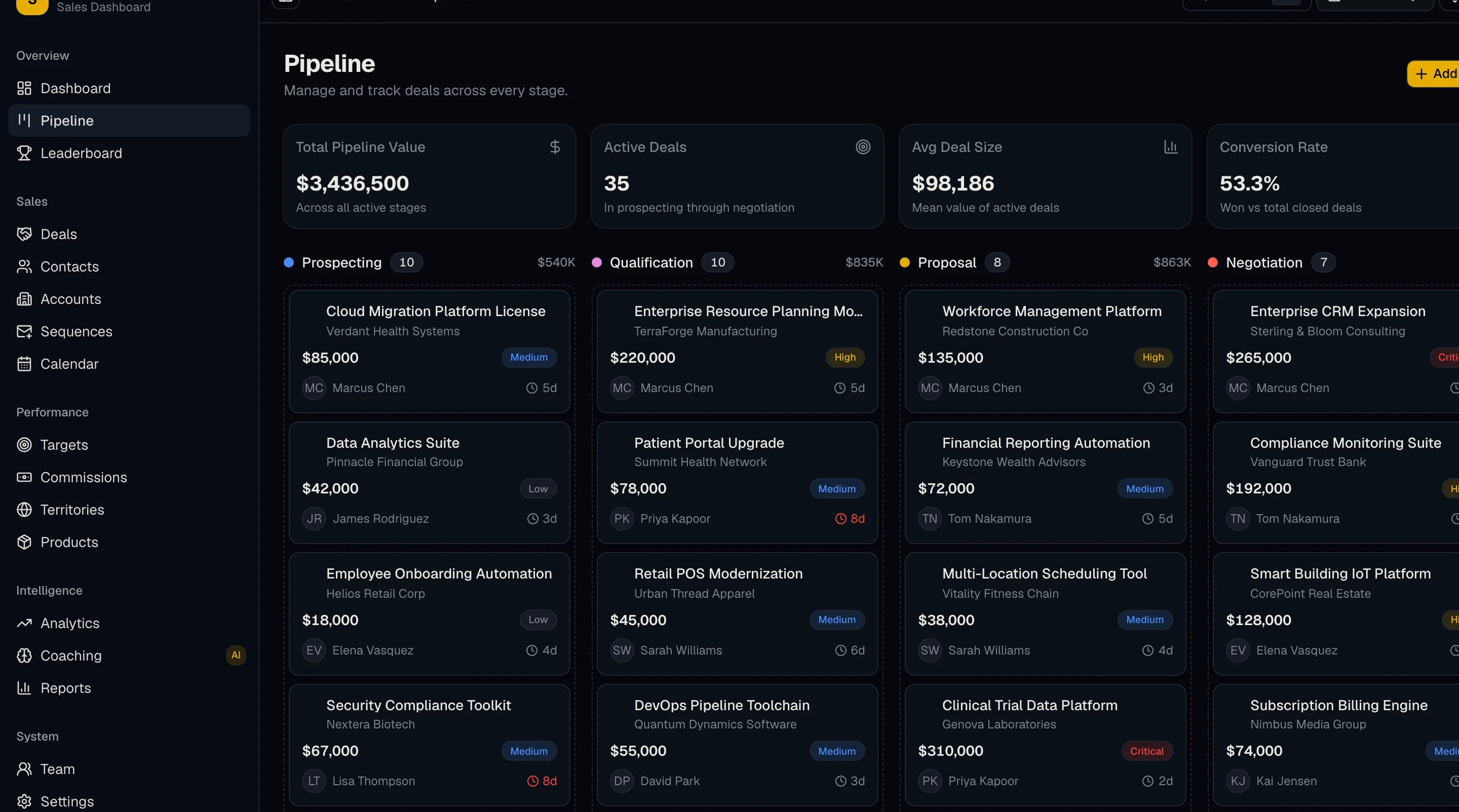
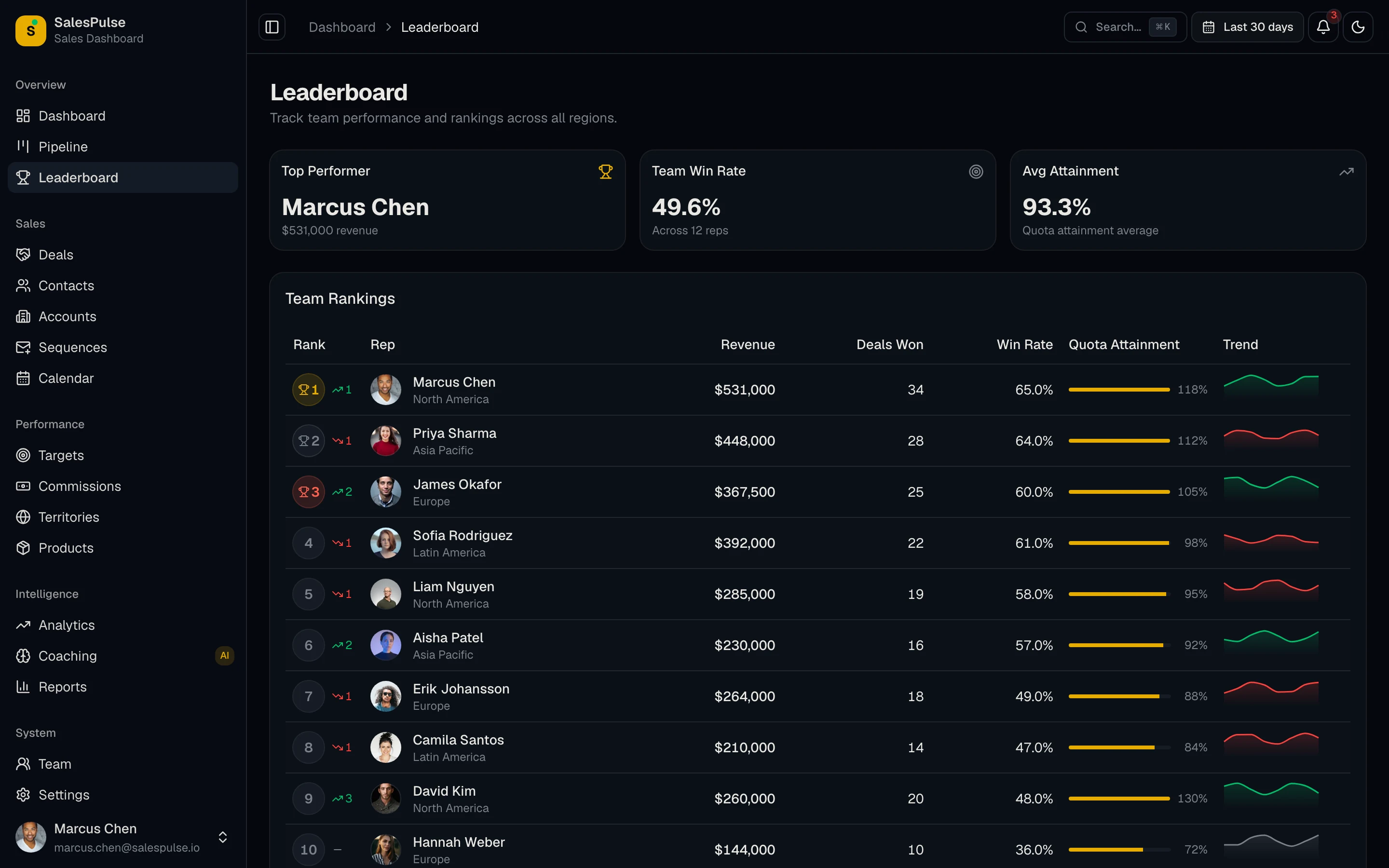
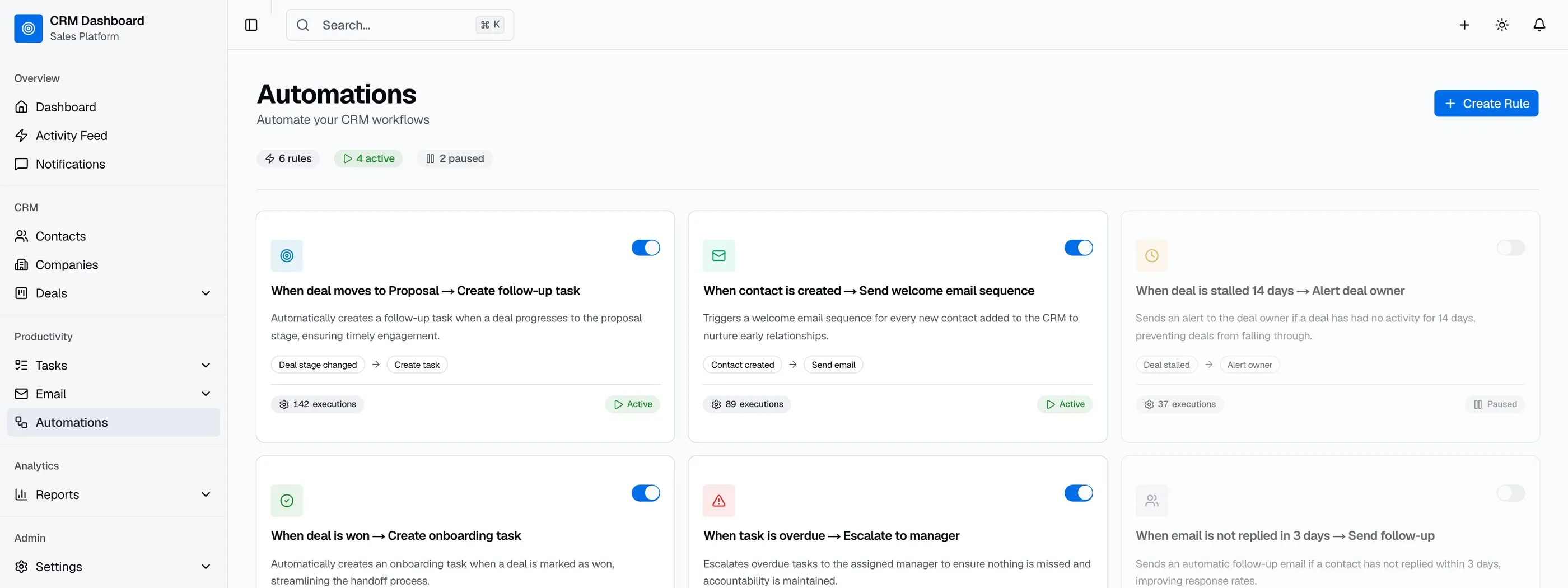
The CRM Dashboard Kit is shipped: 42 screens with Kanban pipeline, contact and company management with activity timelines, deal tracking with forecasting, email inbox UI, and 4 analytics dashboards. Next.js + Tailwind + shadcn/ui, WCAG AA. $165 solo, $199 team, $349 agency. Try the live demo.
Get the CRM Dashboard Kit → or get every kit (18 total) for $749 via All UI Kits →
TL;DR: Quick Picks for 2026
| Need | Top pick | Price |
|---|---|---|
| All-in-one with a free start | HubSpot | Free tier, then steep |
| Cleanest pipeline for pure sales | Pipedrive | $24+/user/mo |
| Closest to Salesforce power, fraction of cost | Zoho CRM | $14+/user/mo |
| Fast setup, native calling | Freshsales | $9+/user/mo, 21-day trial |
| Modern data model, startup-native | Attio | Free tier, $29+/user/mo |
| Open-source modern CRM | Twenty | Free (self-host) |
| Open-source traditional CRM | EspoCRM | Free (self-host) |
| CRM experience inside your product | thefrontkit CRM Dashboard Kit | $165+ one-time |
What Salesforce Actually Does Well
Salesforce is the most powerful CRM ever built, and at enterprise scale nothing else is close. Any process can be modeled, any system integrated, any report constructed. The AppExchange is an economy of its own. For a 500-rep org with territory management, CPQ, and compliance requirements, Salesforce isn't overpriced; it's the only complete answer.
The alternatives exist because most companies buying Salesforce are not that org, and they end up renting a fighter jet to commute.
When to Leave Salesforce
Three signals:
- The admin burden is the product. If changes require a certified admin or a consulting engagement, the tool is running you.
- Reps live in spreadsheets anyway. Adoption failure means you're paying enterprise prices for a database of stale records.
- Renewal math stopped making sense. Per-user fees, add-on SKUs, and mandatory tiers compound into six figures for capabilities you use at 20%.
1. HubSpot
The migration path most SMBs actually take.
Strengths:
- Free CRM to start; genuinely usable before you pay anything
- Sales, marketing, and service hubs in one integrated platform
- Setup measured in days, not quarters; no admin hire required
- Modern UI reps adopt without a fight
Weaknesses:
- The free-to-paid cliff is real: Professional tiers jump to $90-100/seat
- Marketing Hub bills on stored contacts
- Deep customization hits walls Salesforce doesn't have
Best for: SMBs and mid-market teams leaving Salesforce complexity, who want one integrated platform. Full breakdown in our HubSpot alternatives guide.
2. Pipedrive
The anti-Salesforce: one job, done cleanly.
Strengths:
- The most intuitive deal pipeline in the market; reps onboard in a day
- $24-$64/user/month with no implementation project
- Solid automations without an admin priesthood
- Built for sales, not for every department at once
Weaknesses:
- No marketing platform, minimal service tooling
- Reporting depth is a fraction of Salesforce's
- Complex enterprise processes simply don't fit
Best for: Sales-led teams under 100 reps who used 10% of Salesforce and want that 10% to be excellent. Its own market is mapped in the Pipedrive alternatives guide.
3. Zoho CRM
The closest thing to Salesforce's breadth at a tenth of the total cost.
Strengths:
- Workflows, scoring, forecasting, territory management: the enterprise checklist, present
- $14-$52/user/month, and the surrounding Zoho suite replaces more SKUs cheaply
- Zia AI included on mid tiers rather than sold as credits
- Serious customization without certified-admin economics
Weaknesses:
- Busy UI; real setup investment required (a week, not a year)
- Easy to over-configure into a mess
- Support quality varies by region and plan
Best for: Teams that genuinely need Salesforce-style configurability but not Salesforce-style invoices.
4. Freshsales
The fast-setup pick with calling built in.
Strengths:
- Paid from $9/user/month billed annually, with a 21-day trial
- Phone, email, and chat native to the base product
- Freddy AI scoring on paid tiers
- Kanban pipeline familiar to anyone leaving any CRM
Weaknesses:
- Reporting trails Zoho and Salesforce meaningfully
- Marketplace is small
- Enterprise features (territories, advanced permissions) are thin
Best for: Small and mid-size teams that want a working CRM this week, with telephony included.
5. Attio
The modern CRM for companies whose motion never fit Salesforce objects.
Strengths:
- Fully flexible data model: define objects for partnerships, ABM, marketplaces, anything
- Best-in-class UI, real-time and collaborative
- API-first; loved by product-led startups
- Free tier for small teams, paid from $29/user/month
Weaknesses:
- Classic sales management (forecasting, quotas) still maturing
- Pro/Enterprise tiers get expensive
- Flexibility means designing your own process
Best for: Startups and non-linear sales motions where Salesforce's account/opportunity model was always a fiction.
6. Twenty
The open-source modern CRM.
Strengths:
- Free, MIT-licensed, self-hostable; zero per-seat fees forever
- Modern stack (React, GraphQL, Postgres), UI closer to Linear than legacy CRM
- Custom objects and growing extensibility
- Cloud option available
Weaknesses:
- Young project; feature set still filling out
- Integrations trail commercial CRMs badly
- You own uptime, upgrades, and backups
Best for: Developer-led teams that want CRM data on their own infrastructure with a modern interface.
7. EspoCRM
The mature open-source workhorse.
Strengths:
- 10+ years of development; the fullest free CRM feature set (contacts, opportunities, cases, campaigns, reporting)
- Self-hosted free, inexpensive cloud tiers
- Admin-UI customization without code
- Modest hardware requirements
Weaknesses:
- PHP/LAMP stack, dated UI, weak mobile
- Deeper customization means writing PHP
- No modern collaboration features
Best for: Teams that want maximum free functionality self-hosted and value maturity over polish.
8. Build the CRM Frontend with the CRM Dashboard Kit
The build path fits the case no vendor serves: the CRM experience living inside your product. A customer-facing pipeline in your SaaS, a partner deal portal, or a vertical CRM for one industry where generic objects never fit. It also fits Salesforce shops that keep Salesforce as the system of record but need dashboards reps will actually open.
What this looks like:
- Your backend (or Salesforce's API) owns the data
- The CRM Dashboard Kit provides the frontend: Kanban pipeline with keyboard-accessible drag-and-drop, contact and company views with activity timelines, deal tracking with forecasting, email inbox UI, and 4 analytics dashboards
- 35+ screens, Next.js + Tailwind + shadcn/ui, WCAG AA, design-token rebrandable
- One-time $99-$349
Try the live demo. For the roundup view of CRM frontends, see Best CRM Dashboard Templates.
Recommendation by Team Profile
| You | Pick |
|---|---|
| SMB leaving enterprise complexity | HubSpot |
| Pure sales team, want simplicity | Pipedrive |
| Need the power, not the invoice | Zoho CRM |
| Working CRM this week, calling included | Freshsales |
| Non-standard sales motion | Attio |
| Self-hosted, modern stack | Twenty |
| Self-hosted, maximum features | EspoCRM |
| CRM inside your product | Build with the CRM Dashboard Kit |
Pricing at a Glance (25-Person Sales Team, Annual)
| Product | Typical tier | ~Annual cost (25 seats) |
|---|---|---|
| Salesforce (Enterprise) | $165/user/mo | $49,500 + admin/consulting |
| Salesforce (Pro Suite) | $100/user/mo | $30,000 |
| HubSpot Sales Hub (Professional) | $90/user/mo | $27,000 + onboarding |
| Pipedrive (Professional) | $49/user/mo | $14,700 |
| Zoho CRM (Enterprise) | $40/user/mo | $12,000 |
| Freshsales (Pro) | $39/user/mo | $11,700 |
| Attio (Pro) | $59/user/mo | $17,700 |
| Twenty (self-hosted) | Free | Hosting only (~$300-900) |
| EspoCRM (self-hosted) | Free | Hosting only (~$300-900) |
| CRM Dashboard Kit (build path) | One-time $165-$349 | $165-$349 once, plus hosting |
Directional numbers, and for Salesforce deliberately incomplete: the license is historically half the real cost once implementation, admin salary, and add-on SKUs land.
Frequently Asked Questions
What is the best free alternative to Salesforce?
HubSpot's free CRM for a hosted start (watch the upgrade cliff). Self-hosted, EspoCRM gives you the most functionality free, and Twenty gives you the most modern experience. All three cover what a small team actually used in Salesforce.
What is the best open-source alternative to Salesforce?
Twenty for modern UI and stack; EspoCRM for feature completeness. Neither replicates Salesforce's platform depth (CPQ, territory management, the AppExchange), but teams leaving Salesforce rarely used that depth.
Is Salesforce worth it for small business?
Usually not. Starter at $25/user looks competitive, but the value of Salesforce is its configurability, and configuring it requires time and expertise small teams don't have. Pipedrive, Freshsales, or HubSpot free deliver a working CRM in days instead.
Can I keep Salesforce and fix the reporting instead?
Yes, and for orgs mid-contract it's often the pragmatic move. Salesforce stays the system of record; you pull data through its REST API into your own dashboard with your own views and forecast logic. The CRM Dashboard Kit provides that frontend layer without a Tableau contract.
How hard is it to migrate off Salesforce?
Data export is the easy half: accounts, contacts, and opportunities come out via reports or the API, and every competitor ships an importer. The hard half is process: workflows, validation rules, and integrations rebuilt in the new tool, plus the reports leadership actually depends on. Budget a quarter, migrate the pipeline first, and keep read-only access to history through the parallel run.
The Honest Take
Salesforce is the right answer for genuine enterprise complexity, and the wrong default for everyone who bought it aspirationally. HubSpot wins the integrated-platform case cheaper, Pipedrive wins simplicity, Zoho wins power-per-dollar, Attio wins modern motions, and the open-source pair wins ownership.
And when the CRM needs to live inside your product, no vendor rents you that. That's the build path: your data model, your brand, one-time cost.
Want it shipped without hiring a developer?
The build path above assumes you have engineers. If you don't, the team behind thefrontkit does done-for-you launches: we deploy the kit, apply your branding, and wire it to your stack. Fixed quotes, most builds ship in 2-4 weeks, from $1999.