Open Source Ticketing System: 7 Self-Hosted Options for 2026
Open Source Ticketing System: 7 Self-Hosted Options for 2026
The strongest open source ticketing systems in 2026 are osTicket for classic support queues, GLPI if you need asset management alongside tickets, and Zammad if you want something closer to Zendesk. All three are free to self-host. This guide compares them with four more, and names two widely recommended options that no longer deserve the recommendation.
Every listicle on this topic reads the same. Ten tools, all described as excellent, no mention of which ones are dying. So here is the part those posts leave out first.
Two You Should Skip
Peppermint. It shows up in nearly every 2026 roundup and on YouTube. The GitHub repository was archived by its owner on 17 July 2026 and is now read-only. The last commit to main landed on 21 September 2025, and the most recent tag, 0.5.5, is from November 2024. It is a genuinely nice Next.js and Postgres ticketing app, and that is exactly why the archive matters: 86 open issues will stay open. Do not start a new deployment on it.
Hesk, if you specifically need open source. Hesk is good software and actively maintained (version 3.7.12 shipped on 3 September 2026). But it is not open source. The Hesk site calls it "free help desk software" and never names an OSI licence, and the free version carries "Powered by Hesk" branding that you remove by buying a licence: $49.99 one-time for one install, $199.99 for five. If "free" is your requirement, Hesk qualifies. If "open source" is your requirement, it does not, whatever the roundups say.
Or skip the hosting question entirely: Help Desk Kit
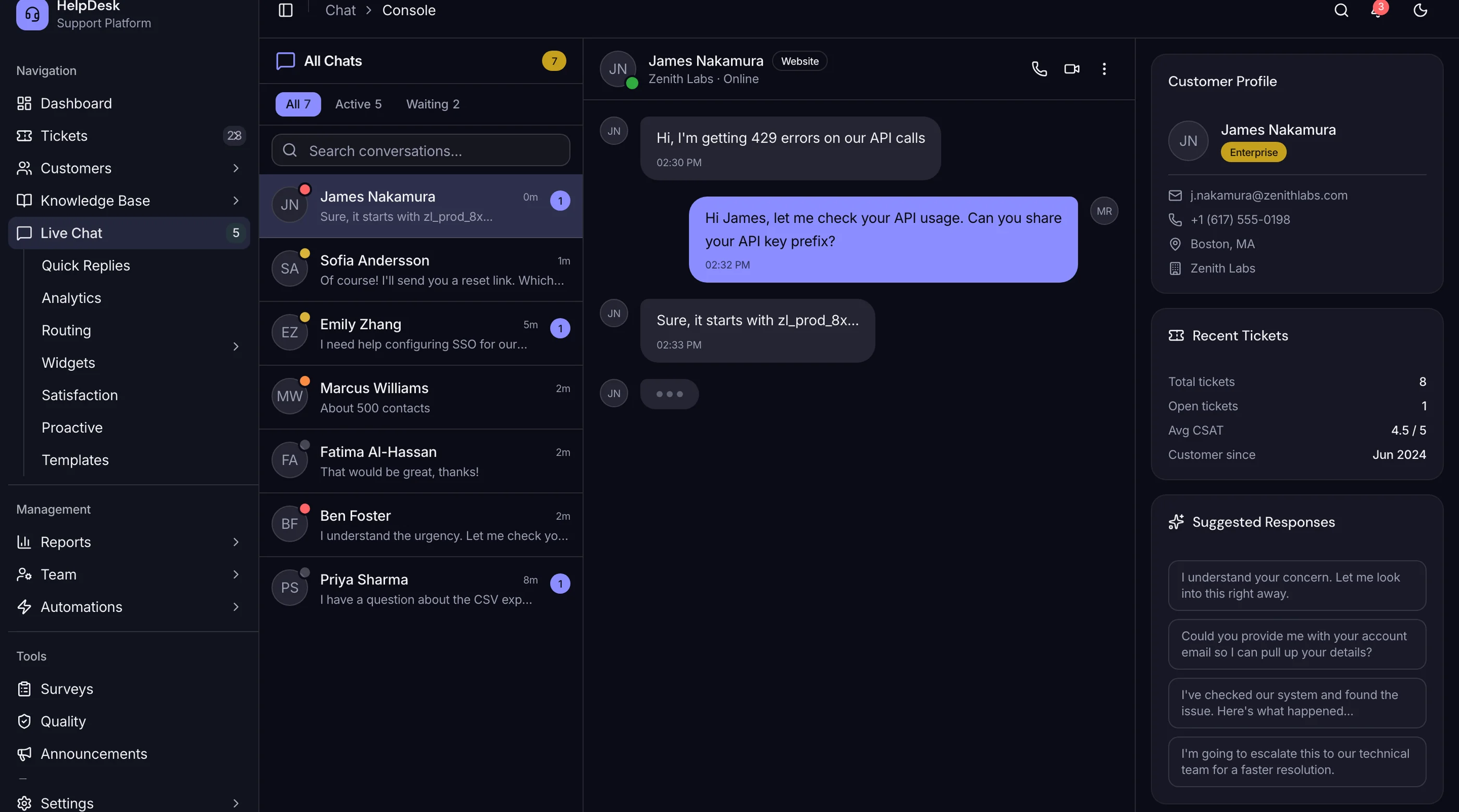
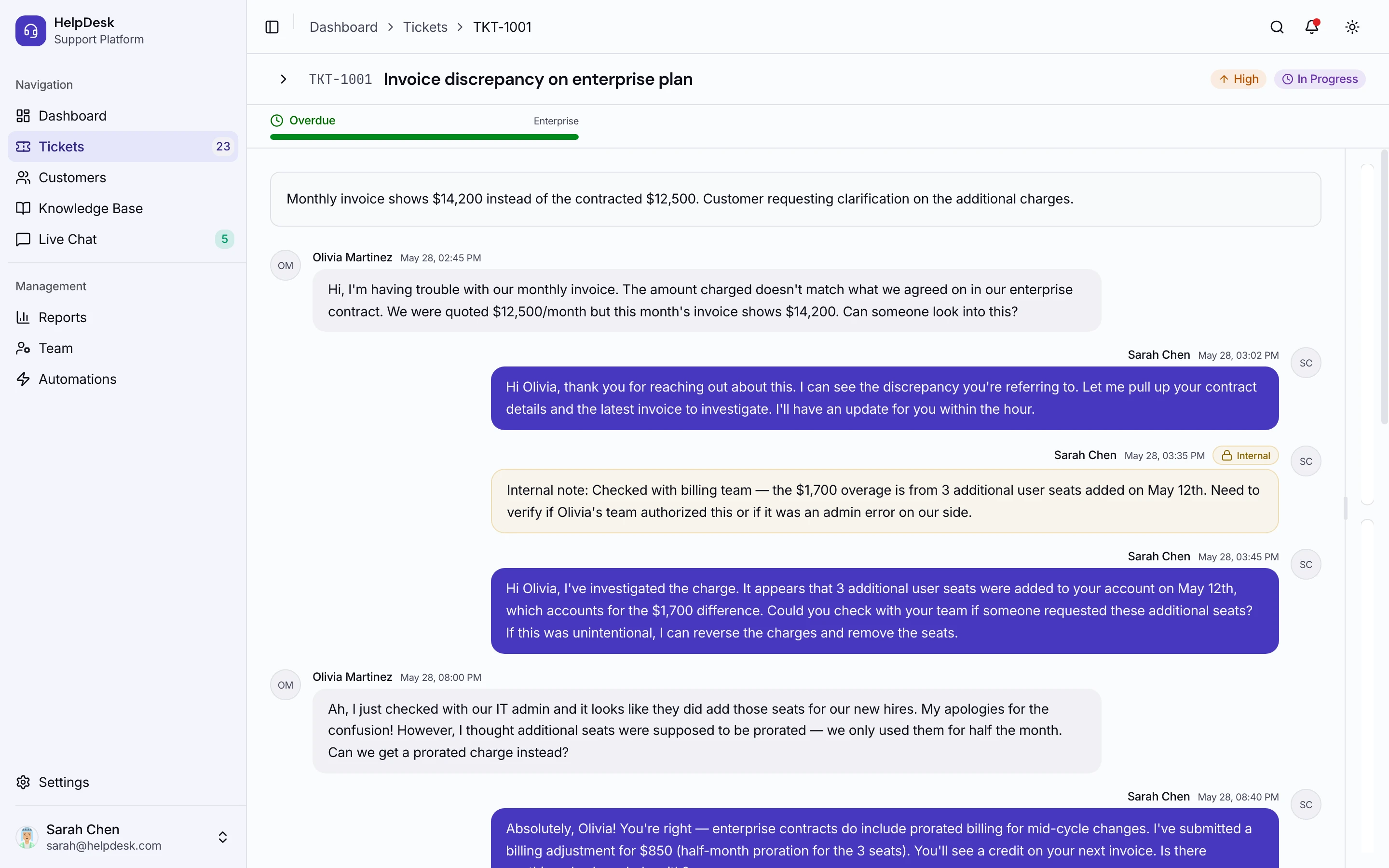
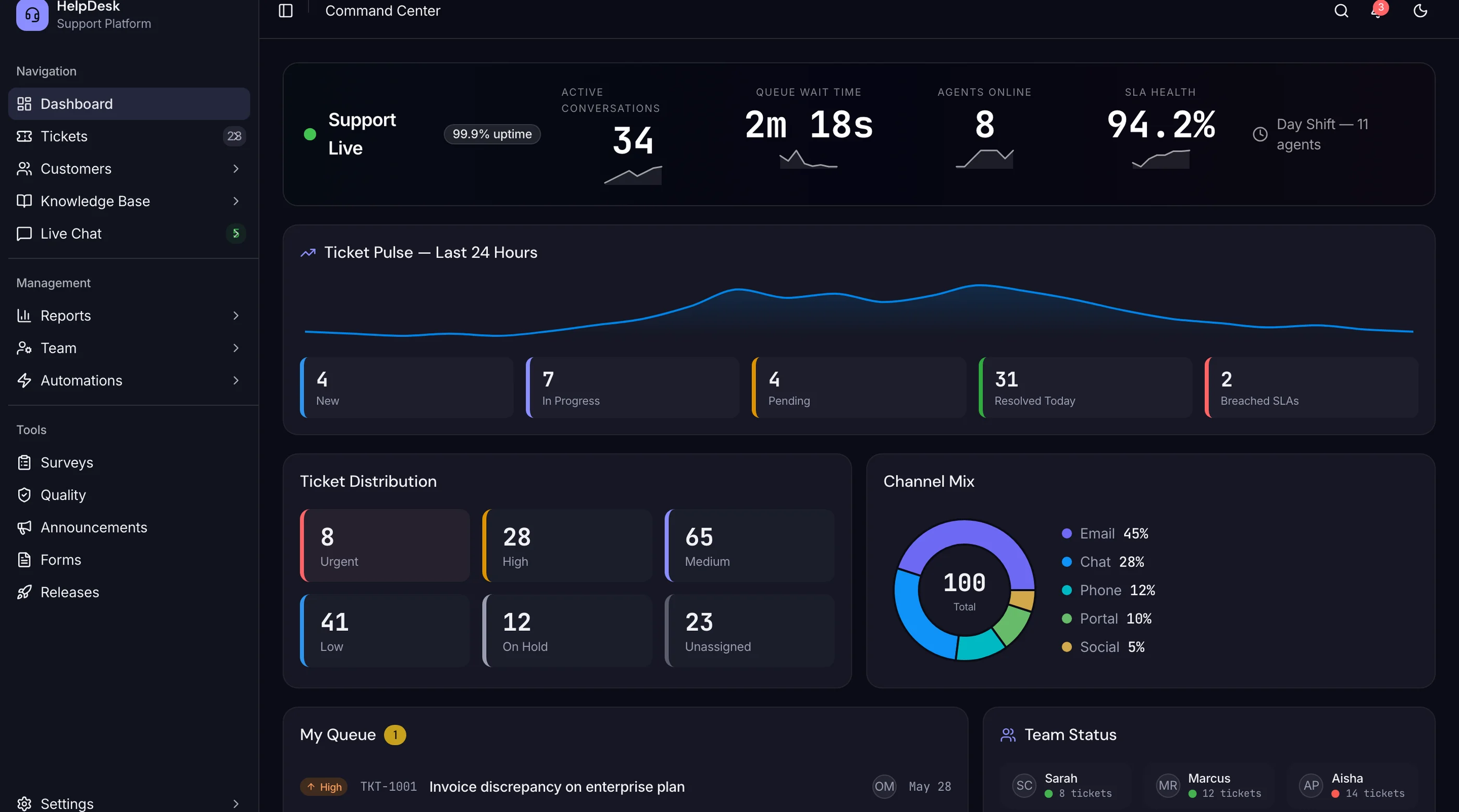
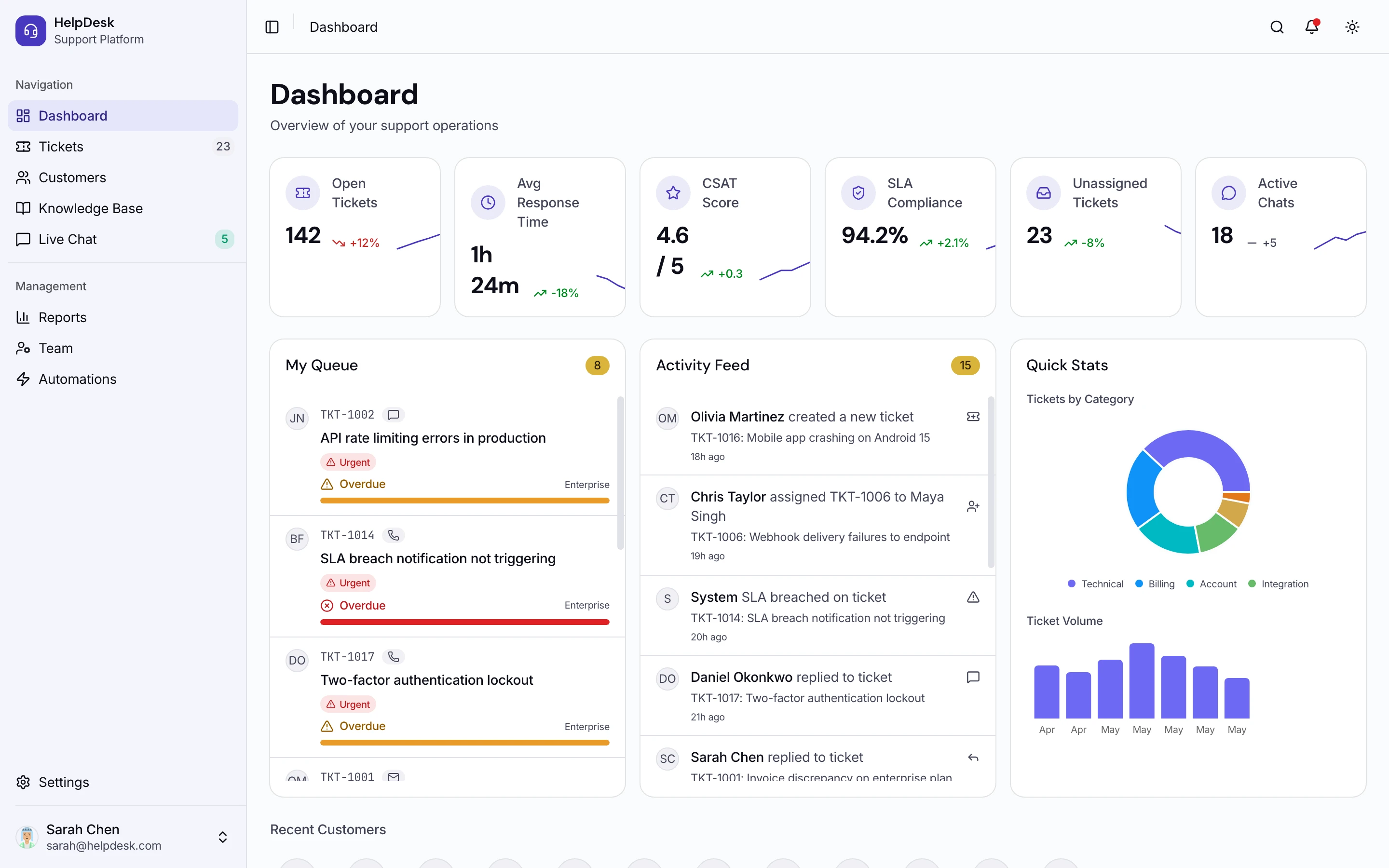
The Help Desk Kit is a Next.js help desk front end you own outright: 110 screens with inbox and SLA tracking, ticket detail with internal notes separated from customer replies, a knowledge base editor, automations written as TypeScript rather than clicked together in an admin UI, and reporting. Next.js + Tailwind + shadcn/ui. $131 solo, $199 team, $349 agency.
Get the Help Desk Kit → or get every kit (18 total) for $749 via All UI Kits →
TL;DR: Which One
| Your situation | Pick | Stack |
|---|---|---|
| Classic support queue, want the safe default | osTicket | PHP + MySQL |
| Tickets plus hardware and licence tracking | GLPI | PHP + MySQL |
| Closest thing to Zendesk, feature-complete | Zammad | Ruby on Rails |
| Lightweight shared inbox, cheap hosting | FreeScout | PHP + MySQL |
| Chat and social matter more than tickets | Chatwoot | Ruby on Rails |
| Symfony shop, unlimited agents free (but see the repo dates) | UVdesk | PHP (Symfony) + MySQL |
| Support desk inside your own product | Help Desk Kit | Next.js |
Which of These Are Actually Alive
For software you are going to host yourself, the repository tells you more than any review site will. G2 barely covers this category: Zammad has 10 reviews there and FreeScout has none at all, because people who self-host a free tool do not go and write vendor reviews. Pulled from the GitHub API on 23 September 2026:
| Project | Stars | Open issues | Last push | Licence |
|---|---|---|---|---|
| Chatwoot | 37,070 | 1,459 | 22 Sep 2026 | MIT Expat, except enterprise/ |
| UVdesk | 19,606 | 80 | 1 Oct 2025 | OSL-3.0 |
| GLPI | 6,376 | 457 | 22 Sep 2026 | GPL-3.0 |
| Zammad | 5,941 | 453 | 22 Sep 2026 | AGPL-3.0 |
| FreeScout | 4,549 | 27 | 22 Sep 2026 | AGPL-3.0 |
| osTicket | 3,918 | 1,195 | 17 Jun 2026 | GPL-2.0 |
| Peppermint | 3,162 | 99 | 21 Sep 2025 | Archived |
Read the last-push column first. Four of these shipped code the day before this was written. osTicket's June date is not neglect, it is the release cadence of a mature project, and it lines up with the 1.17.8 and 1.18.4 releases it cut that day.
The two dates in bold are the ones to act on. Peppermint has not been touched in a year and is formally archived. UVdesk is the surprise: its repository has not been pushed to since October 2025, which is a long silence for a project still marketing itself as actively developed. Star count does not save you here, and UVdesk has plenty of stars.
Licences are worth a glance too, since the vendor sites mostly do not name one. osTicket is GPL-2.0, GLPI is GPL-3.0, Zammad and FreeScout are AGPL-3.0, and UVdesk is OSL-3.0. Chatwoot is the odd one: MIT Expat everywhere except its enterprise/ directory, which carries a separate commercial licence, making it open core rather than plain open source. If you plan to modify and redistribute, that distinction is the one that matters.
What "Open Source Ticketing System" Actually Costs
The licence is the cheap part. Every option below is free to download. The real budget is three lines most comparisons never print:
- Hosting. A small team's ticketing box realistically runs $20 to $60 a month. Rails applications like Zammad and Chatwoot want more memory than a PHP app and more moving parts (Postgres, Redis, a background worker).
- Upgrades. Someone has to apply them. Both osTicket and GLPI ship security-relevant releases.
- Email deliverability. This is the one that surprises people. Inbound parsing, SPF and DKIM, and staying out of spam folders is ongoing work, not a setup task.
For a 10-agent team, self-hosting still beats $55 per agent per month comfortably. For a 2-agent team, it often does not. We wrote about why these deployments stall in Why Self-Hosted Help Desks Stall After Six Months.
1. osTicket
The default answer, and for good reason. osTicket has been running support queues since before most of its competitors existed, and it is still shipping: versions 1.17.8 and 1.18.4 were both released on 17 June 2026.
Strengths:
- Genuinely mature ticket routing from email, web forms and API
- Runs on ordinary LAMP hosting, no Docker required
- Custom fields, forms and queues without touching code
- Free with no agent limit and no branding requirement
Weaknesses:
- The interface looks its age, and no amount of theming fixes that
- Its own download page contradicts itself on supported PHP versions, so check against your host before committing
- The site itself only says "open source" without naming a licence, though the repository is GPL-2.0
- The hosted version, SupportSystem, publishes no price on the main site
Best for: Teams who want the option least likely to be abandoned, and who care more about reliability than interface polish.
2. GLPI
GLPI is not really a help desk. It is an IT service management suite that includes one, which is exactly right if your tickets are about laptops, licences and servers rather than customers.
Strengths:
- Asset inventory and CMDB in the same system as the tickets
- Service catalogue, SLAs and request forms out of the box
- Actively developed by Teclib', currently version 11.0.9
- Free to download and self-host
Weaknesses:
- Much heavier than a pure ticketing tool, and it feels it
- Commercial support is not cheap: GLPI Network self-hosted starts at €100 a month excluding VAT, and their cloud is €19 per user per month
- Installation requirements are not on the download page, they live in separate docs
- Overkill if you never need asset tracking
Best for: Internal IT and MSP teams where tickets and hardware inventory are the same conversation.
3. Zammad
The closest open source equivalent to Zendesk, and the one to choose when feature coverage matters more than hosting simplicity.
Strengths:
- SLA tracking, knowledge base and customer portal all included
- Multi-channel: email, chat, Telegram, SMS, social
- Clean, modern interface by open source help desk standards
Weaknesses:
- Ruby on Rails, so a real DevOps lift if your team is JavaScript-only
- Wants more server than a PHP app for the same ticket volume
- Mobile experience is the weakest part
Best for: Teams leaving Zendesk who want to lose as few features as possible. Our open source Zendesk alternatives guide goes deeper on that specific migration.
4. FreeScout
A Help Scout clone in PHP, and the lightest serious option here. If your support is one shared inbox and you want it on a $5 host, this is the answer.
Strengths:
- Runs on cheap shared hosting, installs like any PHP app
- Email-first inbox with a genuinely clean interface
- Free core with no agent limit
Weaknesses:
- Several things you would consider essential are paid modules at around $50 one-time each, including SLA and automation
- Email only, no real omnichannel story
- Smaller community than osTicket or Zammad
Best for: Solo founders and small teams who want a clean shared inbox and nothing more.
5. Chatwoot
Closer to Intercom than to osTicket. Pick it when conversations arrive over chat and social rather than email.
Strengths:
- One inbox across live chat, email, WhatsApp, Instagram and Facebook
- API-first and pleasant to extend
- Self-host free, or use their cloud from $19 per agent
Weaknesses:
- Knowledge base is basic next to Zammad
- SLA tracking exists but is less mature
- Self-hosting needs Postgres, Redis and Sidekiq, which is the heaviest setup on this list
Best for: Chat-driven support, especially consumer and e-commerce.
6. UVdesk
The one most people have not heard of. A Symfony-based help desk from Webkul, with the most generous free tier terms on this list.
Strengths:
- Free self-hosted with unlimited agents, stated plainly on their pricing page
- Standard LAMP or LEMP hosting, installs via Composer
- Knowledge base, email-to-ticket and workflow automation included
- Cloud option from $8 per agent per month billed annually if you change your mind about hosting
Weaknesses:
- Like osTicket and GLPI, the site never names a licence, though the repository is OSL-3.0
- The one real concern here. No version or release date appears on the product pages, and the community-skeleton repository was last pushed on 1 October 2025, nearly a year before this was written. Everything else on this list shipped code within the last three months
- Smaller ecosystem and fewer integrations than the bigger names
Best for: PHP and Symfony teams who want unlimited agents without a licence conversation, and who are comfortable with a project that has not shipped code in a year. If that gives you pause, osTicket does a similar job on a similar stack and is still moving.
7. Build It Into Your Product
Worth considering when the support desk should not live on a separate subdomain. Inbound email through Postmark or SES, tickets in Postgres, an agent dashboard in Next.js. Our How to Build a Help Desk in Next.js guide covers the data model and the email parsing, which is the part that eats the schedule.
What you get: the inbox inside your product, full control of routing and SLA logic, a customer portal that matches your brand, and no per-agent fee ever.
What it costs: four to six weeks for a credible first version, then ongoing work on deliverability and the edge cases nobody predicts.
Skip the Build: Help Desk Kit
The Help Desk Kit is the front end already built. 110 screens, Next.js + Tailwind + shadcn/ui. Inbox with SLA tracking, ticket detail with internal notes visually separated from customer replies, live chat, knowledge base editor, automations as TypeScript files, and reporting designed to hold up as volume grows.
It is a frontend kit. You bring the email infrastructure and the database. $131 solo, $199 team, $349 agency. Or every kit (18 total) for $749 via All UI Kits.
Get the Help Desk Kit → or See All UI Kits →
Picking Between the Three Serious Ones
| osTicket | GLPI | Zammad | |
|---|---|---|---|
| Best at | Support queues | IT assets plus tickets | Zendesk-style coverage |
| Stack | PHP + MySQL | PHP + MySQL | Ruby on Rails |
| Hosting effort | Low | Moderate | Moderate to high |
| Asset management | No | Yes | No |
| Customer portal | Yes | Yes | Yes |
| Current version | 1.18.4 (June 2026) | 11.0.9 | Actively developed |
| Paid tier | SupportSystem, price not published | From €100/mo self-hosted | Hosted plans available |
Frequently Asked Questions
What is the best open source ticketing system?
osTicket for most teams. It handles classic support queues, runs on ordinary PHP hosting, has no agent limit, and is still shipping releases after more than a decade. Choose GLPI instead if you need asset and licence tracking in the same system, or Zammad if you are replacing Zendesk and want to lose as few features as possible.
Is there a completely free ticketing system?
Yes. osTicket, Zammad, FreeScout, Chatwoot and UVdesk are all free to download and self-host with no licence fee. Your costs are hosting, roughly $20 to $60 a month for a small team, and the time to run upgrades and keep email deliverable. "Free" here means no licence cost, not no cost.
Is osTicket still maintained?
Yes. Two release lines are current, and both 1.17.8 and 1.18.4 were released on 17 June 2026. It is one of the safer bets on this list precisely because it has survived this long.
Should I use Peppermint?
Not for a new deployment. The repository was archived by its owner on 17 July 2026 and is read-only, the last commit to main was 21 September 2025, and the newest tag is from November 2024. It still appears in 2026 roundups and videos that have not been updated.
Is Hesk open source?
No. Hesk is free to download and actively maintained, but its own site never names an open source licence, and the free version carries "Powered by Hesk" branding that you remove by buying a licence at $49.99 for one installation. It is free software in the price sense, not the licence sense.
What is the difference between a help desk and an IT ticketing system?
A help desk answers customers; an IT service desk answers employees. The workflows diverge quickly: IT needs asset links, change management and internal approval chains, which is why GLPI includes a CMDB and osTicket does not. If your tickets are mostly "my laptop won't boot", look at GLPI first.
Can I self-host a ticketing system without a DevOps team?
With osTicket, FreeScout or UVdesk, yes. They are standard PHP applications that install on ordinary hosting. Zammad and Chatwoot are Rails applications with background workers and Redis, so plan on Docker and somebody comfortable running it. If nobody wants that job, a hosted tier is cheaper than it looks once you count the hours.