Robinhood Alternatives: 8 Trading Platforms for 2026
Robinhood Alternatives: 8 Options Compared for 2026
Short answer: for most people leaving Robinhood, Fidelity and Charles Schwab are the two that come up, because they match the zero-commission pricing and add real research, retirement accounts, and customer service. Interactive Brokers is the pick if you want serious tooling or international markets. Webull is the closest feel-alike. And if you're a developer who wants the data and the interface rather than a different broker, the answer isn't a brokerage at all.
Robinhood made commission-free trading normal, and the rest of the industry followed. That's the awkward part of its position in 2026: the thing that made it different is now table stakes everywhere.
People move for three reasons that keep recurring. The research and analysis tools are thin next to the incumbents. Account coverage is narrower, particularly around retirement and specialised account types. And the payment-for-order-flow model, plus the 2021 trading restrictions, left a trust question that some users never got past.
Eight alternatives worth comparing, from full-service brokers to developer-facing platforms to building the dashboard layer yourself.
This is a comparison of platforms and their features, not investment advice. Nothing here is a recommendation to buy, sell, or hold anything, and account terms change constantly. Check current fees and disclosures with the broker before opening an account.
Or skip the build entirely: get the Trading Dashboard Kit
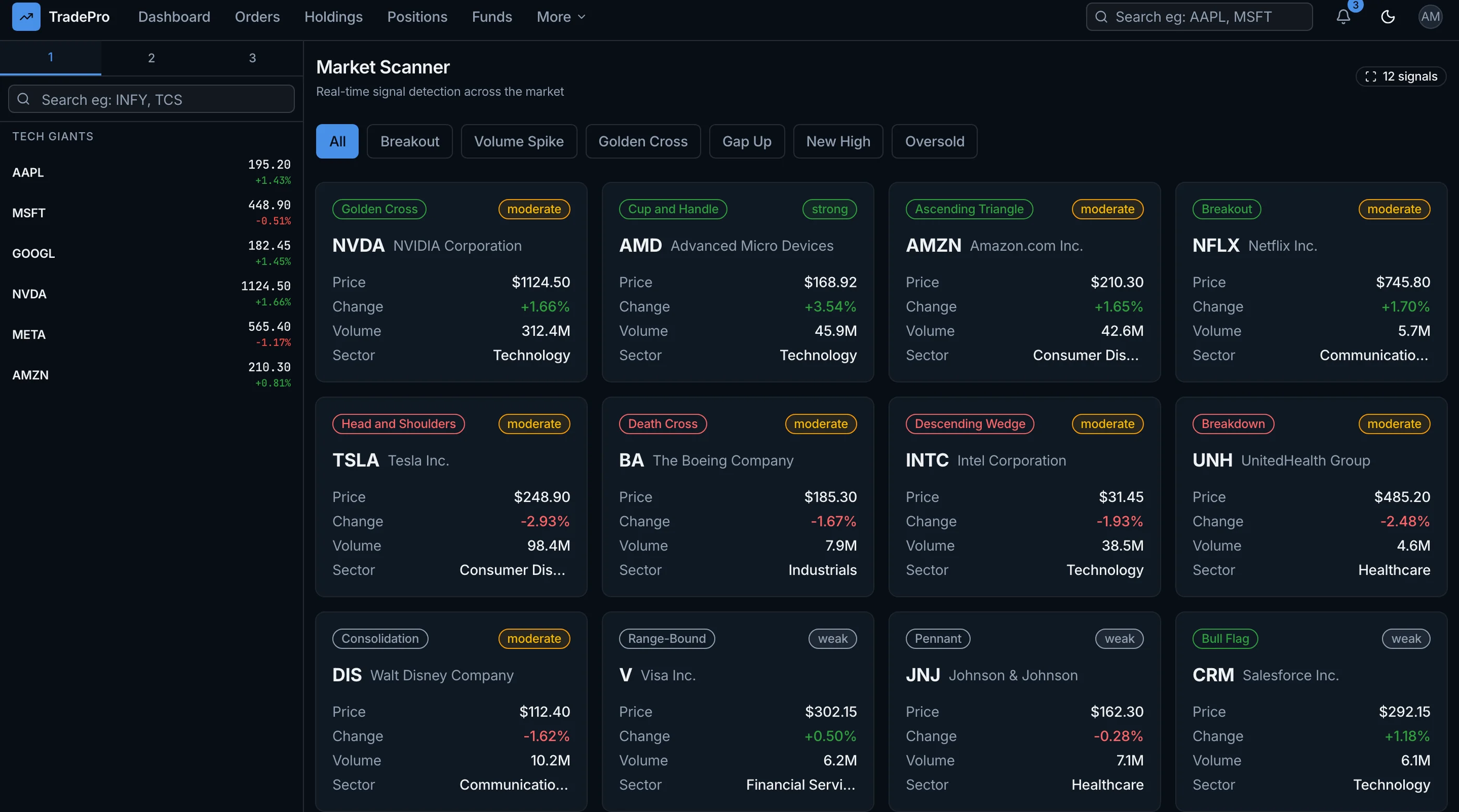
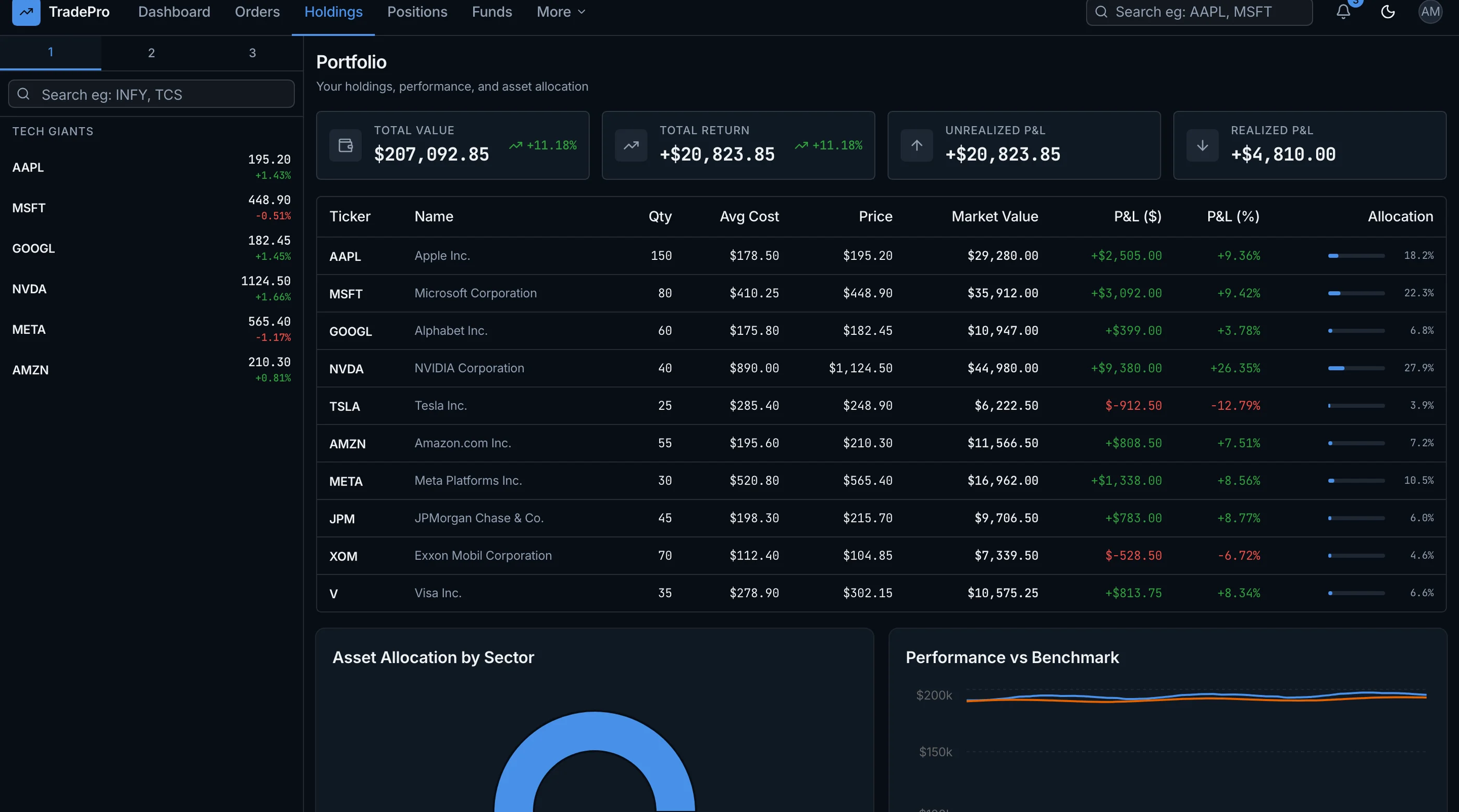
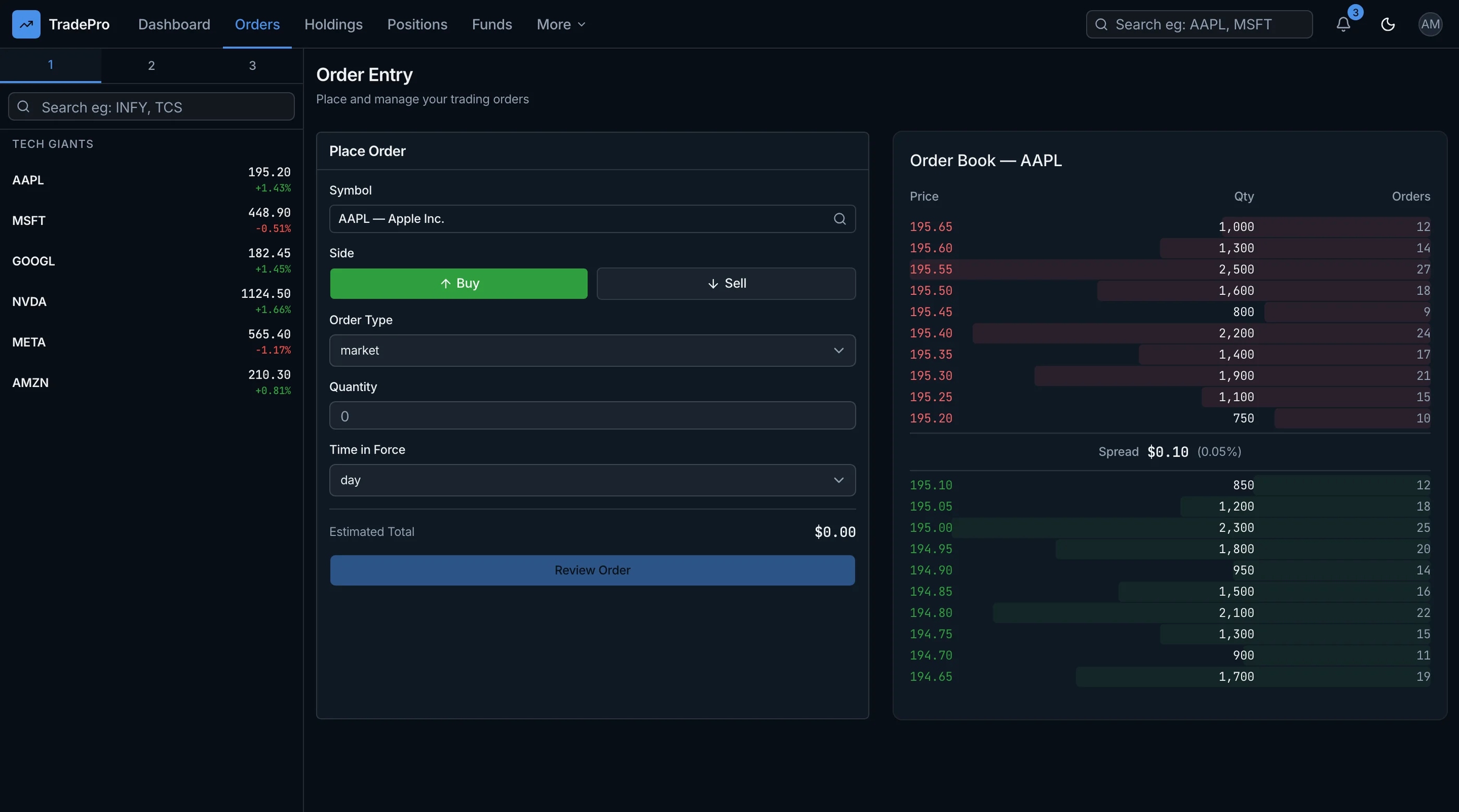
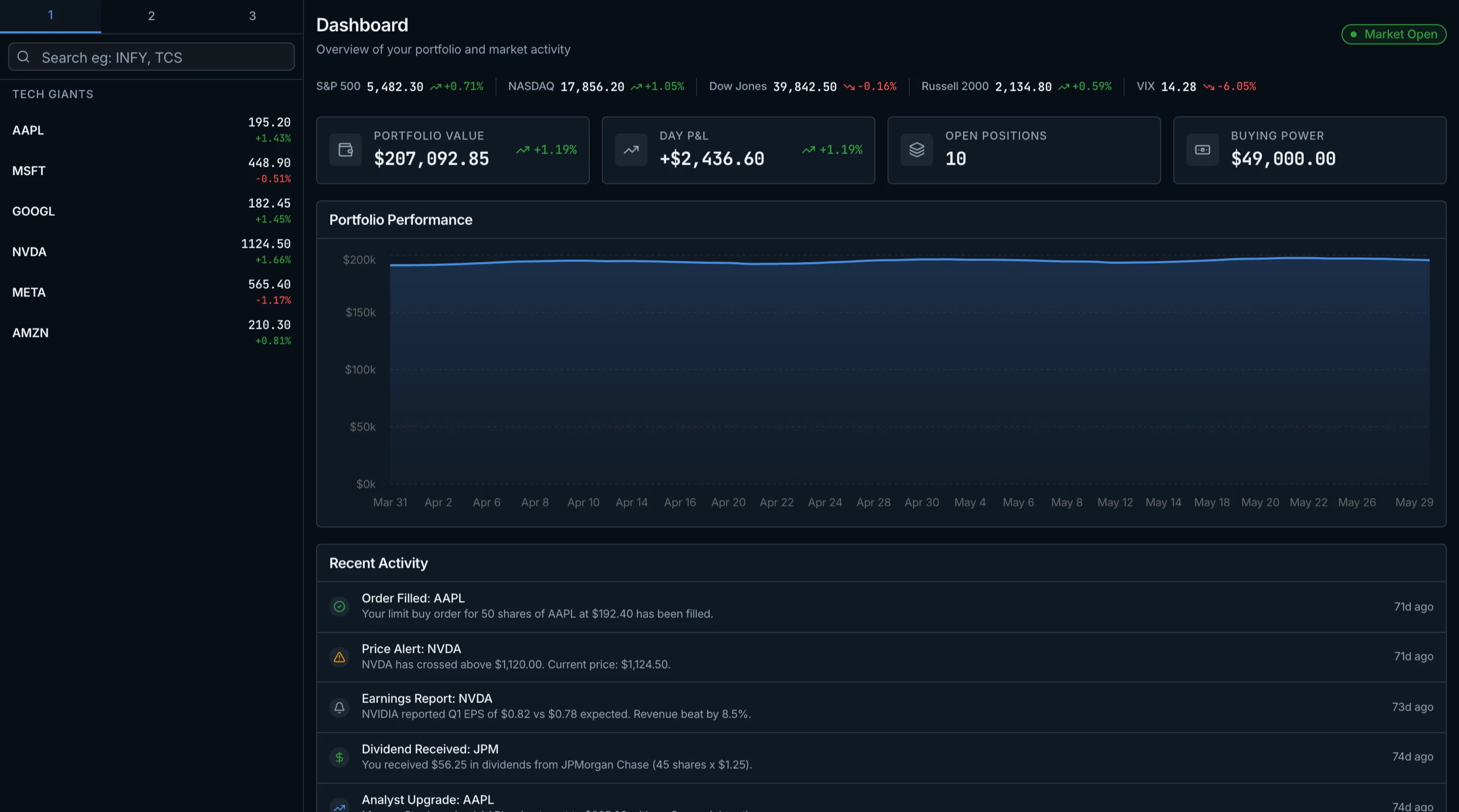
The Trading Dashboard Kit is shipped: 70 screens in a Kite-inspired layout covering order entry with order book depth, portfolio holdings with P&L, an always-visible watchlist panel, a market screener, research pages, social trading, risk analytics, and backtesting. Next.js + Tailwind + shadcn/ui, WCAG AA. $131 solo, $199 team, $349 agency. Try the live demo.
Get the Trading Dashboard Kit → or get every kit (18 total) for $749 via All UI Kits →
TL;DR: Quick Picks for 2026
| Need | Top pick | Notes |
|---|---|---|
| All-round replacement, strong research | Fidelity | $0 stock commissions, full account range |
| All-round replacement, best support | Charles Schwab | $0 stock commissions, thinkorswim included |
| Serious tools, global markets, low margin | Interactive Brokers | Tiered and fixed pricing, deep API |
| Closest feel to Robinhood | Webull | $0 commissions, better charting |
| Fractional investing on autopilot | M1 Finance | Portfolio "pies", automated rebalancing |
| Transparency-first, no PFOF | Public | Tipping model instead of order flow |
| Developer access to market data | Alpaca | API-first brokerage, paper trading |
| Building the interface yourself | thefrontkit Trading Dashboard Kit | $131+ one-time |
What Robinhood Actually Does Well
Worth saying clearly, because the criticism gets loud. Robinhood's mobile experience is still the cleanest in retail brokerage, and the onboarding is the fastest. Fractional shares, a genuinely simple options flow, and a crypto offering under the same login remove friction that older brokers still impose. For someone making their first trade, the app removes almost every reason to hesitate.
The case for alternatives isn't that Robinhood is broken. It's that once you want research, retirement accounts, or programmatic access, you outgrow it.
When to Leave Robinhood
Three signals:
- You want retirement or specialised accounts. Coverage is narrower than the incumbents, and consolidating at one broker is simpler.
- You're making decisions on research you don't have. The screeners, analyst data, and fundamentals are thin compared to Fidelity or Schwab.
- You want programmatic access. Robinhood has no supported public API for retail algorithmic trading. If you want to build, you need a broker that treats that as a feature.
1. Fidelity
The default all-round replacement, and the one most people end up at.
Strengths:
- $0 commissions on US stocks and ETFs
- Deep research, screeners, and analyst reports included
- Full range of account types including retirement
- Strong order execution quality and no payment for order flow on equities
Weaknesses:
- Interface is dense and dated next to Robinhood
- Mobile app is capable but not delightful
- Crypto support is limited compared to a Robinhood or a Webull
- Can feel like enterprise software for a first-time investor
Best for: People consolidating everything at one broker who want research and retirement accounts alongside trading.
2. Charles Schwab
The other default, and the one with the best desktop tooling included.
Strengths:
- $0 commissions on US stocks and ETFs
- thinkorswim comes with the account, which is genuinely professional-grade charting
- Excellent customer service and physical branches
- Full account range after absorbing TD Ameritrade
Weaknesses:
- thinkorswim has a real learning curve
- The main web interface is heavier than it needs to be
- Crypto access is indirect
- Overkill if you place a handful of trades a year
Best for: Active traders who want serious charting without paying for a separate platform. We cover the charting side in TradingView Alternatives.
3. Interactive Brokers
The professional's broker, and the one developers actually use.
Strengths:
- Access to a very wide range of global markets
- Among the lowest margin rates in the industry
- A mature, well-documented API with paper trading
- Tiered pricing that gets cheap at volume
Weaknesses:
- The interface is famously unfriendly to beginners
- Pricing structure takes effort to understand
- Account minimums and inactivity considerations on some plans
- Support is functional rather than warm
Best for: Serious traders, anyone trading non-US markets, and developers who want programmatic access to a real account.
4. Webull
The closest thing to Robinhood with more under the hood.
Strengths:
- Similar mobile-first feel and zero commissions
- Noticeably better charting and technical indicators
- Extended-hours trading and paper trading built in
- Free real-time data on more instruments than Robinhood
Weaknesses:
- Research and fundamentals are still shallow
- Account type coverage is narrower than the incumbents
- Support is thinner than Fidelity or Schwab
- Same payment-for-order-flow model people leave Robinhood over
Best for: People who like Robinhood's shape but want better charts and paper trading.
5. M1 Finance
Automated portfolio investing rather than active trading.
Strengths:
- Portfolio "pies" with automatic rebalancing
- Fractional shares across a whole allocation
- Good for recurring, hands-off investing
- Combines investing, borrowing, and spending
Weaknesses:
- Trading happens in windows rather than instantly, by design
- Not built for active or intraday trading
- Limited research tooling
- Options and advanced instruments are not the focus
Best for: People whose real goal is a consistent allocation rather than individual trades.
6. Public
Built around transparency, for people who left Robinhood over trust.
Strengths:
- Does not use payment for order flow on equities, using an optional tipping model instead
- Social layer where members explain their reasoning
- Clean, modern mobile experience
- Fractional shares and a range of asset types
Weaknesses:
- Smaller platform with fewer advanced tools
- Research depth is limited
- The social feed is not for everyone
- Fewer account types than the incumbents
Best for: People for whom the order-flow model was the specific reason to leave.
7. Alpaca
An API-first brokerage aimed at developers rather than at end users.
Strengths:
- Built API-first, with commission-free equities trading
- Free paper-trading environment for building against
- Market data products alongside the brokerage
- Designed for exactly the algorithmic use case Robinhood does not support
Weaknesses:
- There is barely a consumer interface, which is the point
- You are building, not clicking
- Market data at depth costs extra
- Not appropriate if you want an app to open on your phone
Best for: Developers building automated strategies or their own trading front end.
8. Build the Interface with the Trading Dashboard Kit
The option that matters if you're a builder rather than a switcher.
Every broker on this list gives you their interface. If you're building a fintech product, a portfolio tool for clients, or a front end over a brokerage API like Interactive Brokers' or Alpaca's, the interface is the part you have to make yourself, and it is a lot of work. Order entry alone is a surprising amount of state.
The Trading Dashboard Kit ships 70 screens in a Kite-inspired layout: a compact top navbar with an always-visible watchlist panel, order entry with order types and real order book depth visualisation, a positions tracker, trade history, an options chain, and a holdings table with cost basis and P&L in both dollars and percent. Research covers stock detail pages, fundamentals, technical indicators, and a filterable screener. Analytics adds a risk dashboard with Value at Risk, max drawdown, Sharpe ratio and beta, plus backtesting and P&L analysis. There's a social trading leaderboard with copy trading too.
The boundary matters more here than in any other category. This is the interface only. There is no market data feed, no WebSocket infrastructure, no brokerage API integration, no order execution engine, and no regulatory compliance logic. If you are handling real money, the UI is genuinely the easy part, and this is the easy part done well.
- Screens: 39
- Trading: Order entry with order book depth, positions, options chain
- Portfolio: Holdings with cost basis, P&L, allocation bars
- Research: Stock detail, fundamentals, technicals, filterable screener
- Risk: VaR, max drawdown, Sharpe, beta, concentration analysis
- Not included: Market data feed, WebSocket infra, brokerage API, compliance
- Price: $131 solo / $199 team / $349 agency
See the Trading Dashboard Kit →
Recommendation by Profile
| You | Pick |
|---|---|
| Want one broker for everything including retirement | Fidelity |
| Want professional charting included free | Charles Schwab |
| Trade non-US markets or want low margin rates | Interactive Brokers |
| Like Robinhood but want better charts | Webull |
| Want a hands-off allocation, not trades | M1 Finance |
| Left specifically over payment for order flow | Public |
| Building an automated strategy | Alpaca or Interactive Brokers |
| Building a trading product for other people | Build with the Trading Dashboard Kit |
| Only place a few trades a year and like the app | Staying is fine |
Frequently Asked Questions
What is the best alternative to Robinhood?
Fidelity or Charles Schwab for most people, since both match the zero-commission pricing and add research, retirement accounts, and real customer service. Webull is the closest in feel if you like Robinhood's interface. Interactive Brokers is the answer for global markets, low margin rates, or programmatic access.
Is there a Robinhood alternative with no payment for order flow?
Public built its model explicitly around not using payment for order flow on equities, taking optional tips instead. Fidelity also does not accept payment for order flow on equity orders. Practices differ by asset class and change over time, so check the broker's current disclosures rather than relying on a comparison article.
Which Robinhood alternative is best for beginners?
Webull if you want the same simplicity with better charts. Fidelity if you would rather start somewhere you will not outgrow, accepting a denser interface in exchange. M1 Finance if your actual goal is a steady allocation rather than picking individual stocks.
Does Robinhood have an API for algorithmic trading?
Not a supported public one for retail algorithmic trading. That is the usual reason developers move to Alpaca, which is API-first with a free paper-trading environment, or to Interactive Brokers, which has a mature and well-documented API attached to a full-service account.
Can I build my own trading dashboard instead of switching brokers?
Yes, and for developers it is often the better answer. You keep the broker for execution and build the interface over its API, which means your own views, your own risk metrics, and no dependence on a vendor's roadmap. The build path above with the Trading Dashboard Kit covers the interface; you still supply the data feed and the brokerage integration.
How hard is it to move a brokerage account?
Mechanically it is straightforward, since ACATS transfers move positions between US brokers without selling them, usually within a week or two. The things to check first are transfer-out fees at your current broker, whether every holding is supported at the destination, and the tax treatment of anything that cannot transfer in kind and would have to be sold.
The Honest Take
Robinhood solved a real problem and then the industry copied the solution, which leaves it competing on interface rather than on price. For a lot of people the interface is enough, and staying is a perfectly reasonable answer.
The alternatives win at specific edges: research and account breadth (Fidelity), tooling and support (Schwab), global markets and APIs (Interactive Brokers), familiar feel with better charts (Webull), automated allocation (M1), order-flow transparency (Public), or developer access (Alpaca).
If you're reading this as a builder rather than as an investor, the useful split is that brokers compete on execution and accounts, while the interface is increasingly where products differentiate. That part you can own. For the failure modes that hit trading dashboards in practice, see Why Crypto Dashboards Break in Real Markets.
Want it shipped without hiring a developer?
The build path above assumes you have engineers. If you don't, the team behind thefrontkit does done-for-you launches: we deploy the kit, apply your branding, and wire it to your stack. Fixed quotes, most builds ship in 2-4 weeks, from $1999.