Zoho CRM Alternatives: 10 Easier CRMs for 2026
Zoho CRM Alternatives: 10 Options Compared for 2026
Short answer: if Zoho CRM feels clunky, Pipedrive is the easiest switch for a pure sales team ($14-$69/seat/month billed annually), and HubSpot is the pick if you want marketing and sales in one place. Less Annoying CRM ($15/user/month, one plan, everything included) is the simplest option for small businesses. Attio suits teams whose process never fit Zoho's modules. Twenty is the open-source pick if you'd rather self-host. If price is your only complaint, stay put. Zoho is still one of the cheapest full-featured CRMs around.
Here's the Zoho math, in USD from its own pricing page. Free covers up to 3 users. Standard is $14/user/month billed annually ($20 monthly), Professional is $23 ($35), Enterprise is $40 ($50), and Ultimate is $52 ($65). Ten reps on Professional cost $2,760 a year on annual billing. Move to Enterprise for territory management or the fuller Zia AI and that's $4,800. Cheap next to Salesforce or HubSpot Professional.
So price usually isn't why people leave. The complaints we hear are about everything around it: a busy interface reps avoid, setup that takes weeks, support that depends on your plan and region, and features you need locked one edition higher than the one you pay for. Ten alternatives, from simpler to more powerful to fully owned.
We've covered this market from other angles too: the Pipedrive alternatives guide, the HubSpot alternatives guide, and the Salesforce alternatives guide.
Want a CRM interface your reps will actually open? Build it on your own data
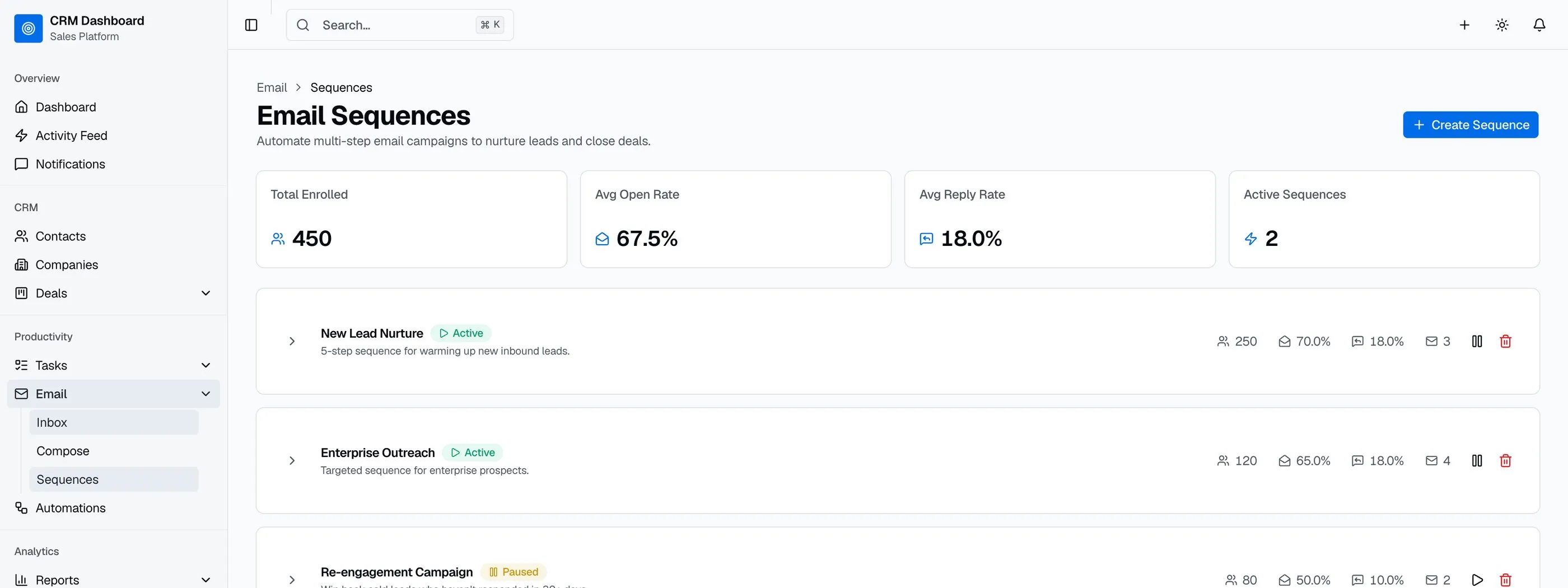
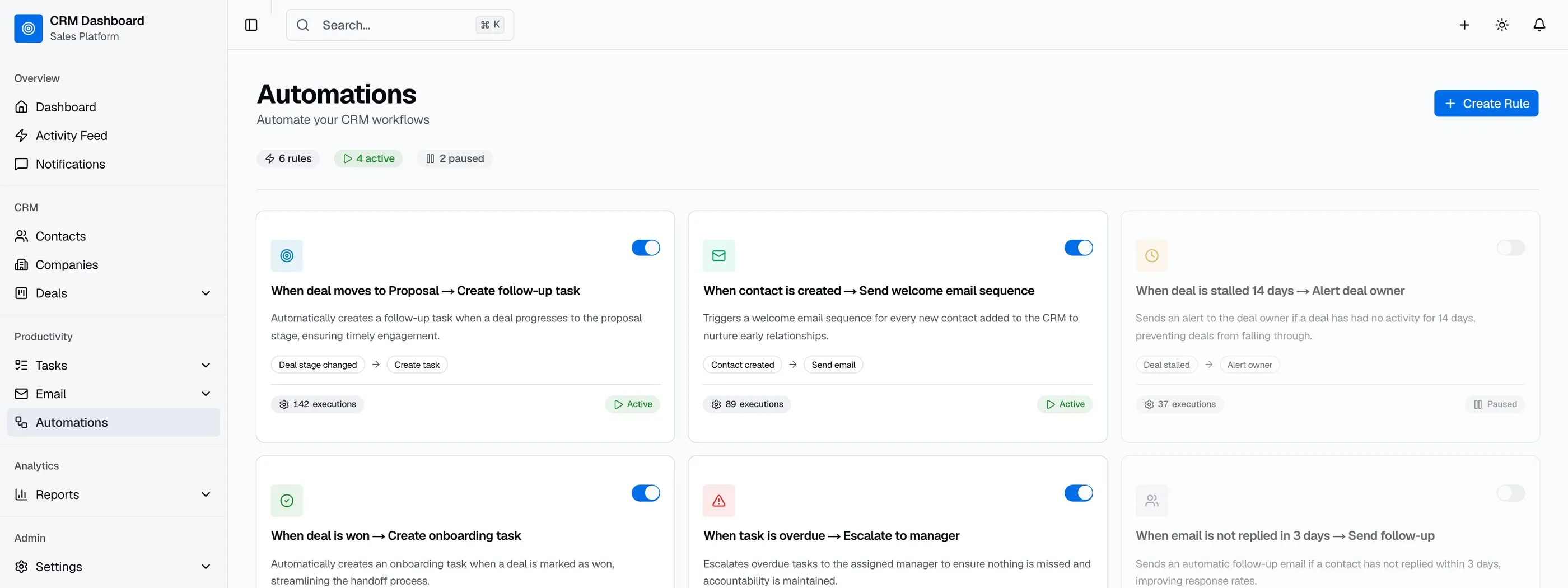
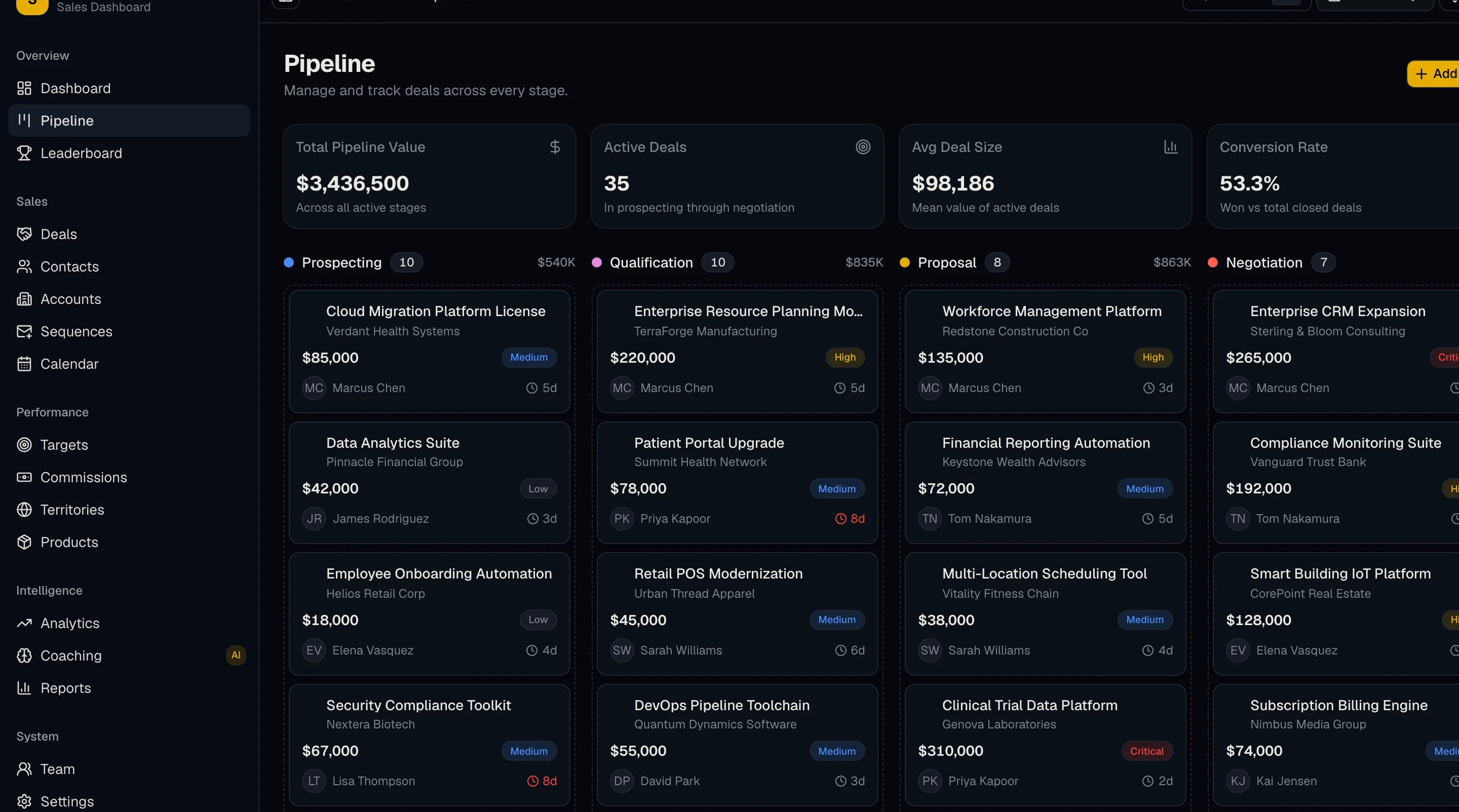
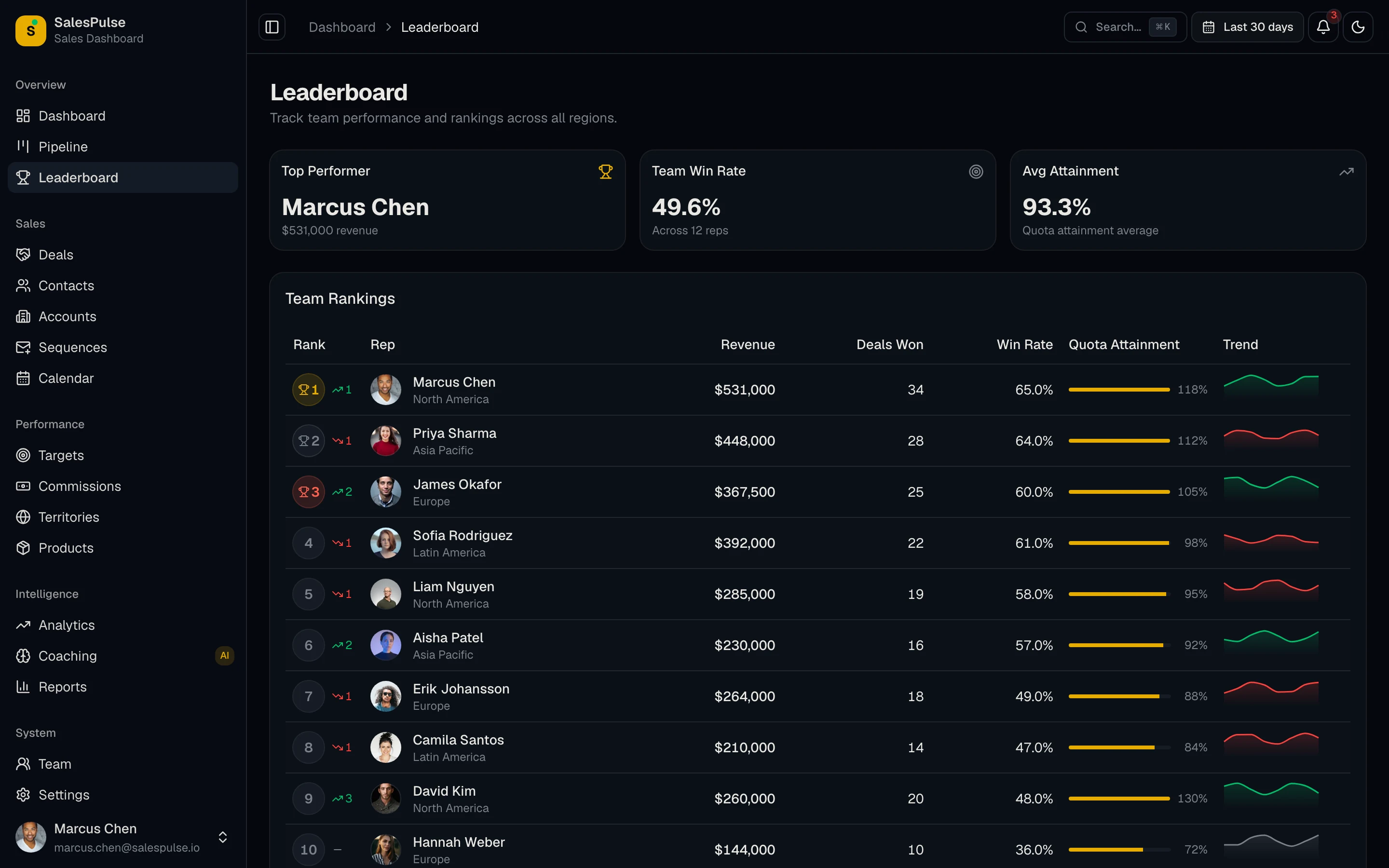
The CRM Dashboard Kit gives you 42 screens of CRM frontend: Kanban pipeline, contacts, companies, deals, tasks, reports, email with a Tiptap composer, and settings. Next.js + Tailwind + shadcn/ui. It's a frontend you wire to your own database or CRM API. $165 solo. Try the live demo.
Get the CRM Dashboard Kit → or get every kit (18 total) for $749 via All UI Kits →
TL;DR: Quick Picks for 2026
| Need | Top pick | Price |
|---|---|---|
| Sales and marketing in one platform | HubSpot | Free (2 users), Starter $20/seat/mo list |
| Cleanest pipeline, fastest onboarding | Pipedrive | $14+/seat/mo |
| Zoho-level features, simpler UI | Freshsales | $9+/user/mo |
| Enterprise headroom later | Salesforce Starter | $25/user/mo |
| Visual boards, non-sales teams too | monday CRM | $12+/seat/mo (3-seat min) |
| Calling-heavy outbound teams | Close | $35+/user/mo, dialer from $99 |
| Lives inside Google Workspace | Copper | $23+/seat/mo |
| Flexible data model, modern UI | Attio | Free (3 users), $35+/user/mo |
| Simplest small-business CRM | Less Annoying CRM | $15/user/mo, one plan |
| Open source, self-hosted | Twenty | Free (self-host), cloud $9+/user/mo |
| CRM screens inside your own product | CRM Dashboard Kit | $165+ one-time |
Prices are billed annually unless noted.
What Zoho CRM Actually Does Well
Be fair to it. Zoho packs workflows, lead scoring, forecasting, territory management, and Zia AI into tiers that cost what competitors charge for their entry plans. The Free edition is real, usable software for up to 3 users, with no time limit. And the wider suite (Books, Desk, Campaigns, Bigin) means one vendor can cover finance, support, and marketing for a fraction of what HubSpot charges for the same spread.
For a cost-conscious team with someone willing to own the configuration, Zoho is hard to beat. The alternatives win on ease, support, and focus.
When to Leave Zoho CRM
Three signals:
- Reps work around it. If deals live in a spreadsheet and Zoho gets updated on Friday afternoon, the cheap license is buying you a stale database.
- The feature you need is always one edition up. Standard to Enterprise nearly triples the per-seat price ($14 to $40). At that point Pipedrive Premium ($49) or Freshsales Pro ($39) deserve a look.
- Nobody owns the setup anymore. The admin who built your layouts and blueprints left, and now every change is archaeology. A simpler tool beats a powerful one nobody can maintain.
1. HubSpot
The move when marketing matters as much as sales.
Strengths:
- Free CRM for up to 2 users, and it's genuinely usable
- Sales, marketing, and service hubs share one database
- Reps adopt the UI without training sessions
- Huge integration marketplace
Weaknesses:
- Professional jumps to $90/seat/month plus a one-time $1,500 onboarding fee
- Marketing Hub bills on stored contacts
- Costs more than Zoho at every comparable tier
Pricing: Free for 2 users. Starter lists at $20/seat/month (the page currently shows a $7 promo on annual billing), Professional $90/seat/month billed annually, Enterprise $150 plus a $3,500 onboarding fee.
Best for: Teams that picked Zoho for its suite and want the same breadth with less friction. The upgrade path is covered in our HubSpot alternatives guide.
2. Pipedrive
The easiest switch for a sales-only team.
Strengths:
- The cleanest deal pipeline in the category; reps learn it in a day
- Email sync, automations, and forecasts from Growth up
- 500+ integrations, and a mobile app people use
- Same $14 entry price as Zoho Standard
Weaknesses:
- No free plan (14-day trial)
- No marketing side without paid add-ons
- Top tiers cost more than Zoho's
Pricing: Lite $14, Growth $24, Premium $49, Ultimate $69 per seat/month billed annually.
Best for: Sales teams that only used Zoho's deals module and want that one screen to be excellent.
3. Freshsales
The closest like-for-like swap, with a friendlier interface.
Strengths:
- Phone, email, and chat built into the product
- Freddy AI scoring and insights
- Cheaper than Zoho at the entry tier
- Freshdesk pairs with it if support runs on Freshworks
Weaknesses:
- Reporting trails Zoho Enterprise
- Smaller marketplace
- Enterprise-grade controls (territories, advanced permissions) are thinner
Pricing: Growth $9, Pro $39, Enterprise $59 per user/month billed annually. 21-day trial.
Best for: Small and mid-size teams that want Zoho's feature shape in a tool reps don't fight.
4. Salesforce Starter
The pick if you expect to outgrow everything else.
Strengths:
- Starter Suite bundles sales, service, and email marketing basics
- Monthly or annual billing at the same price
- The upgrade path goes as far as any company will ever need
- AppExchange for everything else
Weaknesses:
- The next step, Pro Suite, is $100/user/month
- Real customization needs an admin or a consultant
- More setup overhead than Zoho, not less
Pricing: Starter Suite $25/user/month, Pro Suite $100/user/month billed annually.
Best for: Funded teams planning to scale past 50 reps. The trade-offs are in our Salesforce alternatives guide.
5. monday CRM
The visual option, and the one other departments already know.
Strengths:
- Board-based UI that feels like monday work management
- Easy to customize without an admin
- Good fit when ops, onboarding, and sales share one workspace
- Cheapest board-style CRM on this list
Weaknesses:
- 3-seat minimum on every plan
- Sales-specific depth (forecasting, sequences) sits in higher tiers
- Can sprawl into a project tool with a CRM bolted on
Pricing: Basic $12, Standard $17, Pro $28 per seat/month billed annually ($18, $25, $41 monthly). Minimum 3 seats.
Best for: Small teams where sales and delivery work out of the same boards.
6. Close
Built for teams that live on the phone.
Strengths:
- Calling, SMS, and email on every plan
- Power dialer and workflows from Growth up
- Activity reporting built around calls and reach rates
- Fast to set up for outbound teams
Weaknesses:
- The dialer plans cost several times Zoho's Professional tier
- Wrong shape for inbound or marketing-led teams
- Workflows aren't included on Essentials
Pricing: Solo $9, Essentials $35, Growth $99, Scale $139 per user/month billed annually.
Best for: SDR teams making 50+ calls per rep per day.
7. Copper
The CRM that sits inside Gmail.
Strengths:
- Deep Google Workspace integration; works from the Gmail sidebar
- Pulls contacts and activity from email automatically
- Clean pipeline views, light setup
- Less manual data entry than Zoho
Weaknesses:
- Poor fit for Outlook shops
- Contact caps: 2,500 on Basic, 15,000 on Professional
- Business tier is $99/seat
Pricing: Basic $23, Professional $59, Business $99 per seat/month billed annually.
Best for: Relationship-driven teams (agencies, consultancies) that run on Google Workspace.
8. Attio
The modern CRM for processes Zoho's modules never fit.
Strengths:
- Fully flexible objects: model partnerships, investors, or marketplaces natively
- The best UI on this list, real-time and collaborative
- Automatic enrichment and contact syncing, even on Free
- API-first, popular with product-led startups
Weaknesses:
- Plus caps at 10 seats
- Pro jumps to $79/user/month
- Classic sales management (quotas, territories) is still maturing
Pricing: Free for up to 3 users. Plus $35, Pro $79 per user/month billed annually.
Best for: Startups whose sales motion is anything other than leads, accounts, and deals.
9. Less Annoying CRM
The anti-Zoho. One plan, no configuration project.
Strengths:
- One price, every feature, no tiers or contracts
- Setup takes an afternoon
- Support is known for being friendly and quick
- 30-day free trial, no credit card
Weaknesses:
- No advanced automation or AI
- Reporting is basic
- Not built for sales teams over roughly 20 people
Pricing: $15/user/month, everything included.
Best for: Small businesses (real estate, insurance, local services) that want contacts, a pipeline, and follow-up reminders, and nothing else.
10. Twenty
The open-source CRM for teams that want to own it.
Strengths:
- Free to self-host, no per-seat fees
- Modern stack (React, GraphQL, Postgres), UI closer to Linear than to legacy CRM
- Custom objects, workflows, and AI agents
- Cloud option if you don't want to run servers
Weaknesses:
- Younger feature set than Zoho
- Far fewer integrations
- Self-hosting means you own backups, upgrades, and uptime
Pricing: Self-hosted free. Cloud Pro $9/user/month, Organization $19/user/month.
Best for: Developer-led teams that want CRM data on their own infrastructure.
11. Build Your Own CRM Frontend with the CRM Dashboard Kit
Some teams leave Zoho because they need the CRM inside their own product: a customer-facing pipeline in a SaaS app, a partner deal portal, or a vertical CRM for one industry. No hosted CRM rents you that.
What this looks like:
- Your backend owns the data (or Zoho's API stays the system of record)
- The CRM Dashboard Kit supplies 42 screens of frontend: Kanban pipeline, contacts, companies, deals with forecasting, tasks, reports, email with a Tiptap composer, and settings
- Next.js + Tailwind + shadcn/ui, rebranded through design tokens
- You write the API layer; the kit ships no backend
$165 solo, one-time. Try the live demo. For other frontend options, see Best CRM Dashboard Templates.
Recommendation by Profile
| You | Pick |
|---|---|
| Want marketing and sales on one platform | HubSpot |
| Pure sales team, want reps to adopt it | Pipedrive |
| Like Zoho's features, hate its UI | Freshsales |
| Planning to scale into enterprise | Salesforce Starter |
| Sales and delivery share one workspace | monday CRM |
| Outbound calling team | Close |
| Run on Google Workspace | Copper |
| Non-standard sales motion | Attio |
| Small business, want simple | Less Annoying CRM |
| Want to self-host | Twenty |
| CRM inside your own product | CRM Dashboard Kit |
Pricing at a Glance (5 Users, Annual)
| Product | Tier | Per user/mo | ~Annual (5 users) |
|---|---|---|---|
| Zoho CRM | Professional | $23 | $1,380 |
| Zoho CRM | Enterprise | $40 | $2,400 |
| HubSpot Sales Hub | Starter (list) | $20 | $1,200 |
| HubSpot Sales Hub | Professional | $90 | $5,400 + $1,500 onboarding |
| Pipedrive | Growth | $24 | $1,440 |
| Pipedrive | Premium | $49 | $2,940 |
| Freshsales | Pro | $39 | $2,340 |
| Salesforce | Starter Suite | $25 | $1,500 |
| monday CRM | Standard | $17 | $1,020 |
| Close | Essentials | $35 | $2,100 |
| Copper | Professional | $59 | $3,540 |
| Attio | Plus | $35 | $2,100 |
| Less Annoying CRM | Single plan | $15 | $900 |
| Twenty | Self-hosted | Free | Hosting only |
| CRM Dashboard Kit | Solo | One-time | $165 once, plus your backend |
List prices from each vendor's pricing page in September 2026. Zoho stays among the cheapest at comparable feature depth. Only monday CRM, Less Annoying CRM, and Twenty undercut it here, and each does so by doing less.
Frequently Asked Questions
What is the best free alternative to Zoho CRM?
HubSpot's free CRM (up to 2 users) and Attio's free plan (up to 3) are the strongest hosted options. Twenty is free with no user limit if you self-host. Keep in mind Zoho's own Free edition covers 3 users, so switching only makes sense if the product fits you better.
Is Pipedrive easier than Zoho CRM?
Yes, for most sales teams. Pipedrive does one job, the deal pipeline, and reps typically learn it in a day. Zoho does far more, which is exactly why its setup takes longer. At the entry tier they cost the same ($14/seat/month billed annually).
Is Zoho CRM cheaper than HubSpot?
At almost every tier. Zoho Enterprise is $40/user/month billed annually, and HubSpot Sales Hub Professional is $90 plus a $1,500 onboarding fee. HubSpot's free plan is the exception, and it's limited to 2 users.
What's the simplest Zoho CRM alternative for a small business?
Less Annoying CRM. One $15/user/month plan with everything included, no editions, and a setup you can finish in an afternoon. If you're a team of one or two, our free CRM spreadsheet template might be enough for now.
How do I migrate off Zoho CRM?
Zoho exports every module to CSV, and HubSpot, Pipedrive, Freshsales, and Attio all ship importers. The hard parts are blueprints, workflows, and custom functions, which don't transfer anywhere. Move contacts, companies, and open deals first, keep Zoho read-only for history during a short parallel run, and rebuild only the automations you can prove you use.
The Honest Take
Zoho CRM is still the value leader, and plenty of teams should stay on it. Leave when the problem is adoption, support, or a setup nobody can maintain, since a cheaper license won't fix any of those.
Pick by what's actually broken. Pipedrive fixes adoption for sales teams, Freshsales keeps Zoho's shape with a friendlier face, HubSpot adds marketing, Less Annoying CRM removes the configuration entirely, and Attio or Twenty give you a data model you control. We set these up and connect them to accounting and support tools for clients, so if the migration or the sync is the part you're dreading, our CRM integration services cover exactly that. And if the CRM has to live inside your own product, build the frontend and keep the data where it already is.
Want it shipped without hiring a developer?
The build path above assumes you have engineers. If you don't, the team behind thefrontkit does done-for-you launches: we deploy the kit, apply your branding, and wire it to your stack. Fixed quotes, most builds ship in 2-4 weeks, from $1,999.