Salesloft Alternatives: 8 Options Compared for 2026
Salesloft Alternatives: 8 Options Compared for 2026
Short answer: Outreach is the closest like-for-like swap if you run a large team on the same kind of enterprise contract. Apollo is the best pick when you also need lead data, HubSpot Sales Hub works well if your CRM is already HubSpot, and Close is the simplest choice for a small team that wants calling and email in one CRM. lemlist, Instantly, Mixmax and Yesware cover cold outreach and inbox-based tracking at much lower cost.
Salesloft doesn't publish prices. Its pricing page sends you to a sales call, and the products it lists include Cadence, Conversation Intelligence and Deals alongside Clari Forecast. Salesloft and Clari completed their merger in December 2025, and the combined company is still integrating the products. That's one reason teams revisit the contract at renewal, along with the usual one: a quote you can only get by talking to sales is hard to compare.
Below are eight alternatives, with plan names and prices taken from each vendor's own pricing page. Where a vendor hides its prices, we say so.
For nearby comparisons, see our Close CRM alternatives and HubSpot alternatives guides.
Want sales screens inside your own product?
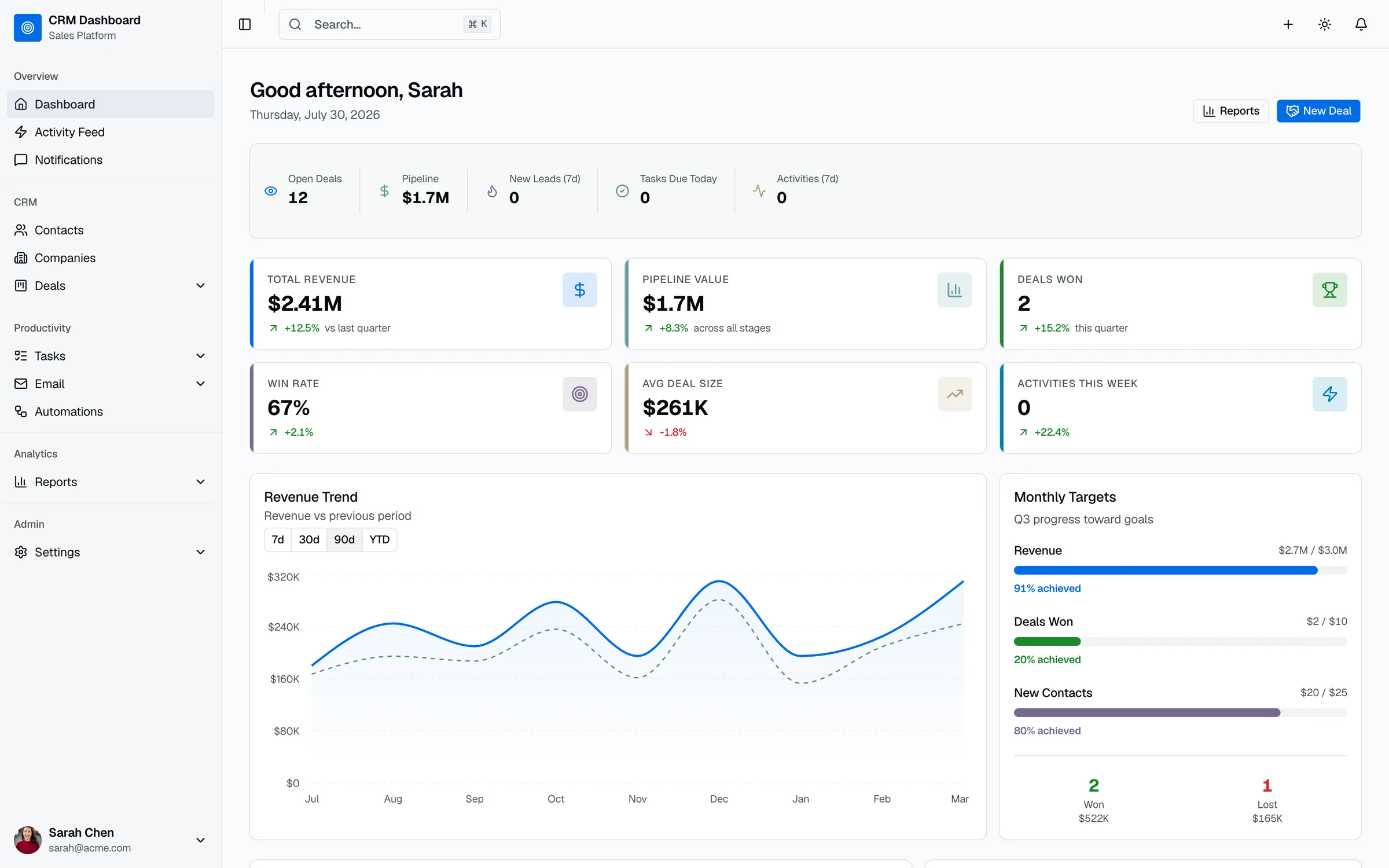
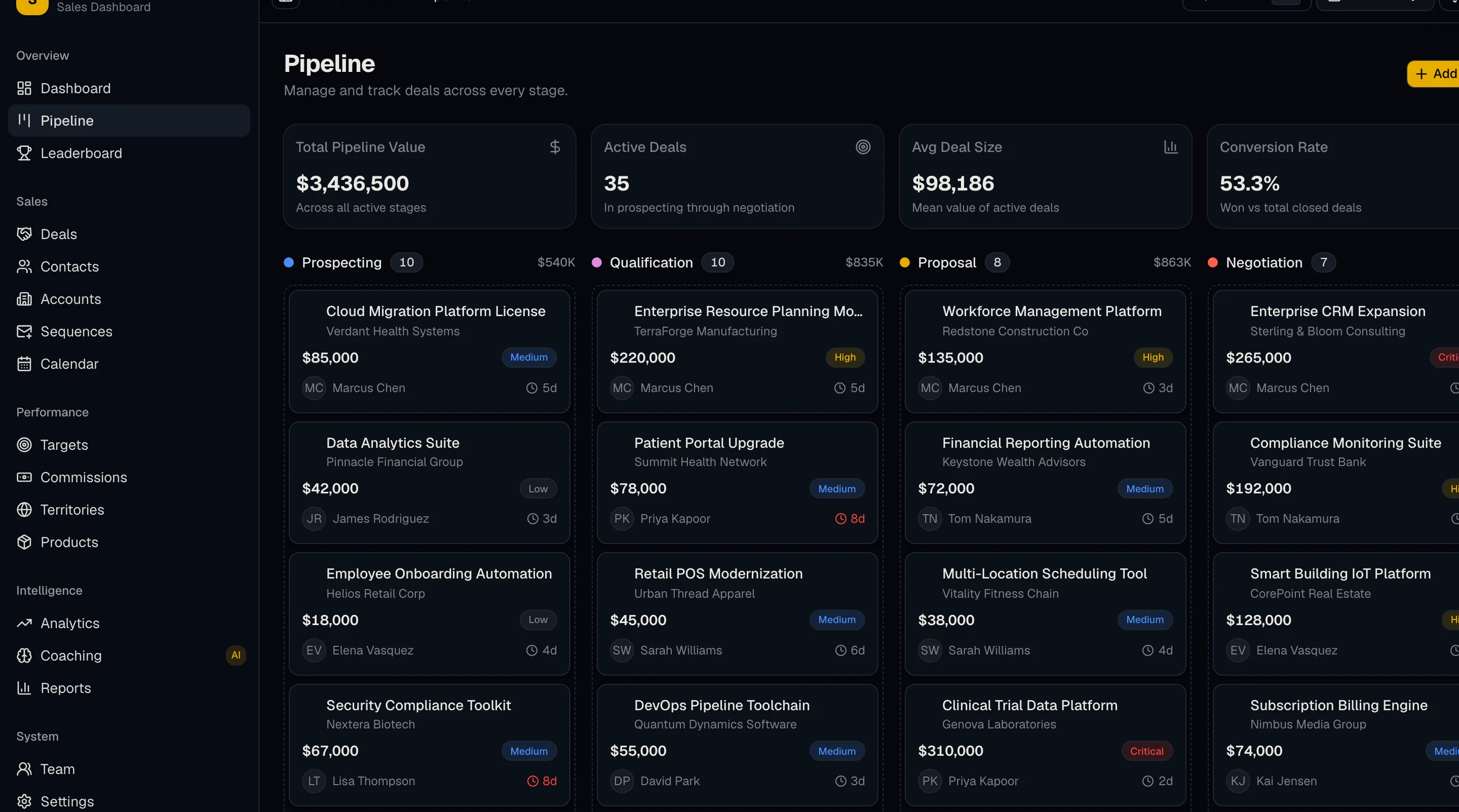
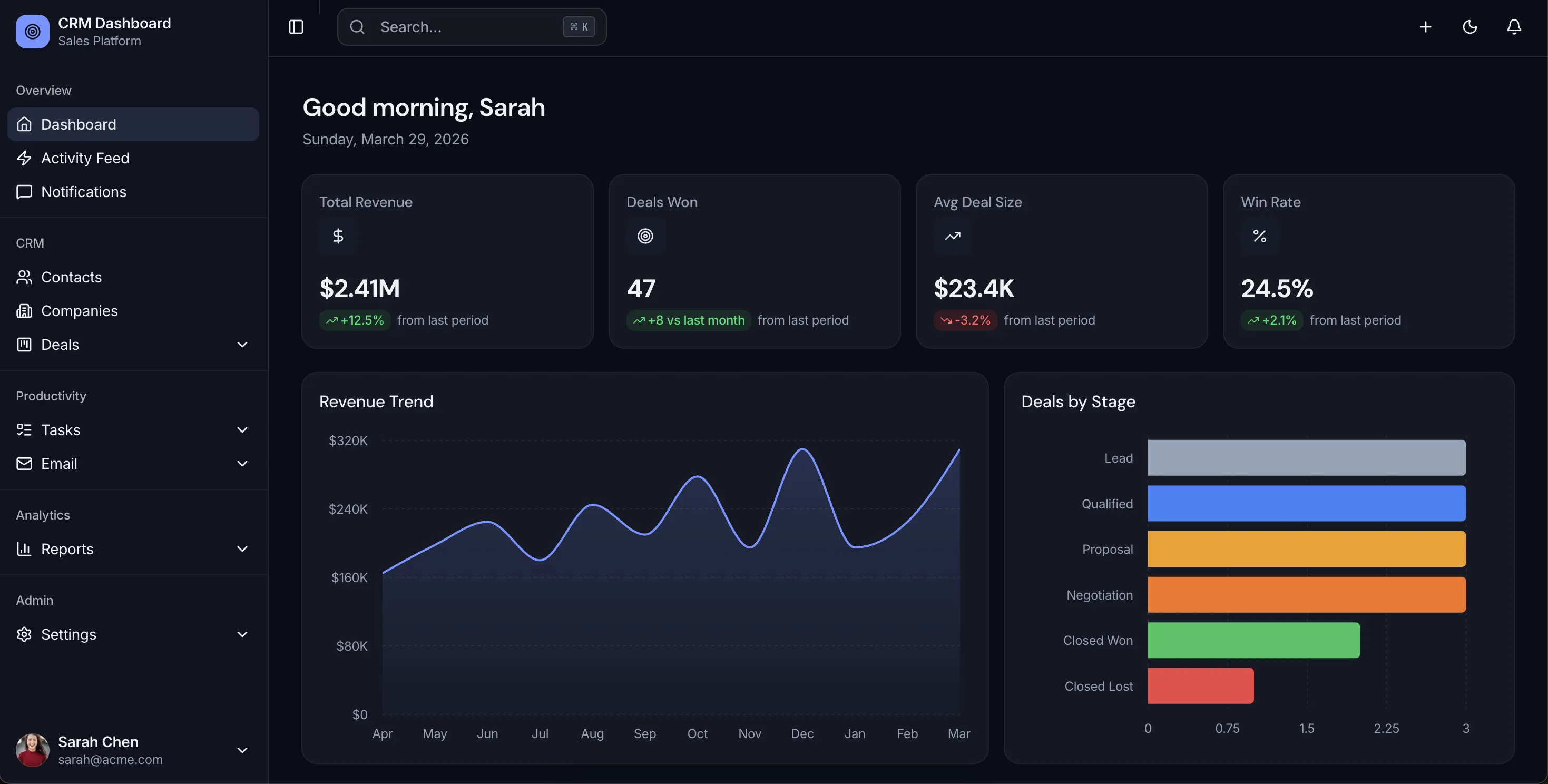
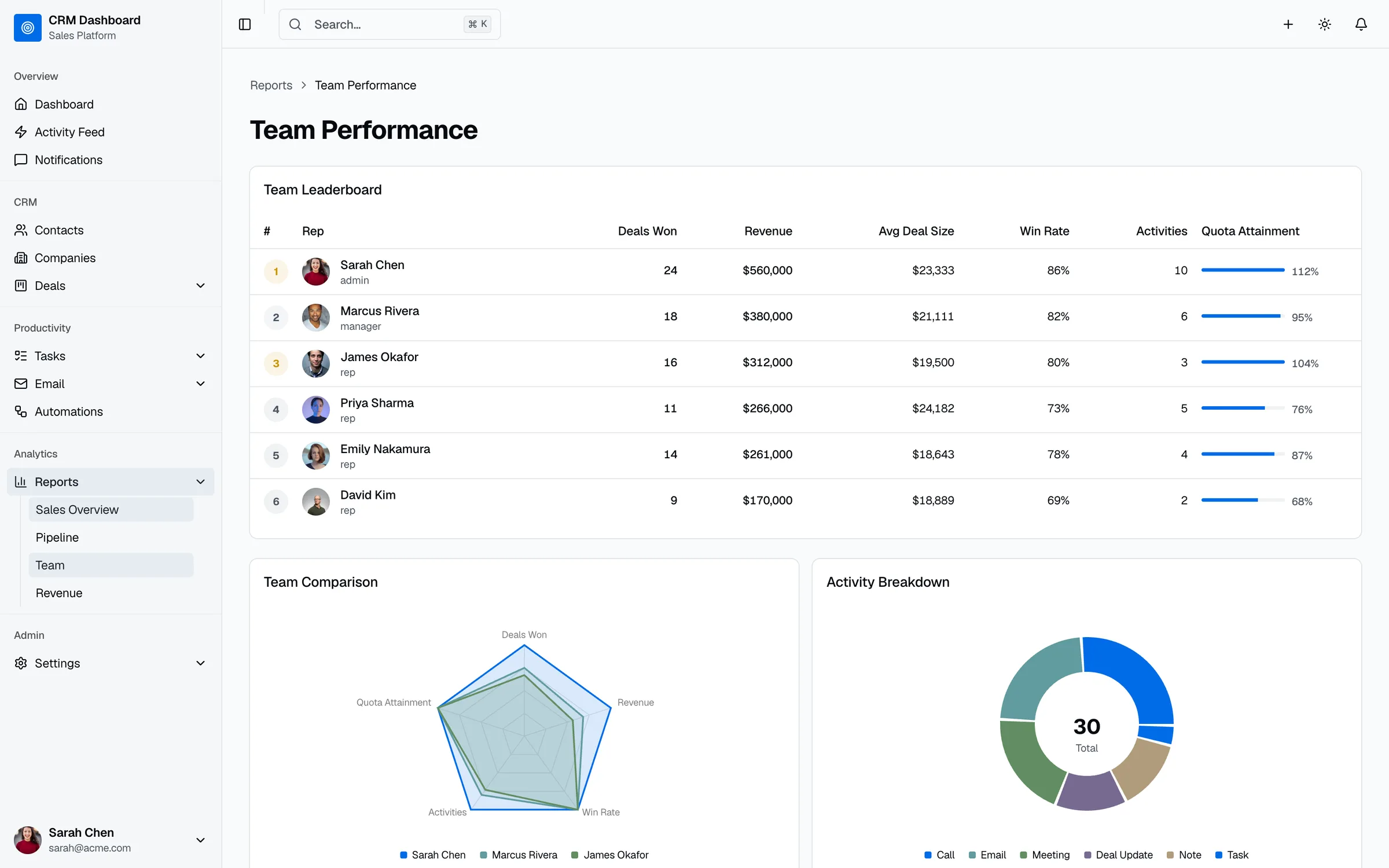
The CRM Dashboard Kit gives you 42 screens of CRM frontend: a drag-and-drop Kanban pipeline, contacts and companies with import, deal records, four analytics dashboards, team performance reports and an email inbox with sequences. Next.js 16, Tailwind CSS v4 and shadcn/ui. It's frontend only, so you bring your own backend. $165 solo. Try the live demo.
TL;DR: Quick Picks for 2026
| Need | Top pick | Price |
|---|---|---|
| Closest enterprise alternative | Outreach | Pricing on request |
| Lead data plus sequences | Apollo | See vendor site |
| Already on HubSpot | HubSpot Sales Hub | Free (2 users), Professional from $90/seat/mo |
| Email and call CRM for small teams | Close | See vendor site |
| Multichannel cold outreach | lemlist | $55/mo annual, $69 monthly |
| High-volume cold email | Instantly | See vendor site |
| Gmail-based sequences | Mixmax | Free (50 recipients/mo) |
| Cheap email tracking | Yesware | Free, Pro $15/seat/mo annual |
| Sales tools inside your own product | CRM Dashboard Kit | $165 one-time |
We checked vendor pricing pages in November 2026. Where a page shows no numbers or labels them unclearly, the table points you to it.
What Salesloft Does Well
Salesloft is a sales engagement platform. Reps work from cadences, which are scripted sequences of emails, calls and tasks, and managers get conversation intelligence and deal views on top. Since the Clari merger, forecasting sits in the same company. If you run a big sales org that wants cadences, call analysis and forecasting from one vendor, that's a coherent pitch.
It's built for teams with dedicated sales ops people who will configure it. Those teams usually get what they pay for.
When to Leave Salesloft
Four signals:
- You can't compare the price. With no public list price, every renewal starts from your last quote. Alternatives that publish plans let you budget before a call.
- You use a fraction of it. If reps only need email sequences and a dialer, a full platform with forecasting is more than the job needs.
- Your CRM already does sequences. HubSpot Sales Hub and Close both include sequences or workflows natively, so a separate tool can mean a second system to sync.
- The product direction is unclear. Mid-merger platforms change. If your contract is coming up, it's a fair time to price out the field.
1. Outreach
The closest enterprise alternative.
Outreach is the other big name in sales engagement, and it's the one most Salesloft buyers price against. Its site has moved to outreach.ai and lists its plans as Amplify Essentials, Core, Plus and Pro.
Strengths:
- Same category and buyer as Salesloft, so switching is a like-for-like evaluation
- Plans scale by AI credits, API calls and custom objects, which suits larger teams
- Four tiers let you start smaller and move up
Weaknesses:
- Every plan says to request pricing
- No free plan
- Built for sales ops teams, which is a lot for a five-person team
Pricing: Pricing on request. Amplify Essentials, Core, Plus and Pro are all quoted by sales. Page limits include 10,000 AI credits on Essentials up to 100,000 on Pro.
Best for: Large teams that want the same kind of platform and are happy to negotiate.
2. Apollo
Lead data and sequencing in one place.
Apollo says it has 240M+ contacts and 30M+ accounts, plus a parallel dialer and 200+ integrations. That makes it a good fit if you pay separately for a data provider today.
Strengths:
- Prospect database and outreach in the same tool
- Dialer and email sequencing included
- A free plan exists, so you can test it before talking to anyone
Weaknesses:
- Credits are pooled per team and expire each billing cycle
- All seats on an account must be on the same plan
- Free plans can only connect Gmail accounts
Pricing: Plans are Free, Basic, Professional and Custom. The pricing page we opened shows no dollar amounts, so check the Apollo pricing page for current rates. Monthly billing costs more per month than annual billing, which is paid upfront.
Best for: Outbound teams that want data and sequences from one vendor.
3. HubSpot Sales Hub
The pick if HubSpot is already your CRM.
Strengths:
- Sequences, calling and pipeline live next to your contact records
- Free plan for up to 2 users, no credit card
- Professional allows up to 500 email sends per user per day in sequences, Enterprise up to 1,000
- Calling minutes included: 500 on Starter, 3,000 on Professional, 12,000 on Enterprise
Weaknesses:
- Professional carries a one-time $1,500 onboarding fee and Enterprise $3,500
- Costs climb fast per seat
- Per-seat costs add up as the team grows
Pricing: Free for up to 2 users. Starter is per seat, see the HubSpot Sales pricing page for the current figure. Professional starts at $90/seat/month, Enterprise is $150/seat/month.
Best for: Teams whose marketing and service already run on HubSpot. If you're weighing HubSpot against other CRMs, our HubSpot alternatives guide goes deeper.
4. Close
A CRM built around calling and email.
Strengths:
- Calling, email and CRM in one app
- Automated workflows and a power dialer on Growth, a predictive dialer on Scale
- Unlimited contacts and leads from Essentials up
- 14-day free trial, no credit card, plus a 30-day money-back guarantee after purchase
Weaknesses:
- Solo is limited to one user and 10k leads, with no workflows
- Calling is usage-based, roughly $0.02 a minute
- Less suited to enterprise cadence management
Pricing: Four plans: Solo, Essentials, Growth and Scale, priced per user. The page shows two prices for each plan without labeling which is monthly, so check the Close pricing page.
Best for: Small inside-sales teams that live on the phone. See our Close CRM alternatives if it's not quite right.
5. lemlist
Multichannel cold outreach with a simple price list.
Strengths:
- Two clear plans, Email and Multichannel, plus a custom Enterprise tier
- Email plan includes up to 50,000 emails a month with unlimited users and senders
- Multichannel plan allows unlimited emails and messages, with 5 senders per user
- Optional lead data and buying intent signal add-ons
Weaknesses:
- Built for outbound, so it isn't a full CRM
- Multichannel pricing is based on users, so it grows with the team
- Add-ons cost extra
Pricing: Email is $55/month on the yearly toggle ($69 monthly). Multichannel is $87/month yearly ($109 monthly). Enterprise is custom. Lead enrichment is $16/month yearly and buying intent signals are $21/month yearly. The page mentions a free trial but gives two different lengths, so confirm it on the lemlist pricing page.
Best for: Small outbound teams and agencies that want multichannel outreach without an enterprise contract.
6. Instantly
High-volume cold email.
Strengths:
- Plans scale by monthly email volume, up to 500,000 emails on the Agency bundle
- Unlimited email accounts on its Outreach plans
- Separate credits for lead data
- No credit card needed to start
Weaknesses:
- Email-focused, with no call dialer or deal management
- The pricing page lists bundles, outreach and credits separately, which is confusing
- Uploaded contacts are capped by plan
Pricing: Three groupings are shown (bundles, outreach and credits) with monthly and yearly rates, but the page repeats plan names with different figures. Check the Instantly pricing page for the current numbers.
Best for: Agencies and founders sending large volumes of cold email.
7. Mixmax
Sequences and tracking inside your inbox.
Strengths:
- Free plan with 50 recipients a month
- Email tracking is unlimited on paid plans
- Paid automated outreach reaches up to 15,000 recipients a month
- A 14-day trial with all features and no credit card
Weaknesses:
- Recipients are bought per user and unused ones don't roll over
- Dialer is an add-on at $9 per member per month plus per-minute usage
- No built-in lead database
Pricing: Free for 50 recipients a month. Paid plans scale with recipients per month, from 100 up to 3,000. The page doesn't show every tier's price consistently, so see the Mixmax pricing page.
Best for: Reps who work from Gmail and want sequences without a separate platform.
8. Yesware
The cheapest way to add tracking and light campaigns.
Strengths:
- Free plan with basic open and attachment tracking and a meeting scheduler
- Straightforward per-seat pricing
- Premium adds shared templates, team reporting and unlimited campaigns
- Enterprise adds a Salesforce inbox sidebar and two-way activity sync
Weaknesses:
- Salesforce sync is Enterprise only
- Free and Pro plans cap campaign recipients at 10 and 20 a month
- Not a dialer or a full engagement platform
Pricing: Free. Pro is $15/seat/month billed annually ($19 monthly). Premium is $35 annual ($45 monthly). Enterprise is $65 annual ($85 monthly).
Best for: Individual reps and small teams who just want to know who opened what.
9. Build Your Own with the CRM Dashboard Kit
Some teams don't want another rented seat. They want rep-facing sales screens inside their own product, a client portal, or an internal tool wired to their data. Our custom CRM development guide covers when building makes sense.
The CRM Dashboard Kit is frontend only: 42 screens covering the sales dashboard, Kanban pipeline, contacts, companies, deals with forecasting, tasks, reports, an email inbox with sequences and settings. You bring the backend and the sending infrastructure. $165 solo. Live demo.
It doesn't send email or dial calls on its own. If you need real deliverability and a dialer, one of the tools above is the faster route.
Recommendation by Profile
| You | Pick |
|---|---|
| Large team, want the same kind of platform | Outreach |
| Need contact data and sequences together | Apollo |
| Already run on HubSpot | HubSpot Sales Hub |
| Small team that sells by phone | Close |
| Multichannel outbound on a budget | lemlist |
| Sending cold email at volume | Instantly |
| Work from Gmail | Mixmax |
| Just need tracking | Yesware |
| Sales screens inside your product | CRM Dashboard Kit |
Pricing at a Glance
| Product | Free plan | Published entry price |
|---|---|---|
| Salesloft | None listed | Hidden, contact sales |
| Outreach | None listed | Pricing on request |
| Apollo | Yes | See vendor site |
| HubSpot Sales Hub | Yes, up to 2 users | Professional from $90/seat/mo |
| Close | 14-day trial | See vendor site |
| lemlist | Trial only | Email $55/mo, Multichannel $87/mo (yearly toggle) |
| Instantly | Start free, no card | See vendor site |
| Mixmax | Yes, 50 recipients/mo | See vendor site |
| Yesware | Yes | Pro $15/seat/mo annual |
| CRM Dashboard Kit | n/a | $165 one-time |
Prices shown were checked on each vendor's own pricing page in November 2026.
Frequently Asked Questions
What is the best alternative to Salesloft?
Outreach is the closest equivalent for large sales teams. For smaller teams, Apollo, Close and HubSpot Sales Hub are better value because their plans are published and they cover sequences and calling.
How much does Salesloft cost?
Salesloft doesn't publish pricing. Its pricing page tells you to contact sales, so you need a quote.
Is there a free alternative to Salesloft?
Yes. HubSpot Sales Hub is free for up to 2 users, and Apollo, Mixmax and Yesware have free plans with limits. Close offers a 14-day trial rather than a free plan.
Is Salesloft still its own company?
Salesloft and Clari completed their merger in December 2025, with product integration continuing. Check Salesloft's newsroom for the latest on branding and packaging.
Can I switch from Salesloft without losing my data?
Usually. Export your contacts, accounts and activity from your CRM, since Salesloft syncs with it, and rebuild cadences in the new tool. Moving the CRM data itself is the harder part, and our HubSpot migration help covers it if HubSpot is your destination.
The Honest Take
Salesloft is a solid platform for big sales orgs, but the hidden pricing and the ongoing Clari integration make it a good moment to compare. If you want the same class of product, get an Outreach quote. If you want something simpler, pick by how your reps actually work: Close for phones, Apollo for data, HubSpot if it's already your CRM, lemlist or Instantly for outbound email, Mixmax or Yesware for inbox tracking. And if the sales tool has to live inside your own product, build the frontend and connect the data you already have.
Switching from Salesloft? We'll handle the move.
We migrate contacts, companies, deals and activity history into HubSpot, map your fields, clean up duplicates and rebuild the workflows your team relies on. If you're staying put and the problem is a broken sync between HubSpot, Salesforce, Pipedrive or QuickBooks, that starts with a $499 audit. Fixed-scope projects, documented and handed over.