ServiceNow Alternatives: 8 ITSM Options for 2026
ServiceNow Alternatives: 8 Options Compared for 2026
Short answer: most teams leaving ServiceNow land on Jira Service Management if they already run Atlassian, or Freshservice if they want ITSM without the implementation project. ManageEngine ServiceDesk Plus is the value pick with real ITIL depth. GLPI and Zammad are the credible open-source options. And a meaningful share of ServiceNow deployments were never really ITSM at all, in which case a support desk is the honest answer.
ServiceNow does not publish pricing. Deals are annual, negotiated, and commonly six or seven figures once you add modules, and implementations are measured in quarters with a partner attached.
Three reasons come up repeatedly. The platform is priced and built for organisations far larger than most of the companies running it. Every change needs a certified developer or a partner, so small process adjustments turn into tickets and quotes. And a lot of instances end up using a fraction of what was bought, because the company needed a service desk and was sold a platform.
Eight alternatives worth comparing, from direct ITSM replacements to open source to owning the interface entirely.
One honest note up front. ServiceNow is IT service management: CMDB, change management, asset tracking, and ITIL process on top. Several options below are full ITSM. Others, including our own kit, are support desks and do not pretend to be a CMDB. Knowing which you actually need is most of the decision.
Or skip the build entirely: get the Help Desk Kit
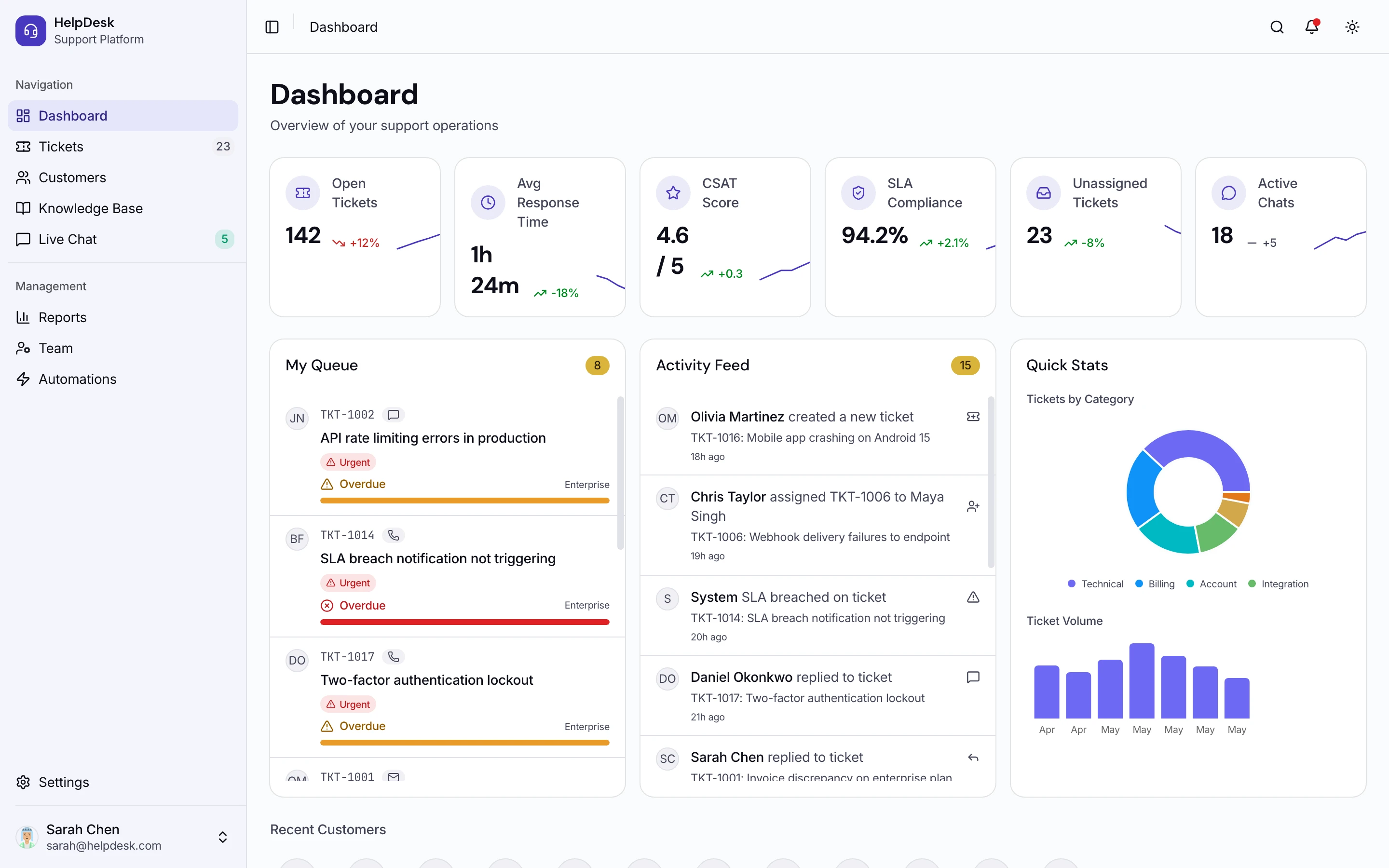
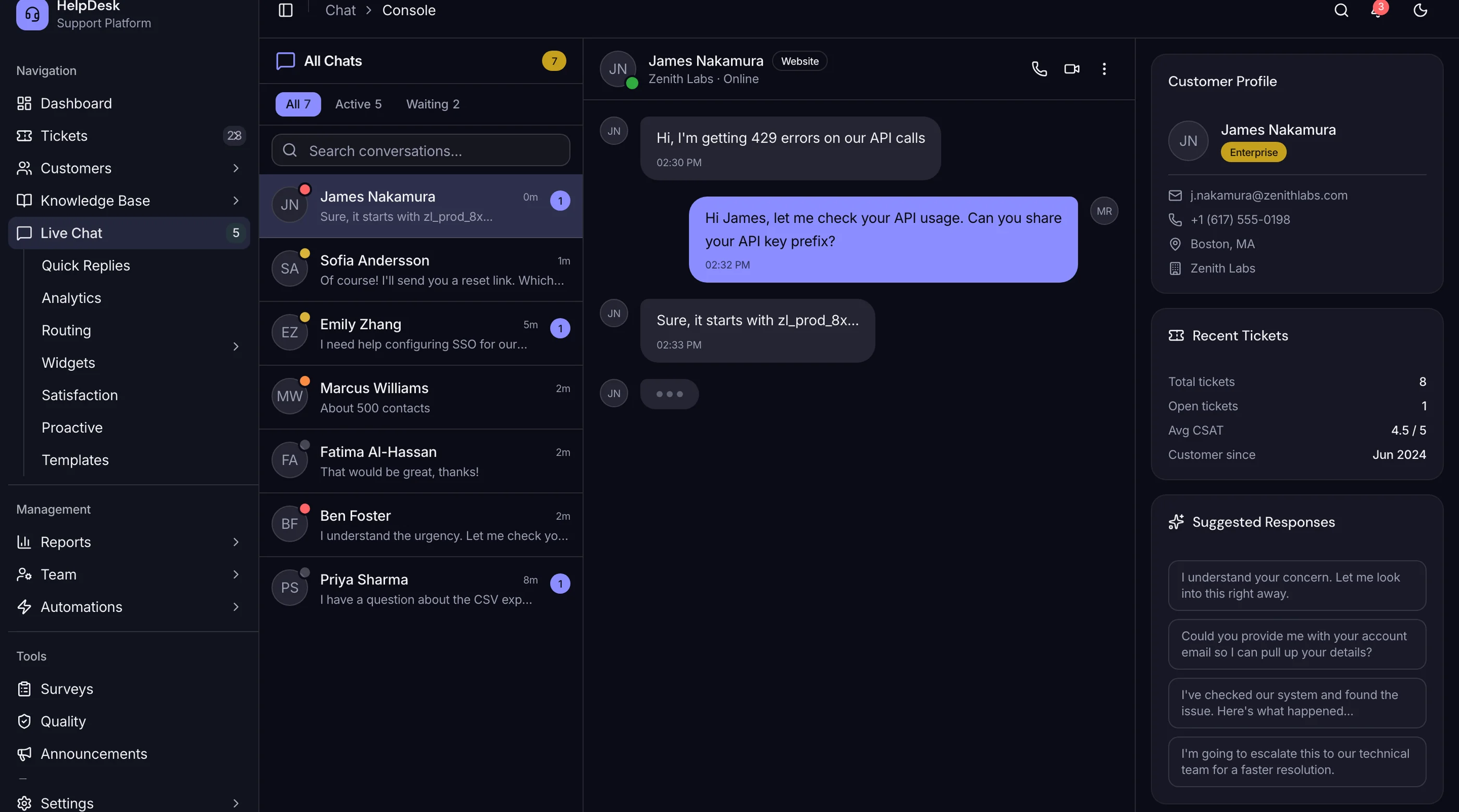
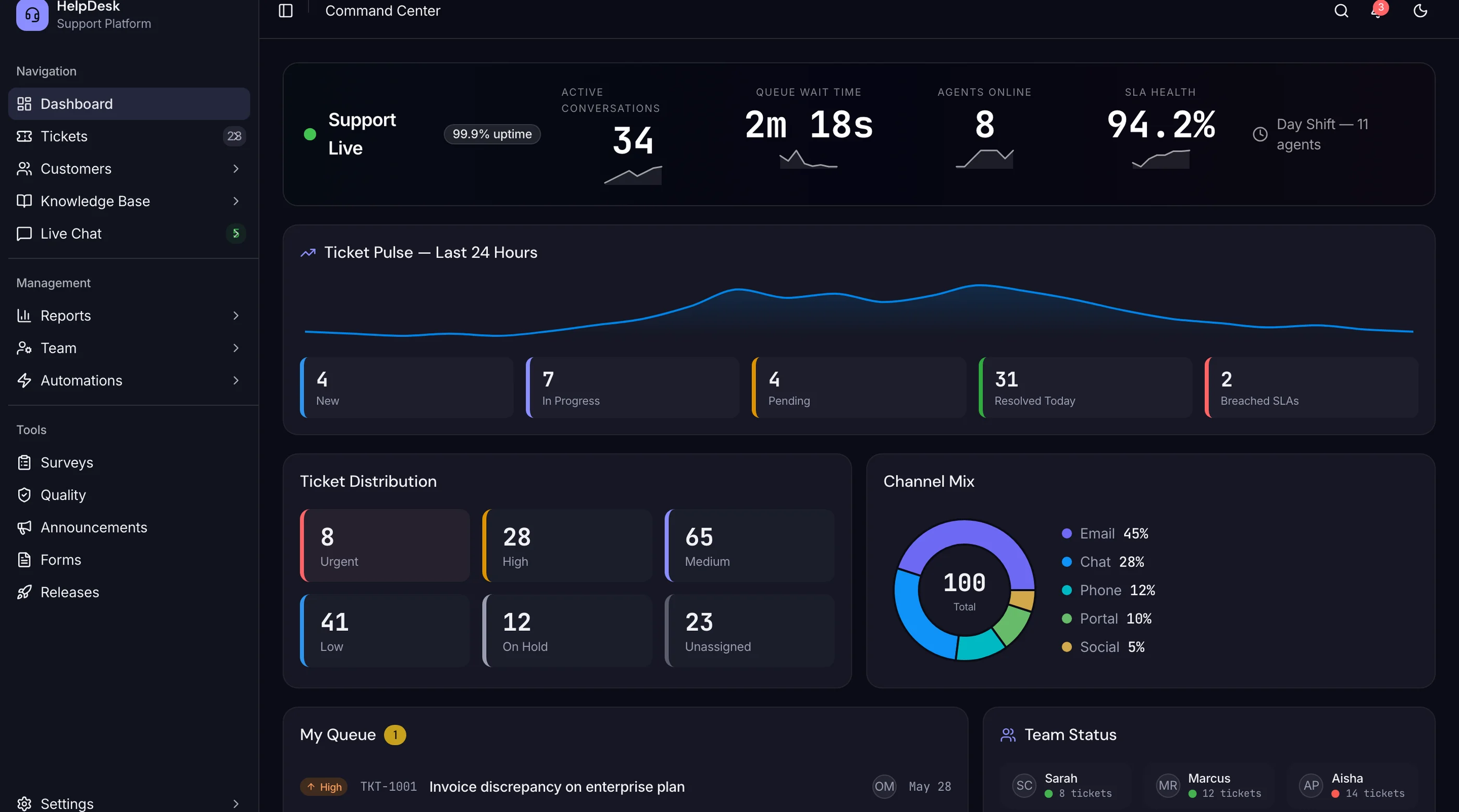
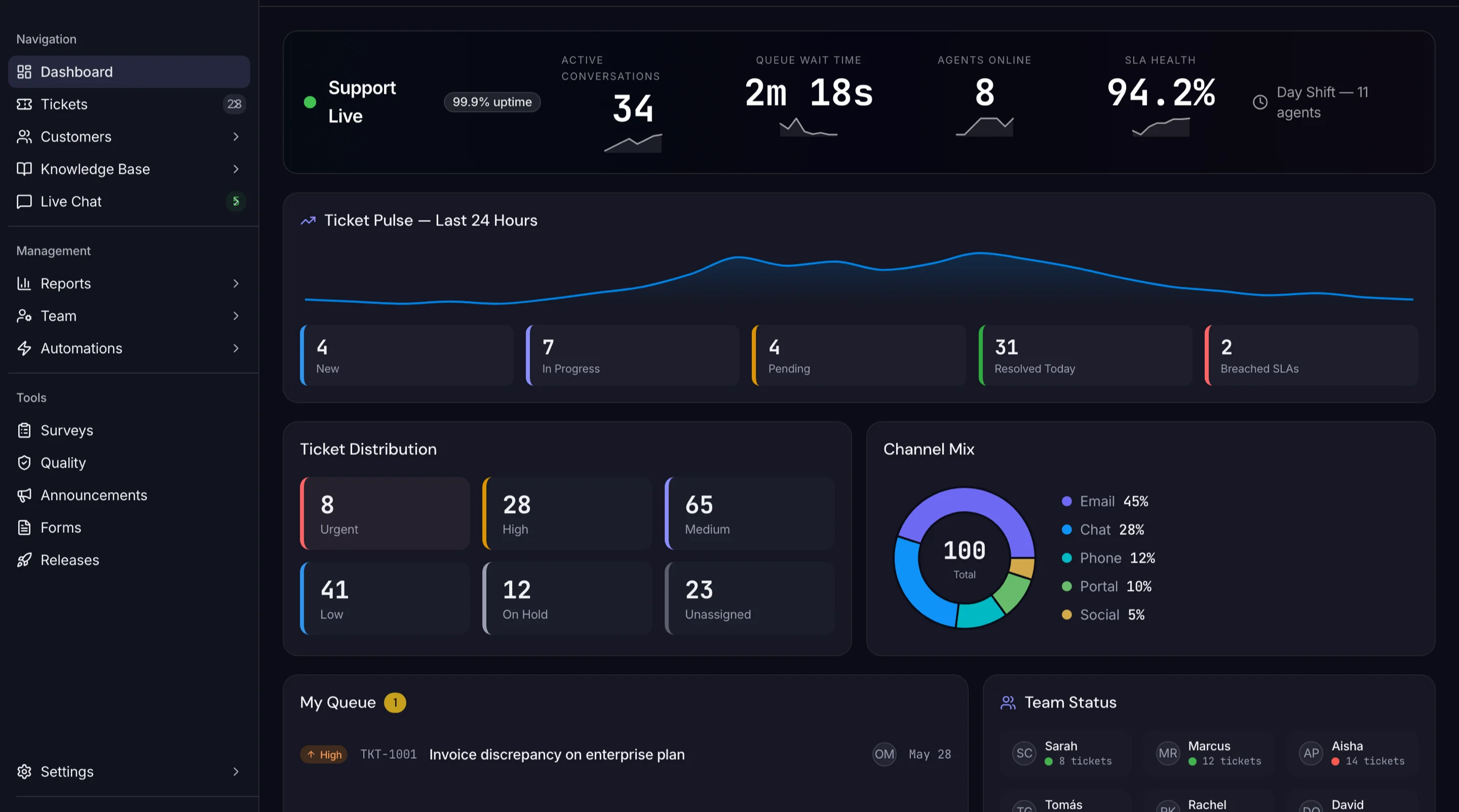
The Help Desk Kit is shipped: 110 screens covering ticket management with SLA tracking, live chat, knowledge base, customer profiles, automations, and team scheduling. Next.js + Tailwind + shadcn/ui, WCAG AA. $131 solo, $199 team, $349 agency. Try the live demo.
Get the Help Desk Kit → or get every kit (18 total) for $749 via All UI Kits →
TL;DR: Quick Picks for 2026
| Need | Top pick | Price |
|---|---|---|
| Already on Atlassian | Jira Service Management | Free tier, from roughly $20/agent/mo |
| ITSM without the implementation project | Freshservice | From roughly $19/agent/mo |
| ITIL depth at a fraction of the cost | ManageEngine ServiceDesk Plus | From roughly $10/tech/mo |
| Open-source ITSM with asset management | GLPI | Free (self-host) |
| Open-source service desk, mature | Zammad | Free (self-host) |
| Customer support rather than IT | Zoho Desk | Free tier, from roughly $14/agent/mo |
| Enterprise ITSM, different vendor | BMC Helix | Quote-based |
| Support desk inside your own product | thefrontkit Help Desk Kit | $131+ one-time |
ITSM pricing is quote-heavy and tiered by module. Treat every number as directional and get your own quote.
What ServiceNow Actually Does Well
Worth saying clearly, because most of this list cannot replace it at the top end. ServiceNow's CMDB is genuinely the best in the category, its workflow engine handles processes far beyond IT, and at 10,000 employees across many business units the consolidation is real value. Companies that use ServiceNow as a platform, not a ticket queue, are usually getting their money's worth.
The case for alternatives isn't that ServiceNow is bad. It's that a lot of companies bought a platform to run a service desk.
When to Leave ServiceNow
Three signals:
- You use tickets and almost nothing else. If the CMDB is stale and the workflow engine runs three flows, you are paying platform prices for a queue.
- Every change needs a partner. When adjusting an approval step requires a statement of work, the tool is heavier than the process it serves.
- Licence renewal outpaces headcount. ITSM cost should track roughly with the org. When it does not, the module footprint has grown past the need.
1. Jira Service Management
The most common landing spot, especially where engineering already lives in Atlassian.
Strengths:
- Tight integration with Jira Software, so incidents and engineering work share a system
- Genuinely usable free tier for small teams
- Good incident, change, and problem management for the price
- Large marketplace and mature automation
Weaknesses:
- Asset and configuration management is weaker than ServiceNow's CMDB
- Gets expensive as agent count climbs
- Atlassian's admin model takes time to learn
- Less suited to non-IT service management
Best for: Companies already running Atlassian who want ITSM without a separate vendor relationship.
2. Freshservice
ITSM built to be deployed in weeks rather than quarters.
Strengths:
- Fast to stand up, with sensible defaults instead of a blank platform
- Covers incident, problem, change, release, and asset management
- Clean interface that agents adopt without heavy training
- Predictable published pricing
Weaknesses:
- Depth drops off against ServiceNow at enterprise complexity
- Advanced features sit in higher tiers
- Reporting is good but less flexible than a platform approach
- Freshworks moved upmarket, and support quality is a recurring theme
Best for: Mid-market IT teams who want real ITSM and cannot fund an implementation project.
3. ManageEngine ServiceDesk Plus
The value option with more ITIL coverage than the price suggests.
Strengths:
- Substantially cheaper per technician than the alternatives above
- Full ITIL process coverage including CMDB and asset discovery
- Available self-hosted as well as cloud, which matters for regulated environments
- Deep integration with the wider ManageEngine estate
Weaknesses:
- Interface feels dated next to Freshservice or Jira
- Configuration is powerful but not friendly
- Support experience varies by region
- The module structure takes effort to understand
Best for: IT teams that need genuine ITIL process at a fraction of enterprise pricing, and can live with an older interface.
4. GLPI
Open-source ITSM with real asset management behind it.
Strengths:
- Free to licence and genuinely self-hostable
- Asset and inventory management is a first-class feature, not an add-on
- Active project with a long track record
- Plugin ecosystem covers most gaps
Weaknesses:
- You own hosting, upgrades, and backups
- Interface is functional rather than pleasant
- Documentation is uneven in English
- Setup effort is real, so budget engineering time
Best for: Teams with IT capacity who want ITSM and asset tracking without licence fees.
5. Zammad
Open-source service desk that competes on agent experience rather than ITIL checkboxes.
Strengths:
- Genuinely full-featured for ticketing, SLAs, knowledge base, and customer portal
- Multi-channel ingestion including email, chat, and social
- Cleaner interface than most open-source options
- Free to licence, self-hosted
Weaknesses:
- Not ITSM: no CMDB, no change management to speak of
- Ruby on Rails stack, so hosting needs someone who cares
- Smaller ecosystem than the commercial options
- Reporting is basic at scale
Best for: Teams whose real need is a strong service desk rather than ITIL process. More on this path in Zendesk Alternatives.
6. Zoho Desk
Worth listing because a large share of ServiceNow instances are doing customer support.
Strengths:
- Very low cost with a usable free tier
- Strong multichannel support and automation for the price
- Integrates with the wider Zoho suite
- Fast to deploy
Weaknesses:
- Customer support, not ITSM: no CMDB, no change management
- Depth drops off for complex enterprise requirements
- Interface is busy
- Support matches the price point
Best for: Teams who discovered their ITSM platform is really a customer support queue.
7. BMC Helix
The other enterprise ITSM platform, for when the requirement genuinely is enterprise.
Strengths:
- Comparable ITSM depth to ServiceNow including CMDB and discovery
- Strong AIOps and automation story
- Credible in large, regulated environments
- A real competitive lever at renewal time
Weaknesses:
- Enterprise pricing and enterprise implementation
- Same partner dependency you were trying to escape
- Migration between two platforms of this size is a programme, not a project
- Smaller ecosystem than ServiceNow
Best for: Large organisations that need full ITSM and want a competing quote before renewing.
8. Build the Support Desk with the Help Desk Kit
The option that fits if the ITSM was always the wrong shape.
Plenty of ServiceNow instances exist because a company needed somewhere for requests to land, and bought a platform. If what you actually need is a support desk, and especially if you need it inside a product you ship to customers, building the interface is cheaper than licensing a platform.
The Help Desk Kit ships 110 screens: threaded tickets with internal notes and attachments, a status-column ticket board with priority badges and SLA indicators, live chat with queue management and a customer context panel, an SLA dashboard with breach alerts and compliance gauges, a knowledge base editor with categories and article analytics, customer profiles with interaction timelines, and agent performance analytics covering response times, resolution rates and CSAT. Team management adds a roles and permissions matrix, shift scheduling, and workload distribution.
Be clear about what this is and is not. It is the frontend. There is no backend, no database, no real-time messaging infrastructure, and no email delivery in the box. It is also not ITSM: no CMDB, no change management, no asset discovery. If you need ITIL process, buy from the list above. If you need a support experience you control, this is the shortcut.
- Screens: 45
- Tickets: Threaded view, internal notes, attachments, Kanban triage
- Chat: Live chat UI with queue management and customer context
- SLA: Tracking dashboard with breach alerts and compliance gauges
- Knowledge base: Article editor with categories and analytics
- Not included: Backend, database, WebSocket infra, email delivery, CMDB
- Price: $131 solo / $199 team / $349 agency
Recommendation by Team Profile
| You | Pick |
|---|---|
| Already run Atlassian | Jira Service Management |
| Want ITSM live in weeks | Freshservice |
| Need ITIL depth on a budget | ManageEngine ServiceDesk Plus |
| Want open source with asset management | GLPI |
| Need a strong service desk, not ITIL | Zammad |
| Discovered you are doing customer support | Zoho Desk |
| Genuinely enterprise, want a competing quote | BMC Helix |
| Building support into your own product | Build with the Help Desk Kit |
| 10,000+ staff using the platform properly | Stay on ServiceNow |
Pricing at a Glance (50 Agents, Annual)
Directional only. ITSM vendors tier by module and negotiate at volume.
| Product | Typical basis | Rough annual cost (50 agents) |
|---|---|---|
| ServiceNow | Quote, annual contract | Six figures is common |
| Jira Service Management | Per agent, per month | Roughly $12,000-$30,000 |
| Freshservice | Per agent, per month | Roughly $11,000-$40,000 |
| ManageEngine ServiceDesk Plus | Per technician | Roughly $6,000-$18,000 |
| GLPI (self-hosted) | Free | Hosting and your time |
| Zammad (self-hosted) | Free | Hosting and your time |
| Zoho Desk | Per agent, per month | Roughly $8,000-$24,000 |
| Help Desk Kit + your backend | One-time | $131-$349 once, plus hosting |
Per-agent SaaS compounds with headcount. Self-hosting compounds with your time. A one-time UI layer does neither, and also does not give you a system of record.
Frequently Asked Questions
What is the best alternative to ServiceNow?
Jira Service Management if you already run Atlassian, since the integration removes a whole class of handoff problems. Freshservice if you want ITSM you can deploy without a partner. ManageEngine ServiceDesk Plus if you need ITIL depth and the budget is the constraint. GLPI if you want open source with real asset management.
Is there a free alternative to ServiceNow?
GLPI and Zammad are both free to licence and self-hostable, and Jira Service Management has a free tier for small teams. GLPI is the closest to ITSM because asset and configuration management are built in. You pay in hosting and maintenance rather than licence fees.
What is the best open-source ITSM?
GLPI, if you need asset management and configuration alongside ticketing. Zammad is the better service desk but is not ITSM and has no CMDB. iTop is worth a look if CMDB depth specifically is the requirement.
Is ServiceNow worth it for a mid-size company?
Usually not. ServiceNow's economics and depth assume large, complex organisations with dedicated platform owners. Under about 1,000 employees, most companies use a fraction of what they license and feel the partner dependency more sharply, because there is no internal platform team to absorb it.
Can I keep ServiceNow and just improve the front end?
Yes, and it is a common pattern. ServiceNow stays the system of record while employees or customers interact through a portal you build over its API, with your own design and your own flows. That is the build path described above with the Help Desk Kit, which gives you the interface while ServiceNow keeps the process.
How hard is it to migrate off ServiceNow?
Harder than a help desk migration, because the workflows and the CMDB carry more than tickets do. Ticket history exports cleanly enough. The work is in reimplementing approval flows, integrations, and any custom applications built on the platform, then reconciling asset data. Budget two to three quarters for a mid-size estate, and migrate module by module rather than all at once.
The Honest Take
ServiceNow is the right answer for large organisations genuinely running it as a platform, and most of this list cannot match it there. The alternatives win at specific edges: Atlassian integration (Jira Service Management), time to value (Freshservice), price with real ITIL (ManageEngine), open source with assets (GLPI), agent experience (Zammad), customer support (Zoho Desk), or an interface you own (build it).
The question worth asking before any of them is which product you actually need. A surprising number of ServiceNow renewals are for a very expensive ticket queue, and the honest fix for that is not another ITSM platform.
For the failure modes that hit self-hosted service desks, see Why Self-Hosted Help Desks Stall.
Want it shipped without hiring a developer?
The build path above assumes you have engineers. If you don't, the team behind thefrontkit does done-for-you launches: we deploy the kit, apply your branding, and wire it to your stack. Fixed quotes, most builds ship in 2-4 weeks, from $1999.