Tidio Alternatives and Competitors: 7 Live Chat Tools
Tidio Alternatives and Competitors: 7 Options Compared for 2026
Short answer: Crisp is the closest swap at a similar price with a nicer interface. Chatwoot is the pick if you want to stop paying per conversation and can self-host. Freshdesk or Zoho Desk if chat turned out to be part of a support desk rather than the whole job. Intercom if you have moved upmarket and budget is no longer the constraint.
Tidio is a live chat and chatbot tool aimed at small businesses and stores, and it is good at being easy. Install the widget, set up a few flows, and you are answering visitors the same afternoon.
Teams outgrow it for fairly predictable reasons. The conversation-based pricing on the AI tier climbs as traffic grows. Ticketing is light, so once chat volume turns into follow-up work you feel the missing structure. And the chatbot builder handles simple flows well but strains when the logic gets real.
Seven alternatives worth comparing, from direct swaps to open source to building chat into the product itself.
Or skip the build entirely: get the Help Desk Kit
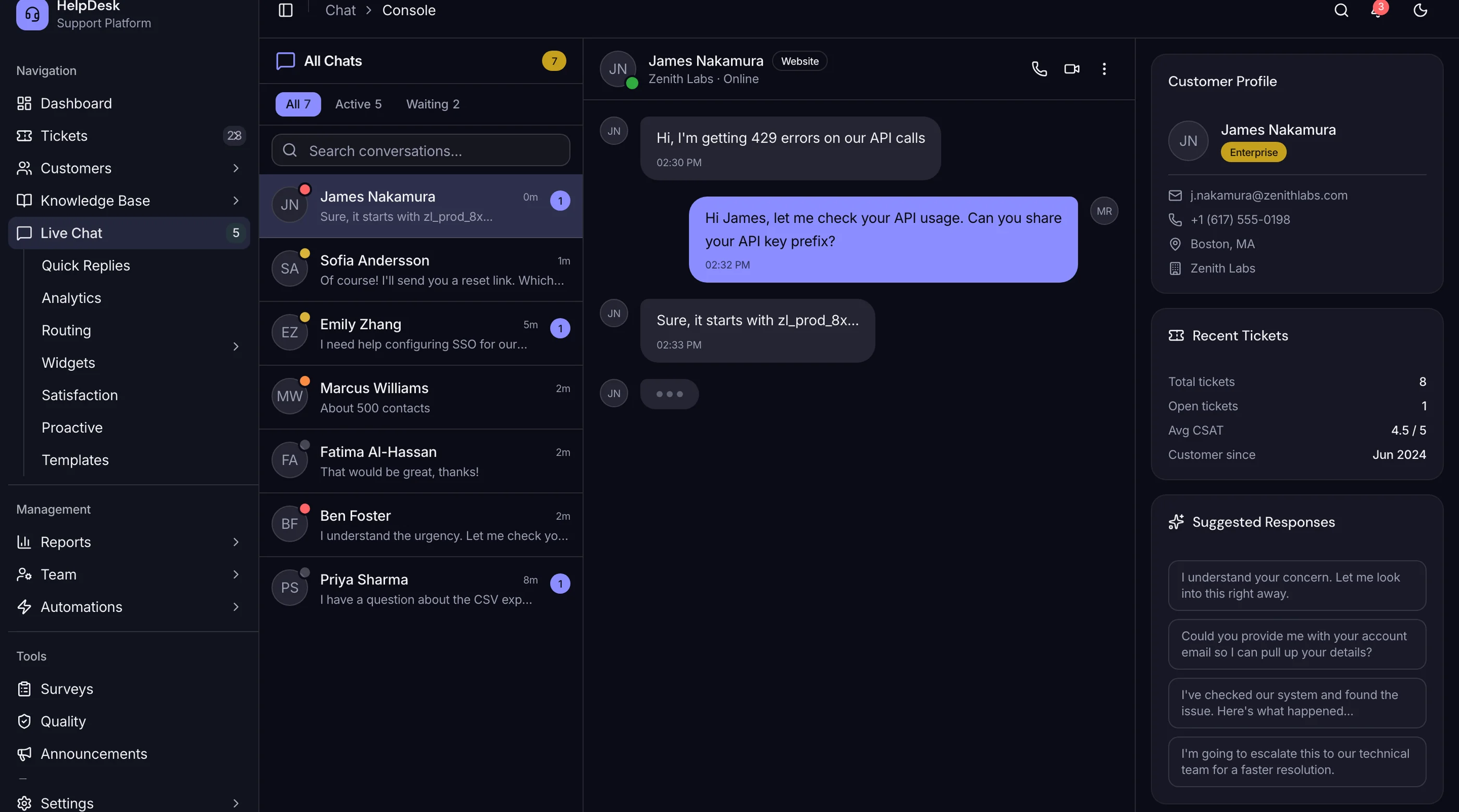
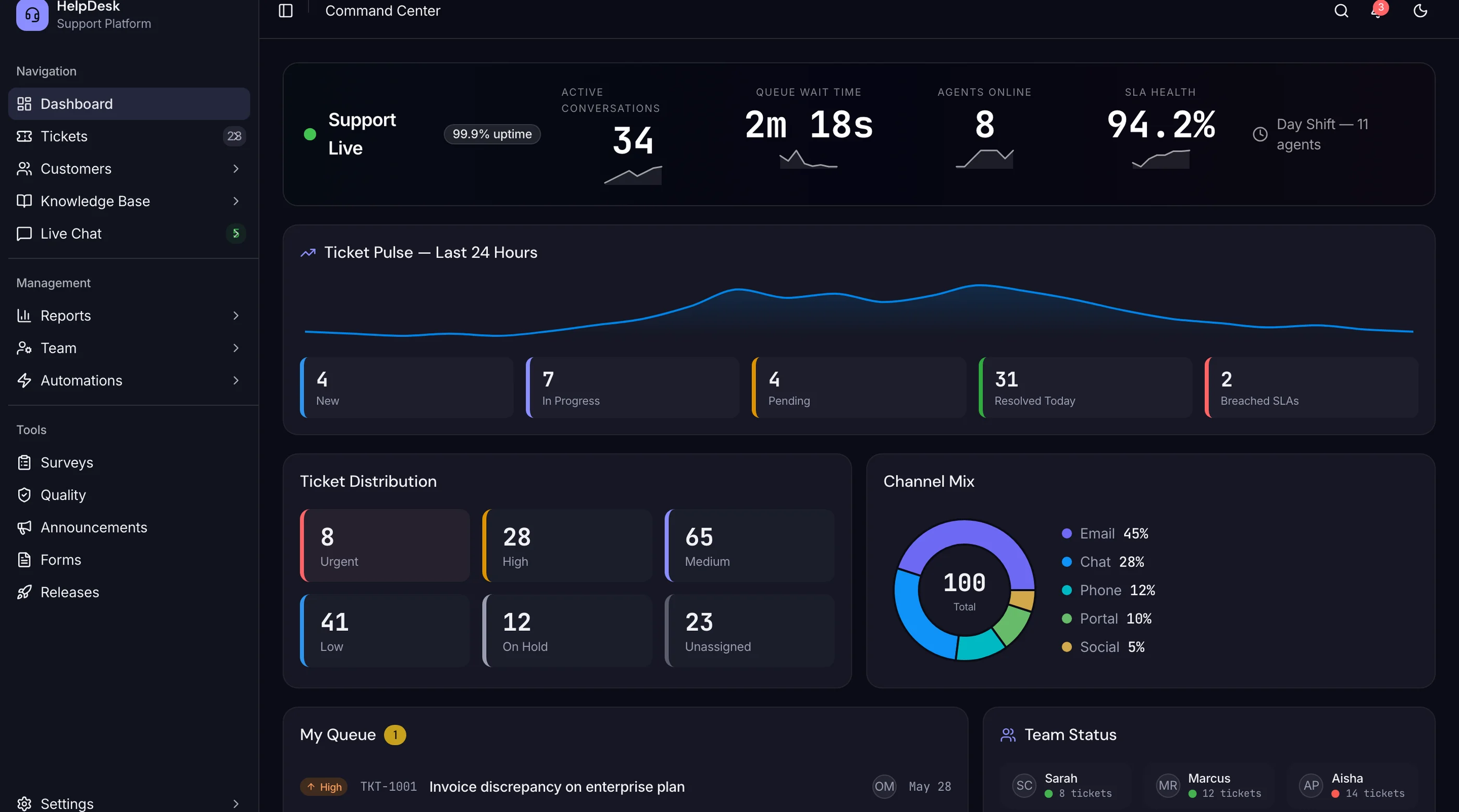
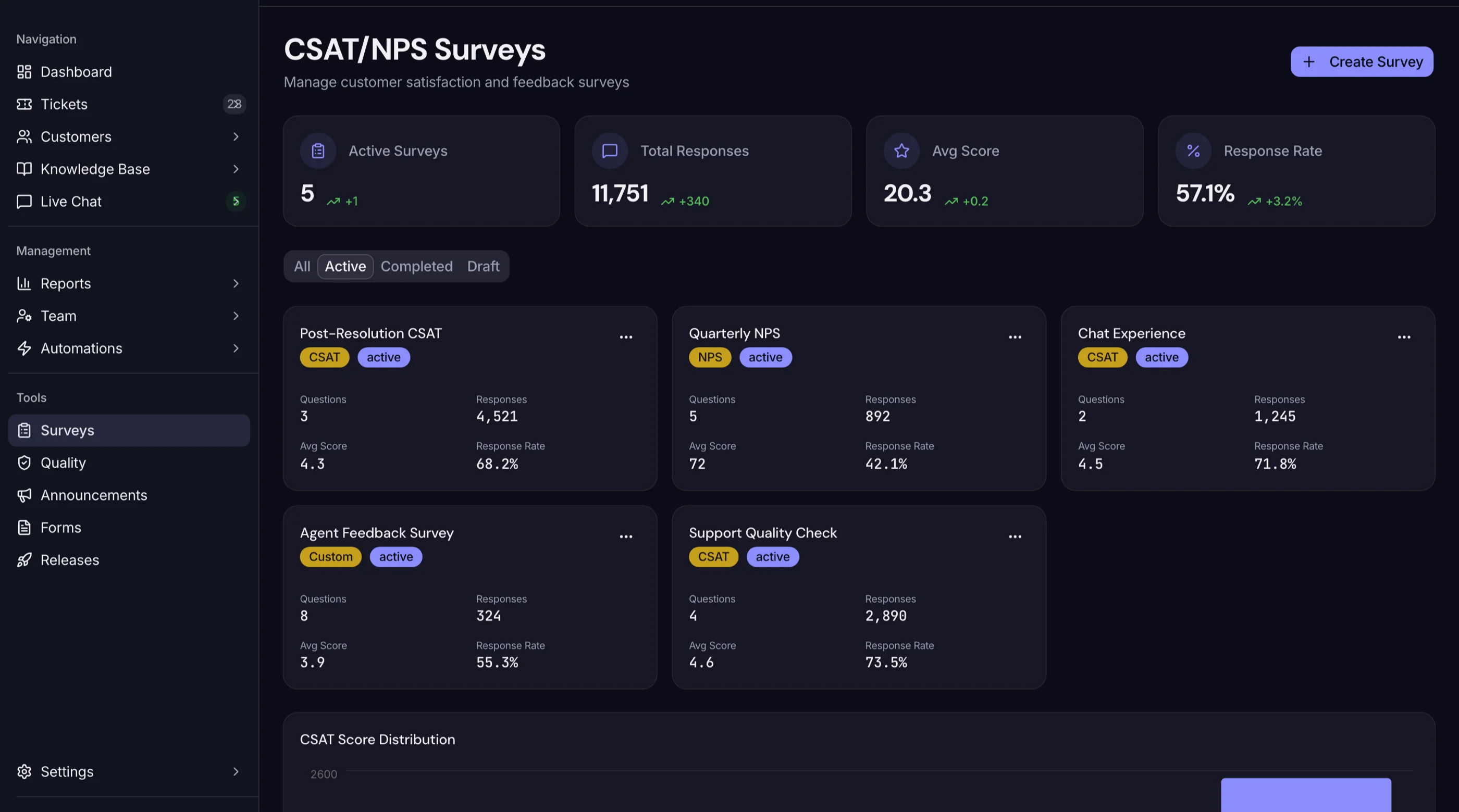
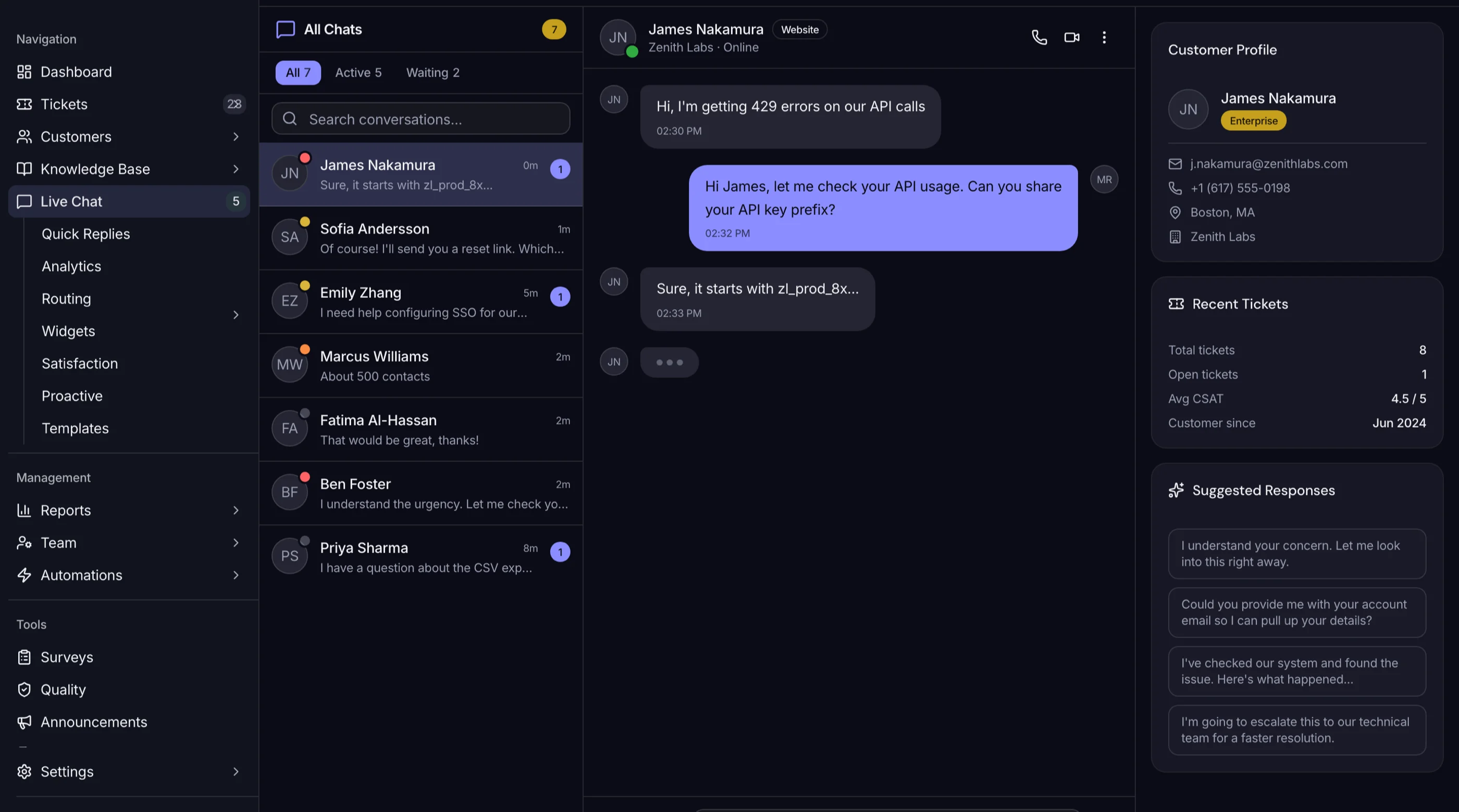
The Help Desk Kit is shipped: 110 screens covering live chat with queue management, ticket management with SLA tracking, knowledge base, customer profiles, automations, and team scheduling. Next.js + Tailwind + shadcn/ui, WCAG AA. $131 solo, $199 team, $349 agency. Try the live demo.
Get the Help Desk Kit → or get every kit (18 total) for $749 via All UI Kits →
TL;DR: Quick Picks for 2026
| Need | Top pick | Price |
|---|---|---|
| Closest swap, better interface | Crisp | Free tier, from roughly $45/mo |
| Open source, no per-conversation fee | Chatwoot | Free self-host, or hosted plans |
| Chat plus a real help desk | Freshdesk | Free tier, from roughly $15/agent/mo |
| Cheapest full support suite | Zoho SalesIQ | Free tier, from roughly $7/user/mo |
| Upmarket, product-led | Intercom | From roughly $29/seat/mo plus usage |
| Free forever, simple | Tawk.to | Free, paid to remove branding |
| Chat inside your own product | thefrontkit Help Desk Kit | $131+ one-time |
Chat tools price on seats, conversations, or resolutions depending on vendor. Compare on your actual traffic.
What Tidio Actually Does Well
Worth saying, because it is easy to undersell. Tidio is genuinely one of the fastest chat tools to get running, the widget is clean, and the free tier is usable rather than a demo. For a small store that wants to answer visitors this week, it is hard to beat on time-to-value.
The case for alternatives is rarely that Tidio is bad. It is that chat volume grows, and small tools price for small volume.
When to Leave Tidio
Three signals:
- Conversation limits shape your behaviour. If you are managing the bot to keep the bill down, the pricing is steering the product.
- Chats become tickets. Once a conversation needs an owner, an SLA and a follow-up, you need a desk rather than a chat widget.
- The bot builder ran out of room. Simple flows are fine. Branching logic against real data usually is not.
1. Crisp
The closest like-for-like, with a better interface.
Strengths:
- Clean, modern inbox that agents genuinely like
- Chat, email, and social in one place with a shared inbox
- Includes a knowledge base and campaigns on paid tiers
- Flat per-workspace pricing on lower tiers rather than per conversation
Weaknesses:
- Advanced automation is thinner than Intercom
- Reporting is adequate rather than deep
- Some features are gated to higher tiers
- Smaller ecosystem than the big platforms
Best for: Teams who like Tidio's shape but want a nicer inbox and clearer pricing.
2. Chatwoot
Open source, and the way out of usage-based pricing entirely.
Strengths:
- MIT licensed and free to self-host, with no conversation cap
- Strong omnichannel support including WhatsApp, Instagram and email
- Modern agent interface comparable to commercial tools
- Hosted plans available if you would rather not run it
Weaknesses:
- Self-hosting is Rails and Docker, so someone must own it
- Chatbot capability is basic compared to Tidio or Intercom
- Reporting is light at volume
- You maintain upgrades and deliverability
Best for: Teams with engineering capacity who want omnichannel chat without a per-conversation meter.
3. Freshdesk
For when chat turned out to be one channel of a support desk.
Strengths:
- Full ticketing with SLAs, automation and a help centre
- Chat included in the suite rather than bolted on
- Free tier for small teams and reasonable paid pricing
- Predictable per-agent model
Weaknesses:
- Chat is a feature, not the focus, so the widget is less polished
- The AI capabilities that matter are add-ons
- Heavier than a chat tool if chat is genuinely all you need
- Per-agent cost grows with hiring
Best for: Teams whose chat conversations keep turning into tickets. Wider comparison in Freshdesk Alternatives.
4. Zoho SalesIQ
The cheapest credible option, especially inside the Zoho ecosystem.
Strengths:
- Very low per-user cost with a usable free tier
- Visitor tracking and lead scoring alongside chat
- Connects to Zoho CRM and Zoho Desk natively
- Chatbot builder included
Weaknesses:
- Interface is dense and less pleasant than Crisp
- Best value only if you already use Zoho
- Chatbot is functional rather than clever
- Support matches the price
Best for: Cost-conscious teams, particularly those already running Zoho CRM.
5. Intercom
The upmarket option, with the pricing to match.
Strengths:
- Best-in-class product tours, messaging and in-app engagement
- Strong AI agent that genuinely deflects volume
- Deep customer data and segmentation
- Mature ecosystem and integrations
Weaknesses:
- Expensive, with seat pricing plus resolution-based AI charges
- Costs can be hard to forecast
- Considerable overkill for a small store
- The move upmarket has left small teams behind
Best for: Product-led SaaS with budget, where chat is part of onboarding and expansion rather than support alone. See also Intercom Alternatives.
6. Tawk.to
Genuinely free, and honest about what that means.
Strengths:
- Free forever for unlimited agents, which is rare
- Simple to install and operate
- Basic ticketing and a knowledge base included
- Pay only to remove branding or add hired agents
Weaknesses:
- Interface feels dated
- Automation and chatbot capability are minimal
- Reporting is thin
- The free model means support is community-driven
Best for: Teams where budget is genuinely zero and simple live chat is enough.
7. Build Chat into the Product with the Help Desk Kit
The option that fits if chat belongs inside your app rather than in a widget on top of it.
Third-party widgets sit outside your product. They load their own bundle, carry their own design, and know nothing about your user beyond what you pass them. For a SaaS where support is part of the experience, or where you are shipping support tooling to your own customers, that boundary is the problem.
The Help Desk Kit ships 110 screens including the chat layer: a live chat interface with conversation list, typing indicators, queue management with priority routing, and a customer context panel beside the thread. Around it sits a full desk: threaded tickets with internal notes, a Kanban triage board with SLA indicators, a knowledge base editor, customer profiles with interaction timelines, and agent performance analytics.
Be clear about the boundary. It is the frontend. There is no backend, no database, no WebSocket or real-time messaging infrastructure, no email delivery, and no AI chatbot logic in the box. You supply the transport and the model. What you get is the interface, on your domain, in your design, with your user data already present.
- Screens: 45
- Chat: Conversation list, typing indicators, queue management, customer context
- Tickets: Threaded view, internal notes, attachments, Kanban triage
- Knowledge base: Article editor with categories and analytics
- Not included: Backend, WebSocket infra, email delivery, chatbot logic
- Price: $131 solo / $199 team / $349 agency
Recommendation by Team Profile
| You | Pick |
|---|---|
| Want Tidio's shape, nicer inbox | Crisp |
| Want to stop paying per conversation | Chatwoot |
| Chats keep becoming tickets | Freshdesk |
| Already run Zoho, price sensitive | Zoho SalesIQ |
| Product-led SaaS with budget | Intercom |
| Budget is genuinely zero | Tawk.to |
| Chat belongs inside your app | Build with the Help Desk Kit |
| Shipping support tooling to customers | Build with the Help Desk Kit |
| Small store, current plan fits | Staying is fine |
Frequently Asked Questions
Who are Tidio's main competitors?
Crisp is the closest direct competitor, matching Tidio's shape at a similar price with a cleaner interface. Intercom competes from above on AI and depth at considerably higher cost, and Zoho SalesIQ from inside the Zoho stack. Tawk.to competes on being free. Chatwoot is the one that changes the model rather than the price, since self-hosting removes per-conversation billing altogether.
How does Tidio rate compared with the alternatives?
Tidio scores 4.6 on G2 from 1,962 reviews as of September 2026, which is genuinely strong and more evidenced than most tools in this category. Teams rarely leave Tidio because the product is bad. They leave when conversation volume makes its pricing awkward, or when chat turns out to be one channel of a support desk rather than the whole thing, and neither of those shows up in a review score.
What is the best alternative to Tidio?
Crisp for most teams, since it is the closest in shape with a better inbox and clearer pricing. Chatwoot if you want to remove usage-based pricing and can self-host. Freshdesk if your chat conversations have started behaving like support tickets and you need SLAs and ownership.
Is there a free alternative to Tidio?
Tawk.to is free for unlimited agents, funded by branding and optional paid services. Chatwoot is free to licence if you self-host. Crisp, Freshdesk and Zoho SalesIQ all have free tiers with limits, which are the easier option if you do not want to run infrastructure.
What is the best open source live chat?
Chatwoot. It is MIT licensed, actively maintained, covers chat, email and social channels, and has an agent interface comparable to commercial tools. The trade is that you own hosting, upgrades and deliverability, which is a real job rather than a one-time setup.
Is Tidio or Crisp better?
Crisp generally has the better agent inbox and more predictable pricing at the lower tiers. Tidio is faster to get running and has the stronger entry-level chatbot builder. If bots are the main reason you are buying, Tidio holds up. If the inbox is where your team lives, Crisp.
Can I add live chat to my own app instead of using a widget?
Yes, and for product-embedded support it is usually better. You control the design, the chat sits inside your authenticated app so user context is already there, and there is no third-party bundle loading on every page. You supply the real-time transport. The build path above with the Help Desk Kit covers the interface.
The Honest Take
Tidio is a good small-business chat tool and there is no reason to leave it while it fits. Most people who do leave are not unhappy with the product, they have outgrown the pricing model or the ticketing depth.
The alternatives win at specific edges: inbox quality (Crisp), no usage meter (Chatwoot), real ticketing (Freshdesk), price (Zoho SalesIQ, Tawk.to), or product-led depth (Intercom).
The option worth weighing separately is whether chat should be a widget at all. If support is part of your product rather than a layer bolted onto it, the interface is something to own.
Want it shipped without hiring a developer?
The build path above assumes you have engineers. If you don't, the team behind thefrontkit does done-for-you launches: we deploy the kit, apply your branding, and wire it to your stack. Fixed quotes, most builds ship in 2-4 weeks, from $1999.