Freshdesk Alternatives and Competitors: 8 Tools for 2026
Freshdesk Alternatives and Competitors: 8 Options Compared for 2026
The strongest Freshdesk alternatives in 2026 are Zendesk if you need more features, Zoho Desk if you want the same job done cheaper, and Help Scout if agent experience is what is actually bothering you. Freshdesk's direct competitors also include Front for shared-inbox teams, and if you would rather not pay per agent at all, Zammad, FreeScout and Chatwoot are free to licence and self-host. This guide compares all eight on price, agent experience and hosting effort.
Freshdesk Growth is $19/agent/month, Pro is $55 and Enterprise is $89, billed annually. Its free program covers 2 agents for six months. Growth still undercuts Zendesk's $55 entry plan, which is Freshdesk's pitch, but Pro now lists at the same $55 per agent. So why do teams look for alternatives? Three reasons come up: the AI features that matter are add-ons (Freddy AI Copilot is $29/agent/month extra, on Pro and Enterprise only), support quality has become a common complaint as Freshworks moved upmarket, and the per-agent model still punishes growing teams.
Eight alternatives worth comparing, from the premium incumbent to free self-hosted options to owning the help desk entirely.
For what a help desk actually has to do, see our How to Build a Help Desk in Next.js guide.
TL;DR: Quick Picks for 2026
| Need | Top pick | Price |
|---|---|---|
| Most features, enterprise-grade | Zendesk | $55+/agent/mo |
| Cheapest full-featured | Zoho Desk | Free tier, $7+/agent/mo |
| Friendliest agent experience | Help Scout | $25+/user/mo |
| Shared-inbox-first teams | Front | $25+/seat/mo |
| Omnichannel, open source | Chatwoot | Free / $19+/agent |
| Free self-hosted, lightweight | FreeScout | Free + paid modules |
| Free self-hosted, full-featured | Zammad | Free |
| Help desk inside your product | thefrontkit Help Desk Kit | $131+ one-time |
How These Actually Rate on G2
Ratings pulled from G2 on 23 September 2026. Read the right-hand column before the middle one.
| Product | G2 rating | Reviews |
|---|---|---|
| Front | 4.7 | 2,513 |
| Chatwoot | 4.5 | 16 |
| Zammad | 4.5 | 10 |
| Freshdesk | 4.4 | 3,771 |
| Zoho Desk | 4.4 | 7,948 |
| Help Scout | 4.4 | 431 |
| Zendesk | 4.3 | 7,078 |
| FreeScout | Not rated | "hasn't been reviewed yet" |
The scores are useless on their own. Six of the eight sit between 4.3 and 4.5, which is the range almost every established B2B tool lands in, and a tenth of a point is noise. The review counts are the part that carries information, and they differ by three orders of magnitude.
Two things follow. Chatwoot and Zammad look excellent at 4.5, but that is 16 and 10 reviews, which is a handful of enthusiasts rather than evidence, and it is the pattern you would expect from self-hosted tools whose users do not write G2 reviews. Front's 4.7 across 2,513 reviews is the only score here that is both high and well-evidenced, and it is worth taking seriously if shared inbox is your shape.
Freshdesk's own 4.4 over 3,771 reviews is genuinely good. People do not leave Freshdesk because it is bad software. They leave over the pricing model, which no G2 score captures.
What Freshdesk Actually Does Well
Freshdesk nailed the mid-market: most of Zendesk's feature set for less at the entry tiers, with easier setup. Omnichannel routing, SLA policies, a decent knowledge base, and a marketplace that covers common integrations. For teams of 5-50 agents with standard support workflows, it's a rational default.
The alternatives win where Freshdesk is stretched: premium polish, rock-bottom pricing, agent experience, or ownership.
When to Leave Freshdesk
Three signals:
- The add-ons pushed up the bill. Freddy AI Copilot alone takes Pro from $55 to $84 per agent, before extra bots or day passes.
- Support for your support tool is the bottleneck. If resolving platform issues takes longer than resolving your own tickets, the discount stopped being worth it.
- Support needs to live inside your product, white-labeled, on your data.
1. Zendesk
The category incumbent. More of everything, at a price.
Strengths:
- Deepest feature set in support: routing, SLA, workforce management, analytics
- Marketplace and API ecosystem nothing else matches
- AI agents and copilots are genuinely mature
- Scales past 1,000-agent operations
Weaknesses:
- $55-$115/agent/month; the exact pricing Freshdesk exists to undercut
- Complexity requires real admin investment
- Per-agent + AI add-on pricing compounds fast
Best for: Teams outgrowing Freshdesk upward: 50+ agents, complex routing, compliance requirements. We compared its own alternatives in the Zendesk alternatives guide. For the full cost picture, including AI resolutions and Copilot, see Zendesk pricing explained.
2. Zoho Desk
The price-performance pick, especially inside the Zoho suite.
Strengths:
- Free for 3 agents; paid from $7/agent/month (Express), with Standard at $14
- Full feature set at every tier: SLA, workflows, multi-department
- Zia AI included on Professional and Enterprise instead of sold as an add-on
- Native links to Zoho CRM, Books, and the rest of the suite
Weaknesses:
- UI density; setup takes longer than Freshdesk
- Support quality has the same mid-market complaints
- Outside the Zoho ecosystem, integrations thin out
Best for: Cost-conscious teams, especially ones already on Zoho CRM (a pattern from our Pipedrive and HubSpot comparisons).
3. Help Scout
The agent-experience pick. Support software that feels like email.
Strengths:
- The most pleasant agent UI in the category; near-zero training time
- Shared inbox model that support teams actually enjoy using
- Docs (knowledge base) and Beacon widget are clean and effective
- AI Assist, Drafts and Summarize are included; AI Answers costs $0.75 per resolution
Weaknesses:
- Lighter on enterprise features: no deep workflow engine
- Reporting is good but not analyst-grade
- Phone support requires integrations
Best for: SMB and mid-market teams that prize agent happiness and simplicity over configurability.
4. Front
The shared-inbox platform for teams where support is conversations, not tickets.
Strengths:
- Email-native: support, sales, and ops share one collaborative inbox
- Internal comments, assignments, and SLAs layered onto real email
- Strong automation and analytics for an inbox tool
- Feels natural for high-touch B2B support
Weaknesses:
- $25-$105/seat/month climbs fast at the tiers you'll actually want
- Not built for high-volume consumer ticketing
- Starter is capped at 10 seats
Best for: B2B teams doing relationship-heavy support where every customer email deserves a human thread.
5. Chatwoot
The open-source omnichannel option.
Strengths:
- Live chat, email, WhatsApp, Instagram, and Telegram in one open-source inbox
- Self-hosted free, or cloud from $19/agent/month
- Modern UI that doesn't feel like open-source software
- API-first with website widget included
Weaknesses:
- Ticketing depth (SLA, complex routing) trails the incumbents
- Self-hosting a Rails + Postgres + Redis stack is real ops work
- Reporting is serviceable, not deep
Best for: Teams where chat and social channels dominate, and data ownership matters.
6. FreeScout
The lightest-weight serious help desk. A free Help Scout clone.
Strengths:
- Free core, self-hosted on PHP hosting (FreeScout says it runs even on shared hosting)
- Clean shared-inbox experience modeled on Help Scout
- Paid modules with lifetime licenses add knowledge base, chat, workflows and more
- Tiny operational footprint
Weaknesses:
- Module-based model means assembling your feature set piecemeal
- Automation needs the paid Workflows module
- No support plan, though paid installation and development help is available
Best for: Small teams that want a clean shared inbox for effectively free and don't need enterprise workflows.
7. Zammad
The most feature-complete free self-hosted help desk.
Strengths:
- SLA tracking, knowledge base, customer portal, and text modules, all free
- Multi-channel: email, chat, telephony integrations, social
- Serious ticketing depth that FreeScout doesn't attempt
- Active development
Weaknesses:
- Ruby on Rails stack with real resource requirements
- UI is functional but dated
- Upgrades and scaling are on you
Best for: Teams that want the fullest free feature set and have the DevOps capacity to run it.
8. Build It Into Your Product with the Help Desk Kit
The build path is for support that lives inside your product: a customer portal in your SaaS, white-labeled support for your clients' end users, or a vertical help desk where generic tools never fit the workflow.
What this looks like:
- Your backend owns tickets, customers, and messages
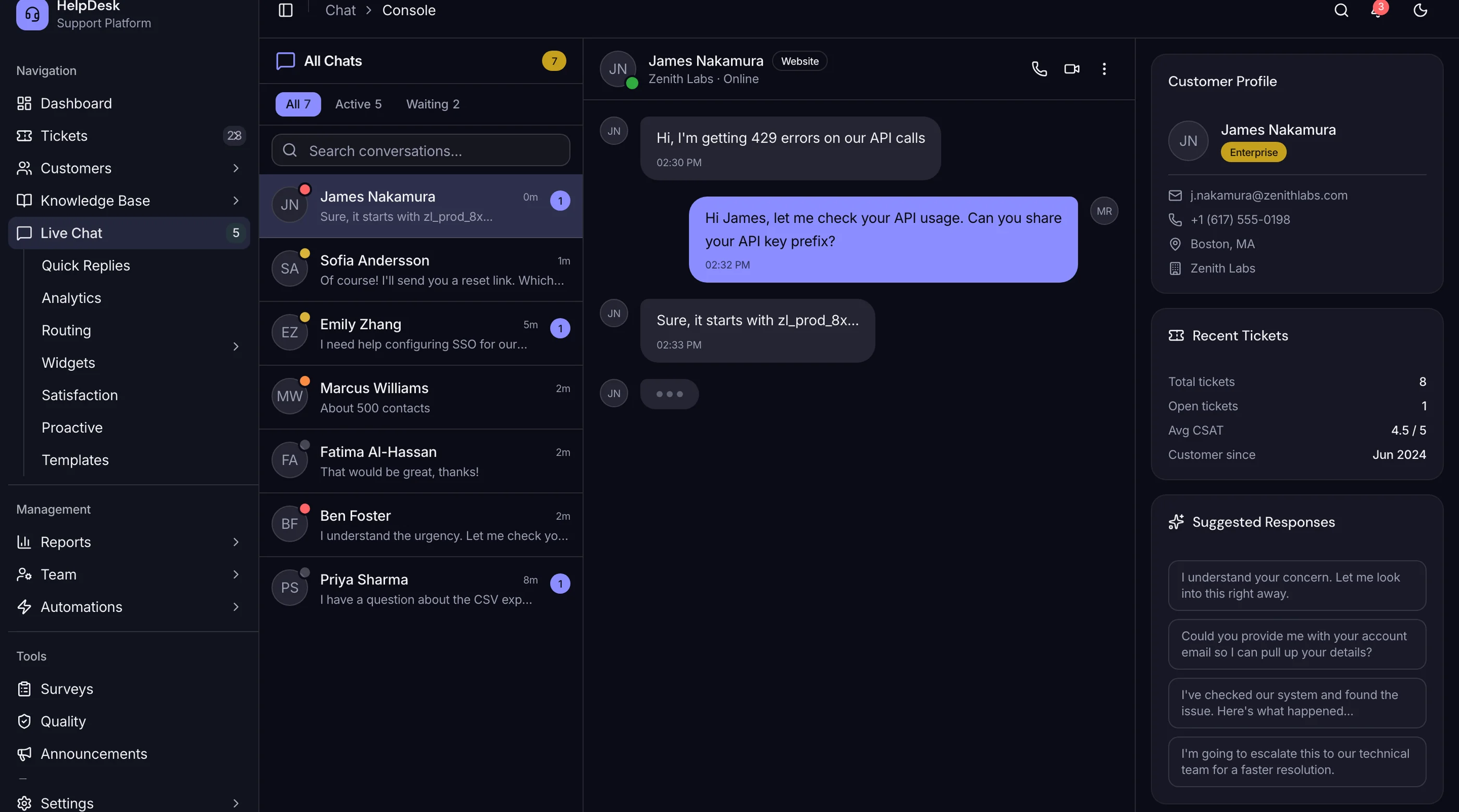
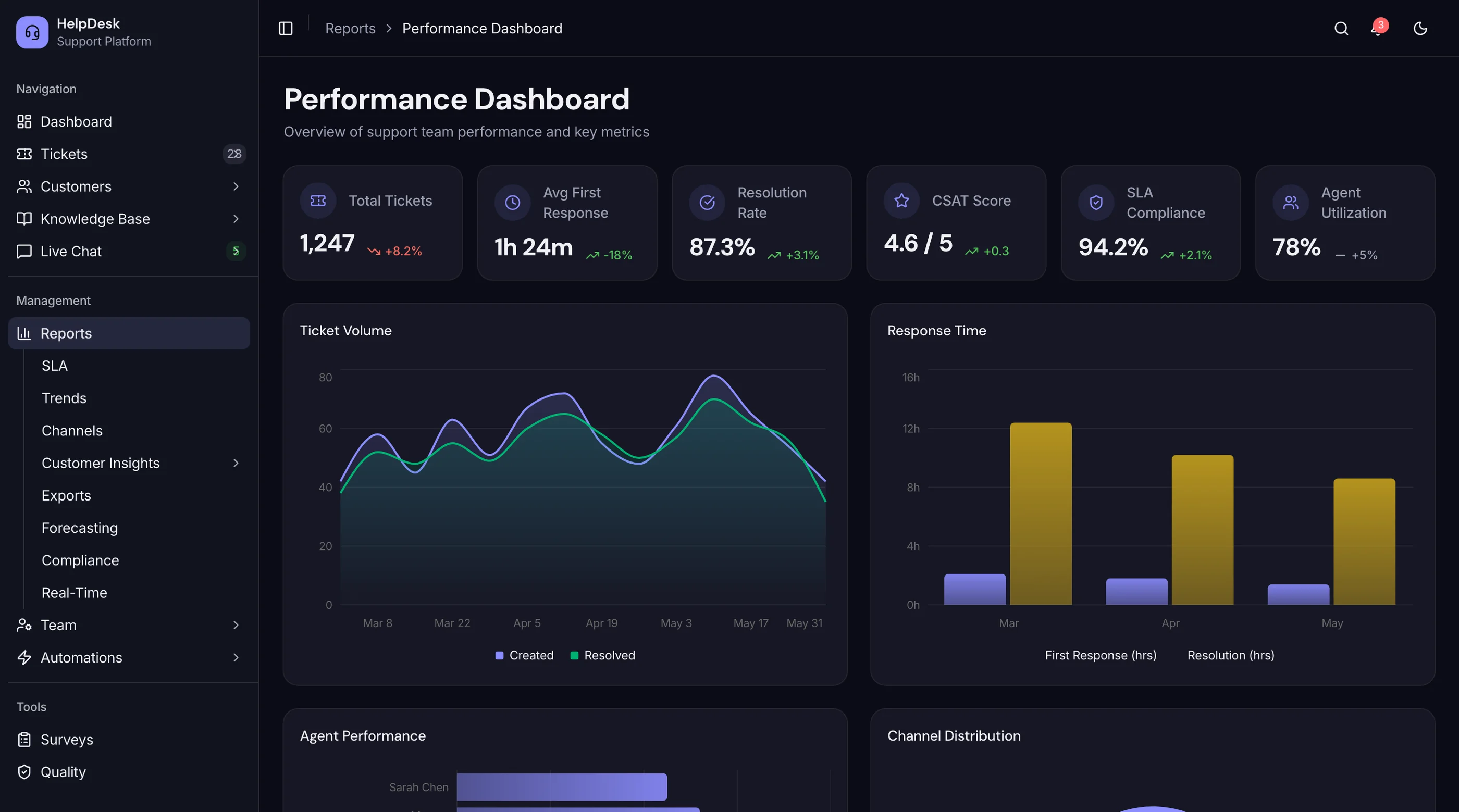
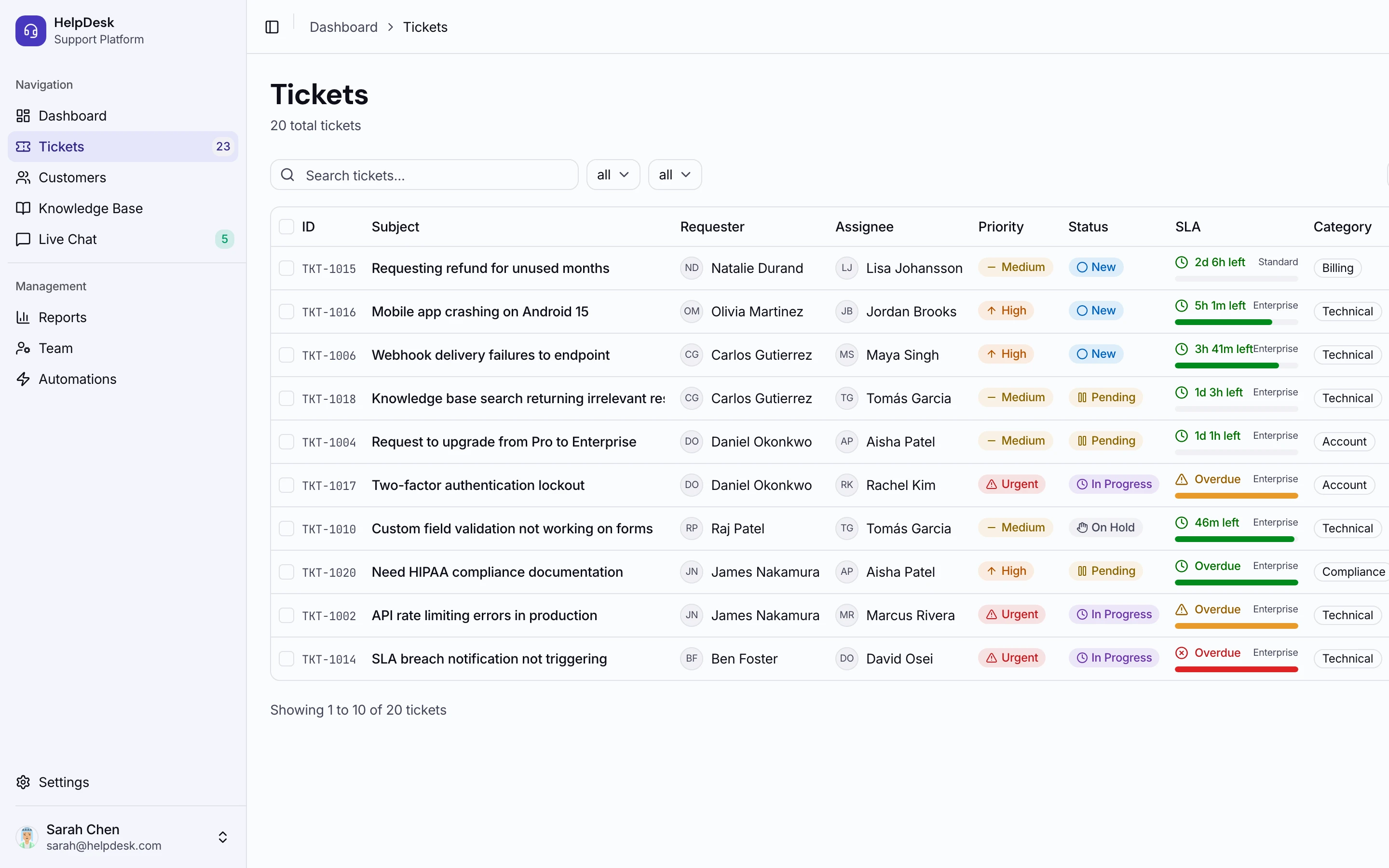
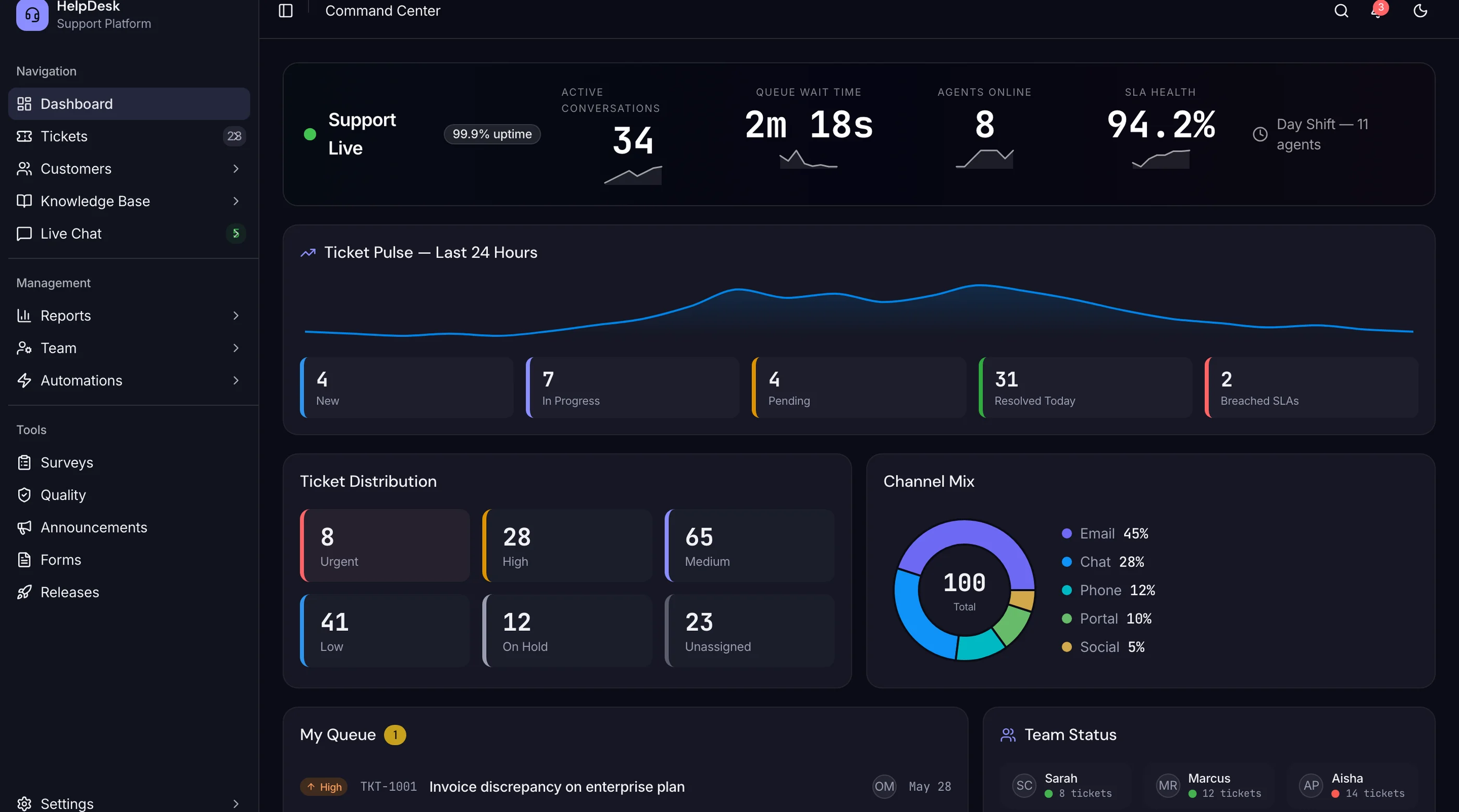
- The Help Desk Kit provides the frontend: 110 screens covering ticket inbox with SLA tracking, ticket detail with internal notes separated from customer replies, live chat, knowledge base editor, customer profiles, and reporting
- Next.js + Tailwind + shadcn/ui, WCAG AA accessible, token-driven theming for white-label deployments
- One-time $131-$349 instead of per-agent forever
Try the live demo, or get every kit (18 total) for $749 via All UI Kits. For why self-hosted help desk projects stall (and how to avoid it), see Why Self-Hosted Help Desks Stall.
Recommendation by Team Profile
| You | Pick |
|---|---|
| Outgrowing Freshdesk upward | Zendesk |
| Cheapest full feature set | Zoho Desk |
| Agent experience first | Help Scout |
| High-touch B2B conversations | Front |
| Chat and social channels dominate | Chatwoot |
| Small team, near-zero budget | FreeScout |
| Full features, self-hosted free | Zammad |
| Support inside your product | Build with the Help Desk Kit |
Pricing at a Glance (10-Agent Team, Annual)
| Product | Typical tier | ~Annual cost (10 agents) |
|---|---|---|
| Freshdesk (Growth) | $19/agent/mo | $2,280 |
| Freshdesk (Pro) | $55/agent/mo | $6,600 |
| Freshdesk (Pro + Freddy AI Copilot) | $84/agent/mo | $10,080 |
| Zendesk (Suite Team) | $55/agent/mo | $6,600 |
| Zoho Desk (Professional) | $23/agent/mo | $2,760 |
| Help Scout (Plus) | $45/user/mo | $5,400 |
| Front (Professional) | $65/seat/mo | $7,800 |
| Chatwoot (self-hosted) | Free | Hosting (our estimate: ~$300-600) |
| FreeScout (self-hosted) | Free + modules | Modules (our estimate: ~$100-300 once) |
| Zammad (self-hosted) | Free | Hosting (our estimate: ~$300-600) |
| Help Desk Kit (build path) | One-time $131-$349 | $131-$349 once, plus hosting |
Prices are annual list prices from each vendor's pricing page in September 2026. The Freshdesk-specific catch is the AI add-on math: Freddy AI Copilot adds more than half again to Pro's per-agent cost ($29 on $55), and Pro already lists at the same $55 as Zendesk Suite Team.
Connecting Freshdesk to Your CRM and Dev Tools
Support data only pays off when sales and engineering can see it. Here's what Freshdesk's official integrations actually do, as of September 2026:
- Salesforce: Freshworks' Salesforce Connector shows Salesforce leads, contacts, accounts, cases and opportunities beside a ticket, and agents can create records from there. The background data sync covers contacts and accounts only, and it runs on the paid Connector apps add-on ($80 per 5,000 tasks). Not available on the Free plan. (Freshdesk support)
- Jira: the Jira Plus app, built by Freshworks, links a ticket to up to 5 Jira issues, with comment sync, status sync and custom field mapping. Growth plan and up.
- Slack: create tickets from messages and push notifications to channels. Notes sent to Slack are cut at 250 characters, and updates can take up to 5 minutes.
- HubSpot: the main HubSpot CRM app comes from Spritle Software and is verified by Freshworks. Freshworks also publishes its own Freshdesk-HubSpot contact sync and a HubSpot Connector app.
- API: limits apply per minute across the whole account: 100 on Growth, 400 on Pro, 700 on Enterprise.
The sidebar views cover the easy part. The gaps show up when you need tickets and Salesforce cases to stay in step automatically, support history on the deal record where sales actually works, or a backfill on Growth, where your whole account shares 100 API calls a minute. And if you switch help desks, every one of these connections has to be rebuilt.
That's work we do. Our CRM integration audit checks what's syncing between your help desk and CRM, where records drift, and what it takes to fix, from $499. Or run the free sync health checklist first.
Frequently Asked Questions
Who are Freshdesk's main competitors?
Zendesk is the direct one, competing on the same omnichannel, per-agent model at the tier above. Zoho Desk undercuts Freshdesk on price with a similar feature set, Help Scout competes on agent experience rather than feature count, and Front takes the shared-inbox angle. On the self-hosted side, Zammad, FreeScout and Chatwoot compete by removing per-agent pricing entirely.
What is the cheapest Freshdesk alternative?
Zoho Desk if you want a hosted tool, since its free edition covers 3 users and its paid tiers start below Freshdesk Growth. If you are willing to run a server, FreeScout is the cheapest overall: the core is free and it installs on ordinary PHP hosting, so a small team's real cost is $20 to $60 a month of hosting rather than a per-agent fee.
Why do companies switch from Freshdesk?
Three reasons come up repeatedly. The per-agent model gets expensive exactly when you grow the support team. The AI features that matter are paid add-ons rather than included, with Freddy AI Copilot adding $29 per agent per month on top of Pro's $55. And Pro now lists at $55, the same as Zendesk Suite Team, which removes the price advantage that put Freshdesk on the shortlist in the first place.
Which Freshdesk alternative has the best reviews?
Front, at 4.7 on G2 from 2,513 reviews as of September 2026, and it is the only option here with a score that is both high and backed by a large sample. Zoho Desk and Help Scout both sit at 4.4, level with Freshdesk itself, and Zendesk is at 4.3. Chatwoot and Zammad show 4.5, but from 16 and 10 reviews respectively, which is too small a sample to compare against the thousands behind the hosted tools.
What is the best free alternative to Freshdesk?
Zoho Desk's free tier (3 agents) is the strongest hosted option. Self-hosted, FreeScout is the lightest to run and Zammad is the most complete. Chatwoot is the pick if live chat matters more than email ticketing. We compared every genuinely free option, and the catches attached to each, in free help desk software: what's actually free.
What is the best open-source alternative to Freshdesk?
Zammad for classic ticketing depth (SLA, knowledge base, portal). Chatwoot for omnichannel chat-first support. FreeScout for a minimal shared inbox on minimal hardware. All three are production-ready in 2026.
Is Zendesk or Freshdesk better?
Zendesk has more depth everywhere: routing, analytics, marketplace, AI. Freshdesk delivers the common 80% for less at the entry tiers (Growth is $19 per agent against Zendesk's $55), though Freshdesk Pro now lists at the same $55. Under 25 agents with standard workflows, Freshdesk's trade usually wins; past 50 agents or with complex routing, Zendesk's depth starts paying for itself.
Can I run a help desk without per-agent pricing?
Yes, two ways. Self-host Zammad, FreeScout, or Chatwoot: unlimited agents, you pay only hosting. Or build support into your product with the Help Desk Kit: one-time license, your infrastructure, no seat math ever.
How hard is it to migrate off Freshdesk?
Tickets, contacts, and companies export via API or CSV, and most competitors ship importers. Knowledge base articles usually need manual porting. The practical approach: migrate open tickets and contacts, keep read-only Freshdesk access for history, and sunset it after a quarter.
Does Freshdesk integrate with Salesforce?
Yes. Freshworks' Salesforce Connector app shows Salesforce leads, contacts, accounts, cases and opportunities inside a ticket, and lets agents create them. Its data sync only covers contacts and accounts, requires the paid Connector apps add-on, and isn't available on the Free plan. Syncing tickets or cases automatically needs custom work.
The Honest Take
Freshdesk is still a rational mid-market default; its problem is that its own add-on pricing is eroding the discount that made it famous. Zendesk wins on depth, Zoho on price, Help Scout on agent experience, Front on B2B conversations, and the open-source trio on ownership.
And when support is a feature of your product rather than a tool for your team, the rentals all fit poorly. That's the build path: one-time cost, your data, your brand.
Want it shipped without hiring a developer?
The build path above assumes you have engineers. If you don't, the team behind thefrontkit does done-for-you launches: we deploy the kit, apply your branding, and wire it to your stack. Fixed quotes, most builds ship in 2-4 weeks, from $1999.