Linear Alternatives: 10 Issue Trackers Compared for 2026
Linear Alternatives: 10 Options Compared for 2026
Short answer: Plane if you want something that feels like Linear but can be self-hosted. Shortcut if you want Linear's speed with a roomier free plan (free for up to 10 users). GitHub Projects or Zenhub if your work already lives in GitHub. Jira if you need heavy workflow configuration. Huly if you want an open-source all-in-one with unlimited users on a flat price. ClickUp or Asana if non-engineers need to use the tool too.
Linear is fast, opinionated and loved by engineering teams. The pricing is straightforward: Free has unlimited members but only 2 teams and 250 issues. Basic is $10/user/month and Business is $16/user/month, both billed yearly. Enterprise is custom and annual-only.
The 250-issue cap is what pushes most small teams to pay, and it arrives quickly. Then the features many teams want (unlimited teams, private teams, guests, Linear Insights, Triage Intelligence, Linear Asks, and Zendesk and Intercom integrations) sit on Business. For a 20-person engineering org, that's 20 x $16 x 12 = $3,840 a year. SAML and SCIM are Enterprise-only.
So what would you miss, and who does it better for your team? Every price below comes from the vendor's live pricing page, checked October 2026.
Coming from Jira instead? Our Jira alternatives guide covers that move, and Trello alternatives covers the lighter end.
Building issue tracking into your own product? Start with the Kanban PM Kit
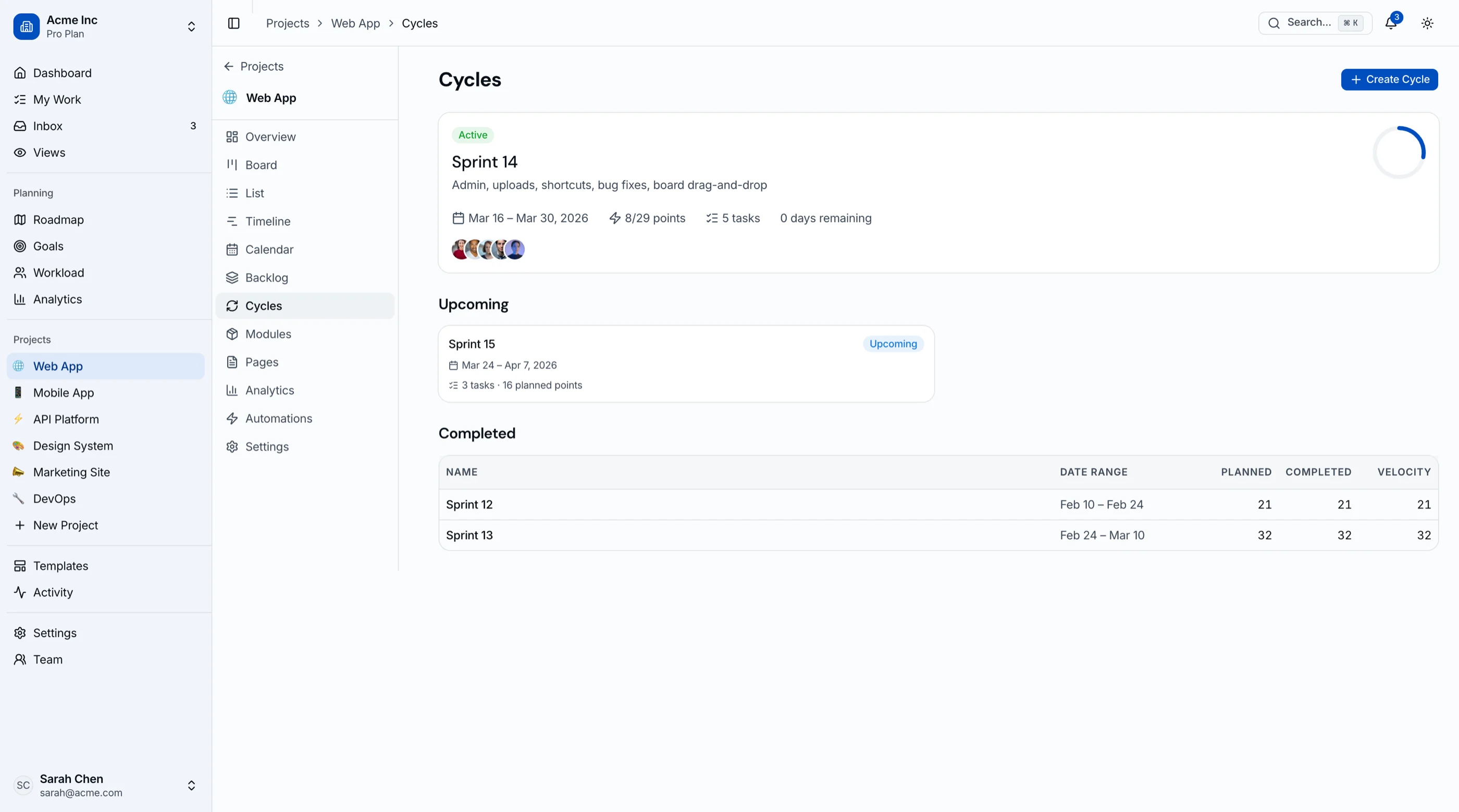
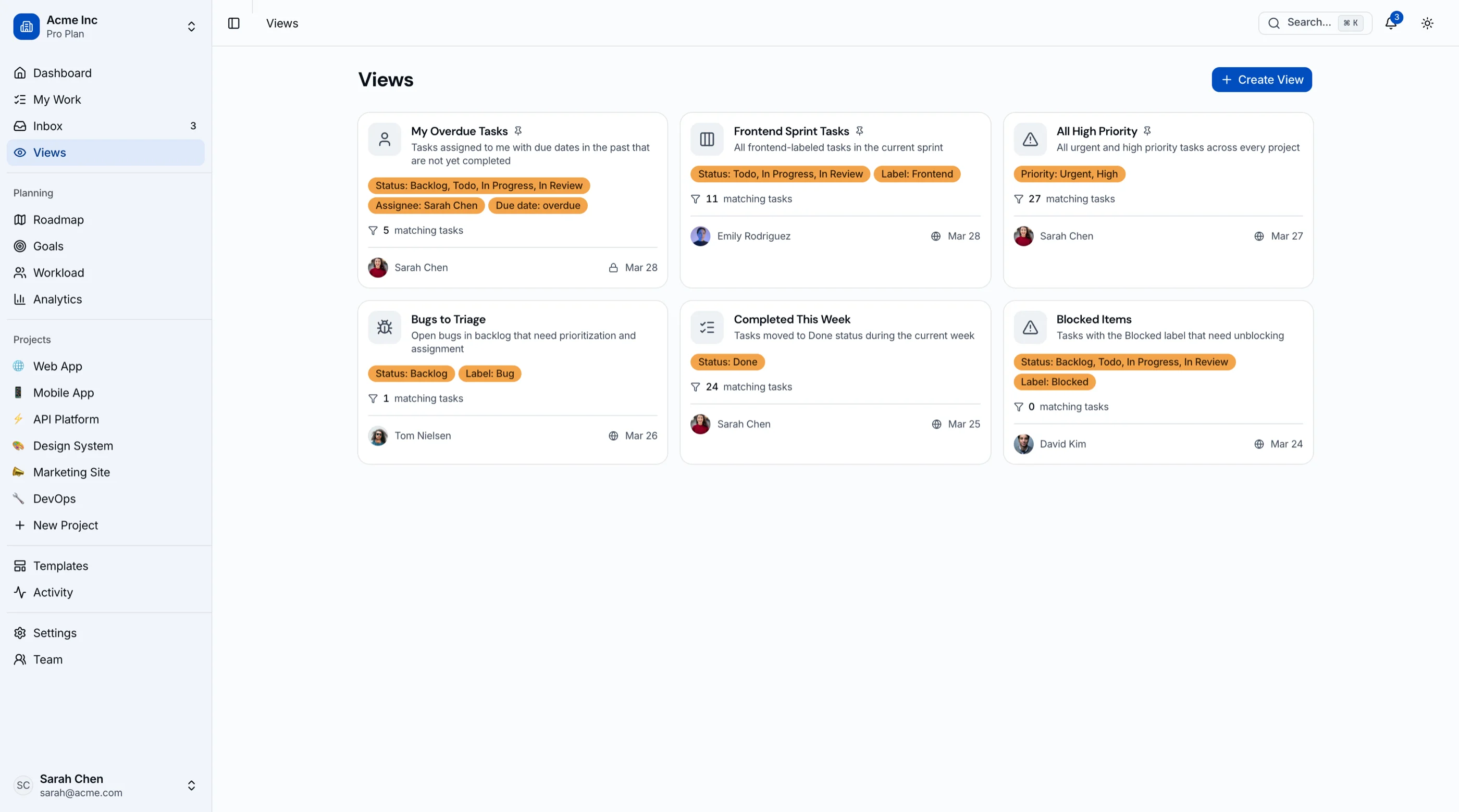
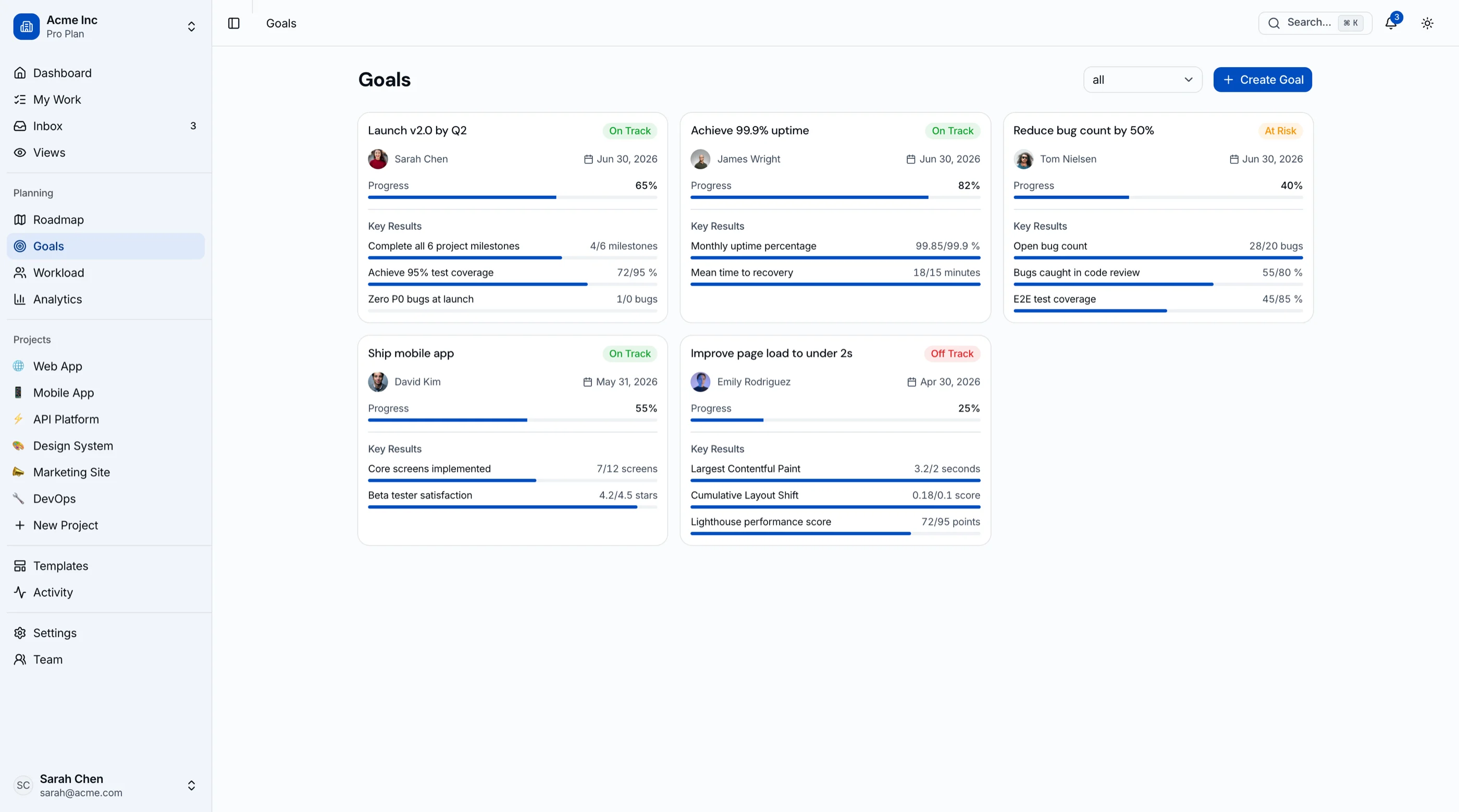
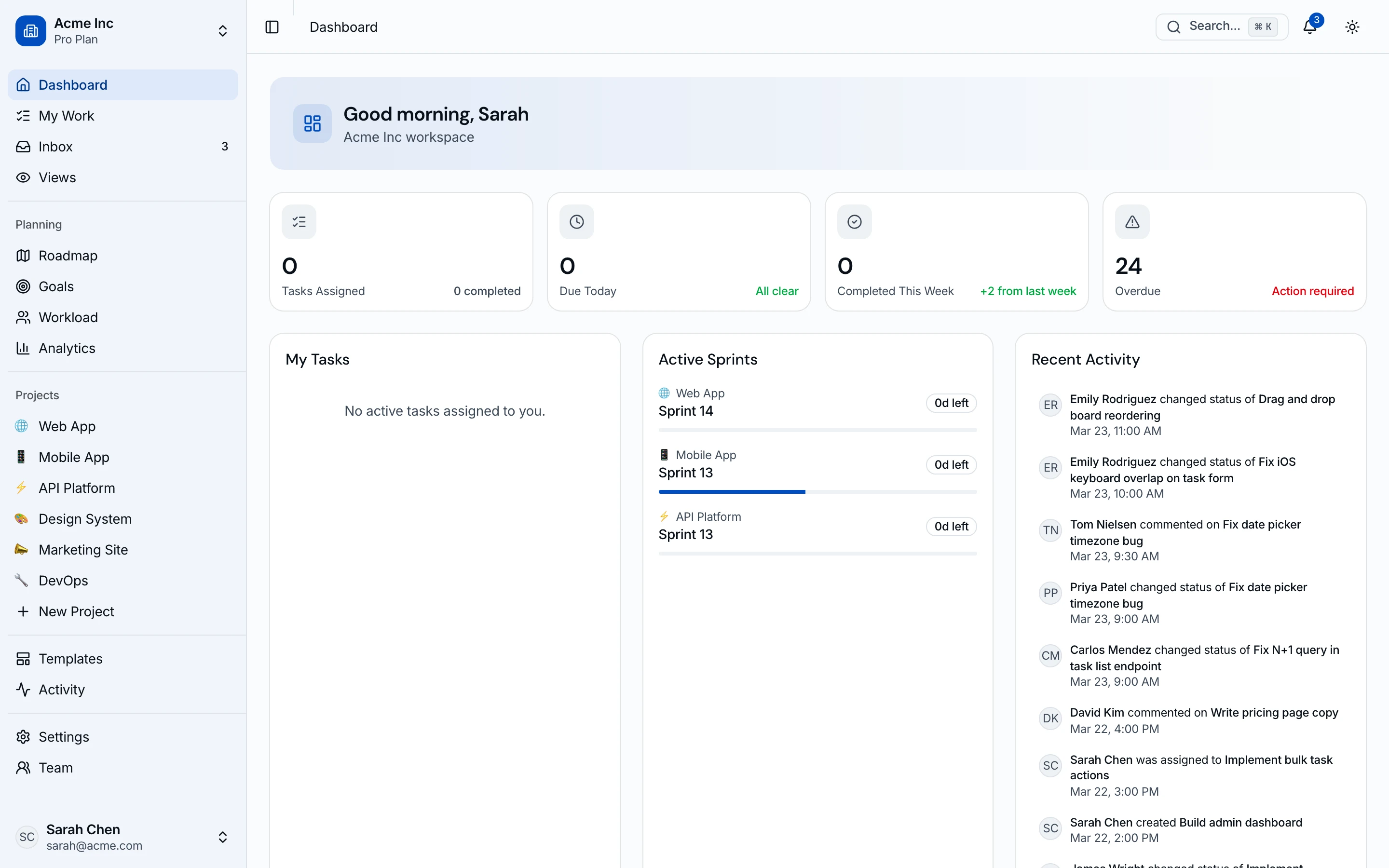
If you're adding project or issue tracking to a SaaS product, or building an internal tool shaped around your workflow, the Kanban PM Kit gives you the frontend: 45 screens of drag-and-drop Kanban boards, sprint cycles with burndown charts, a roadmap with milestones, a workload view with capacity status, goals with key results, and analytics. Next.js 16 + Tailwind CSS v4 + shadcn/ui. $131 solo. Live demo.
Get the Kanban PM Kit → or get every kit (18 total) for $749 via All UI Kits →
TL;DR: Quick Picks for 2026
| Need | Top pick | Price |
|---|---|---|
| Linear-style UX, self-hostable | Plane | Free up to 12 users, Pro $6/user/mo (yearly) |
| Fast tracker, bigger free plan | Shortcut | Free up to 10 users, Team $8.50/user/mo |
| Heavy workflow configuration | Jira | Free up to 10 users, Standard ~$8.48/user/mo |
| Work already lives in GitHub | GitHub Projects | Free, Team $4/user/mo |
| Sprint planning on top of GitHub | Zenhub | Free, Teams $4.99/user/mo (yearly) |
| Open-source all-in-one, flat price | Huly | Free, paid from $19.99/mo |
| Engineering plus everyone else | ClickUp | Free, paid from $9/user/mo (yearly) |
| Cross-functional planning | Asana | Free for 2, paid from $10.99/user/mo (yearly) |
| Open source, traditional PM | OpenProject | Free (self-host) |
| Issue tracking inside your product | Build it | $131+ one-time |
What Linear Actually Does Well
Speed is the headline, and it's real. Linear's keyboard-first UI makes creating and triaging issues feel instant, and the opinionated workflow (cycles, projects, triage) means there's very little to configure. That's why engineering teams love it.
The Free plan is generous on people: unlimited members. Linear has also leaned into AI, with the Agent platform and Linear Agent on every plan, and Triage Intelligence and Code Intelligence on Business. Linear Asks and the Zendesk and Intercom integrations on Business help pull requests from outside engineering into the tracker.
Most alternatives win on price, hosting, or breadth beyond engineering. Very few beat Linear on feel. Know that going in.
When to Leave Linear
- You hit 250 issues on Free and $10-16/user feels like a lot for a side team. Shortcut, Plane and Zenhub all have more room on their free plans.
- You need to self-host. Linear is cloud-only. Plane, Huly and OpenProject run on your servers.
- Non-engineers need it too. Linear is shaped for software teams. ClickUp and Asana fit marketing, ops and design better.
- You need SAML or SCIM. Those are Linear Enterprise only, which is custom-priced.
1. Plane
The closest thing to Linear you can host yourself.
Strengths:
- Open source (AGPL-3.0) and self-hostable, with full data ownership
- Free cloud plan for up to 12 users, including cycles and modules
- Wiki and GitHub integration from Pro
- Cheaper per seat than Linear at every paid tier
Weaknesses:
- Email and form intake are Business-only
- The polish gap to Linear is small but noticeable
- Self-hosting means upgrades and backups are yours
Pricing: Free (12 users). Pro $6/user/month yearly ($8 monthly), Business $13 yearly ($15 monthly). Enterprise Grid is custom.
Best for: Teams that like Linear's model but want their data on their own servers.
2. Shortcut
A fast tracker with a roomier free plan.
Strengths:
- Free for up to 10 users with Kanban, roadmap, iterations, reports and docs
- GitHub, Slack and Figma integrations on Free
- Business adds OKRs and multiple workspaces
- 14-day free trial on paid plans, no card
Weaknesses:
- Free is limited to 1 team and 1 workflow
- Team plan caps you at 5 teams
- Smaller ecosystem than Jira
Pricing: Free (10 users), Team $8.50/user/month, Business $12/user/month (yearly prices). Enterprise custom.
Best for: Small engineering teams that want Linear's pace without paying past 10 people.
3. Jira
The most configurable issue tracker there is.
Strengths:
- Free for up to 10 users, with backlog, board, timeline and calendar views
- Customizable workflows and custom fields on every plan
- Rovo AI search, chat and agents from Standard
- Premium adds cross-team planning, dependency management and a 99.9% uptime SLA
Weaknesses:
- Slower and heavier than Linear
- Configuration debt piles up over the years
- Per-user price changes with team size, so check your own number on the page
Pricing: Free (10 users). On monthly billing, Atlassian's calculator showed Standard at $8.48/user/month and Premium at $15.56. Annual billing saves up to 17%. Enterprise is annual-only, via sales.
Best for: Organizations that need complex workflows, permissions and audit trails. We cover the reverse move in Jira alternatives.
4. GitHub Projects
The tracker you already have if your code is on GitHub.
Strengths:
- Issues and Projects are included on GitHub Free
- Lives next to the code, PRs and reviews
- No new tool for developers to learn
Weaknesses:
- Planning features are lighter than Linear's cycles and triage
- Awkward for non-developers
- Reporting is basic
Pricing: Free. GitHub Team $4/user/month, Enterprise from $21/user/month (GitHub lists both as first-12-month prices).
Best for: Small dev teams who want tracking right next to their repos.
5. Zenhub
Sprint planning and reports on top of GitHub issues.
Strengths:
- Sprint planning, estimates, roadmaps and velocity reports on Free
- Free covers up to 50 users
- Enterprise includes a self-hosted, on-prem option
Weaknesses:
- Free is limited to 2 connected repos and 250 issues
- Tied to GitHub, so it doesn't help if your code lives elsewhere
- AI features start on Teams
Pricing: Free. Teams $4.99/user/month billed yearly (up to 50 users, 5,000 issues). Enterprise custom.
Best for: GitHub-first teams that want agile planning without leaving GitHub.
6. Huly
An open-source workspace with issue tracking and built-in video and audio calls.
Strengths:
- Open source (EPL-2.0), with the code on GitHub
- Unlimited users on every plan, including Free
- Flat monthly pricing by storage and traffic instead of per seat
Weaknesses:
- Younger product, so expect rough edges
- Doing everything in one app means each part is less deep than a specialist
- AI pricing is still listed as "TBD"
Pricing: Common free (10GB storage), Rare $19.99/month, Epic $99.99/month, Legendary $399.99/month.
Best for: Teams that want an open-source workspace with no per-seat fees.
7. ClickUp
For engineering teams that share a tool with the rest of the company.
Strengths:
- Free Forever plan with unlimited tasks and members
- Docs, whiteboards, forms and chat in one place
- Time tracking on every paid plan
Weaknesses:
- Much slower to navigate than Linear
- Lots of features means lots of setup
- Free plan caps storage at 60 MB
Pricing: Core $9/user/month, Business $17/user/month, billed annually (listed against regular prices of $12 and $25). Enterprise custom.
Best for: Companies that want one workspace for engineering, product and ops. More in our ClickUp alternatives.
8. Asana
Cross-functional planning that engineering can live with.
Strengths:
- Timeline and Gantt views from Starter
- Portfolios and workload balancing on Advanced
- Free Personal plan for up to 2 users
Weaknesses:
- Not built for engineering workflows like cycles and triage
- Seats sold in increments past 5 users
- Timesheets and budgets are an add-on
Pricing: Starter $10.99/user/month yearly ($13.49 monthly), Advanced $24.99 yearly ($30.49 monthly). Enterprise custom.
Best for: Product orgs where engineering is one team among many. See Asana alternatives.
9. OpenProject
The mature open-source PM tool.
Strengths:
- Community edition is free and open source (GPL-3.0)
- Gantt charts, work packages, time and cost reporting
- Enterprise available as cloud or on-premises
Weaknesses:
- UI is far from Linear's speed
- Enterprise plans need 25+ users
- Self-hosting is your job
Pricing: Community free. Enterprise Basic €5.95, Professional €10.95, Premium €15.95 per user/month; Corporate on request.
Best for: Organizations that need on-prem project management and don't mind a traditional UI.
10. Build Your Own Tracker
Some teams don't need another tracker. They need tracking inside their own product: a client-facing board, an internal tool shaped around a specific workflow, or project features in a SaaS app.
What that looks like:
- The Kanban PM Kit supplies the UI: Kanban boards with drag-and-drop, sprint cycles with burndown, roadmap with milestones, workload, goals and analytics, 45 screens in Next.js 16 + Tailwind CSS v4 + shadcn/ui
- You bring the backend, or start from the Full-Stack Kanban PM Kit, which is wired to Supabase with auth and row-level security
- One-time $131 solo, $199 team, $349 agency
Be realistic: this is a build, and your own engineering team should keep a real tracker. It pays off when the tracker is part of what you ship. Try the demo or read How to Build a Kanban App in Next.js.
Recommendation by Profile
| You | Pick |
|---|---|
| Love Linear, need self-hosting | Plane |
| Small team, want free longer | Shortcut |
| Complex workflows and permissions | Jira |
| Everything lives in GitHub | GitHub Projects or Zenhub |
| Want one open-source tool for everything | Huly |
| Engineering + non-engineering teams | ClickUp or Asana |
| On-prem, traditional PM | OpenProject |
| Happy, under 250 issues | Stay on Linear Free |
| Tracking is part of your product | Build it |
Pricing at a Glance (20 Users, Annual Where Offered)
| Product | Setup that fits | ~Annual cost (20 users) |
|---|---|---|
| ClickUp (Business) | $17/user/mo | $4,080 |
| Linear (Business) | $16/user/mo | $3,840 |
| OpenProject (Professional) | €10.95/user/mo, 25-user minimum | ~€3,285 |
| Shortcut (Business) | $12/user/mo | $2,880 |
| Asana (Starter) | $10.99/user/mo | $2,638 |
| Linear (Basic) | $10/user/mo | $2,400 |
| Jira (Standard) | ~$8.48/user/mo (monthly billing) | ~$2,035 |
| Plane (Pro) | $6/user/mo | $1,440 |
| Huly (Epic) | $99.99/mo flat | $1,200 |
| Zenhub (Teams) | $4.99/user/mo | $1,198 |
| GitHub Team | $4/user/mo | $960 |
| Plane, Huly or OpenProject self-hosted | Free | Hosting only |
| Kanban PM Kit | Build path | $131+ one-time + backend work |
List prices from each vendor's page in October 2026. Jira's per-user price depends on team size, so treat that row as a ballpark. OpenProject is priced in euros.
Frequently Asked Questions
How much does Linear cost in 2026?
Free has unlimited members, 2 teams and 250 issues. Basic is $10/user/month and Business is $16/user/month, billed yearly. Enterprise is custom and annual-only, and it's where SAML and SCIM live.
What is the best free alternative to Linear?
Shortcut is free for up to 10 users, Plane's cloud is free for up to 12, Jira is free for up to 10, and Zenhub is free for up to 50 (with a 250-issue cap). Huly's free plan has unlimited users. GitHub Projects is free with any GitHub account.
Is there an open-source alternative to Linear?
Yes. Plane is the closest in feel and is AGPL-3.0. Huly is EPL-2.0 with unlimited users on every plan. OpenProject is GPL-3.0 and more traditional. All three can be self-hosted.
Is Linear better than Jira?
For speed and day-to-day developer experience, most teams say yes. Jira wins when you need custom workflows, permission schemes and audit trails, and it's free for up to 10 users where Linear Free caps you at 250 issues.
Can I self-host Linear?
No, Linear is cloud-only. If self-hosting is a requirement, Plane is the closest match, with Huly and OpenProject as other options.
The Honest Take
Linear is the best-feeling issue tracker on the market. If your team is engineering-only, under the issue cap or happy at $10-16 a seat, stay.
Leave for a specific reason. Self-hosting points to Plane, Huly or OpenProject. A bigger free plan points to Shortcut or Zenhub. GitHub-centric teams should try GitHub Projects first. Complex enterprise workflows still point to Jira. Cross-functional companies do better in ClickUp or Asana.
And if what you really need is issue tracking inside your own product, build it on a kit and keep Linear for your own team.
Want it shipped without hiring a developer?
The build path above assumes you have engineers. If you don't, the team behind thefrontkit does done-for-you launches: we deploy the kit, apply your branding, and wire it to your stack. Fixed quotes, most builds ship in 2-4 weeks, from $1999.