Workday Alternatives: 8 HR Platforms for 2026
Workday Alternatives: 8 Options Compared for 2026
Short answer: for companies under 200 people, BambooHR is the usual replacement for Workday. Between 200 and 1,000, HiBob and Rippling are the two that come up most. If payroll is the real problem, Gusto is the answer. If budget is the real problem, Zoho People costs a fraction of everything else. And if you only need the reporting layer, keep your HRIS and build the dashboard yourself.
Workday doesn't publish pricing, which tells you most of what you need to know about who it's for. It's enterprise HCM: payroll, benefits, talent, planning, and analytics in one system, sold on annual contracts with implementations measured in quarters rather than weeks.
Teams look for alternatives for three reasons that come up again and again. The cost only makes sense at scale, so companies that grew into Workday early end up over-tooled. Implementation and change requests need consultants, which makes small changes slow and expensive. And the interface was built for HR administrators rather than for the managers and employees who touch it a few times a year.
Eight alternatives worth comparing, from mid-market platforms to open-source self-hosted to owning the dashboard layer outright.
For what an HR dashboard actually has to show, see our How to Build an HR Dashboard in Next.js guide.
Or skip the build entirely: get the HR Dashboard Kit
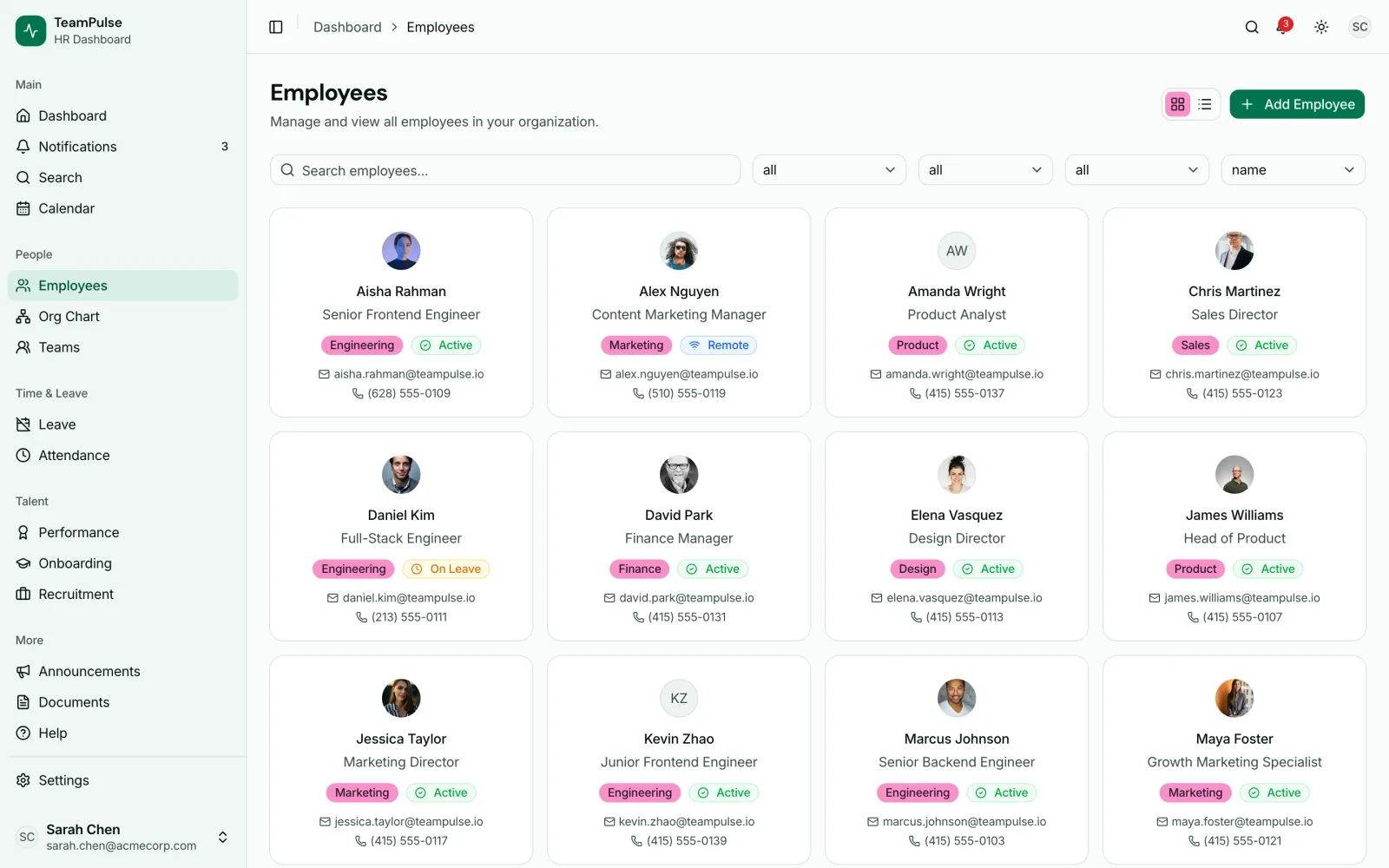
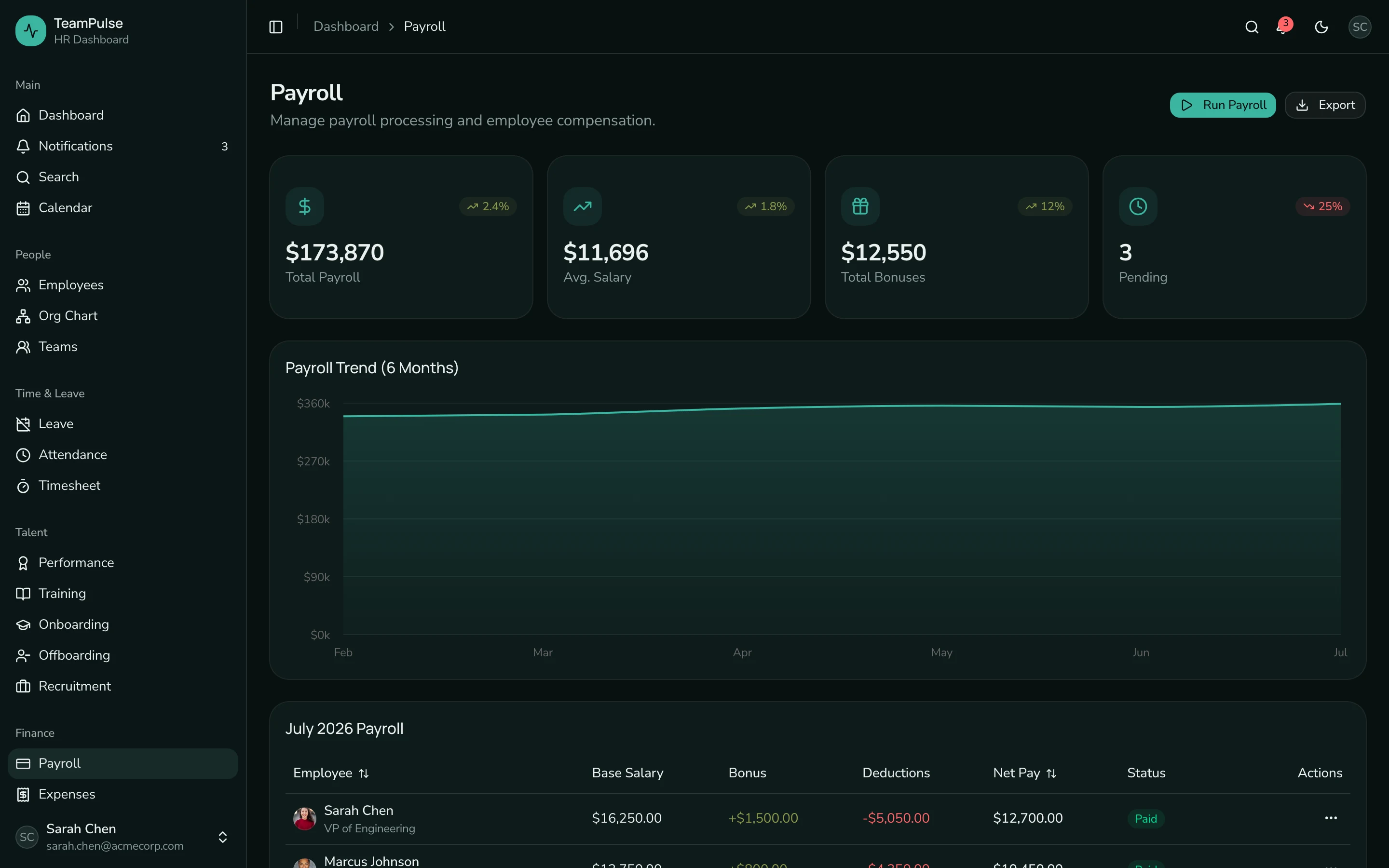
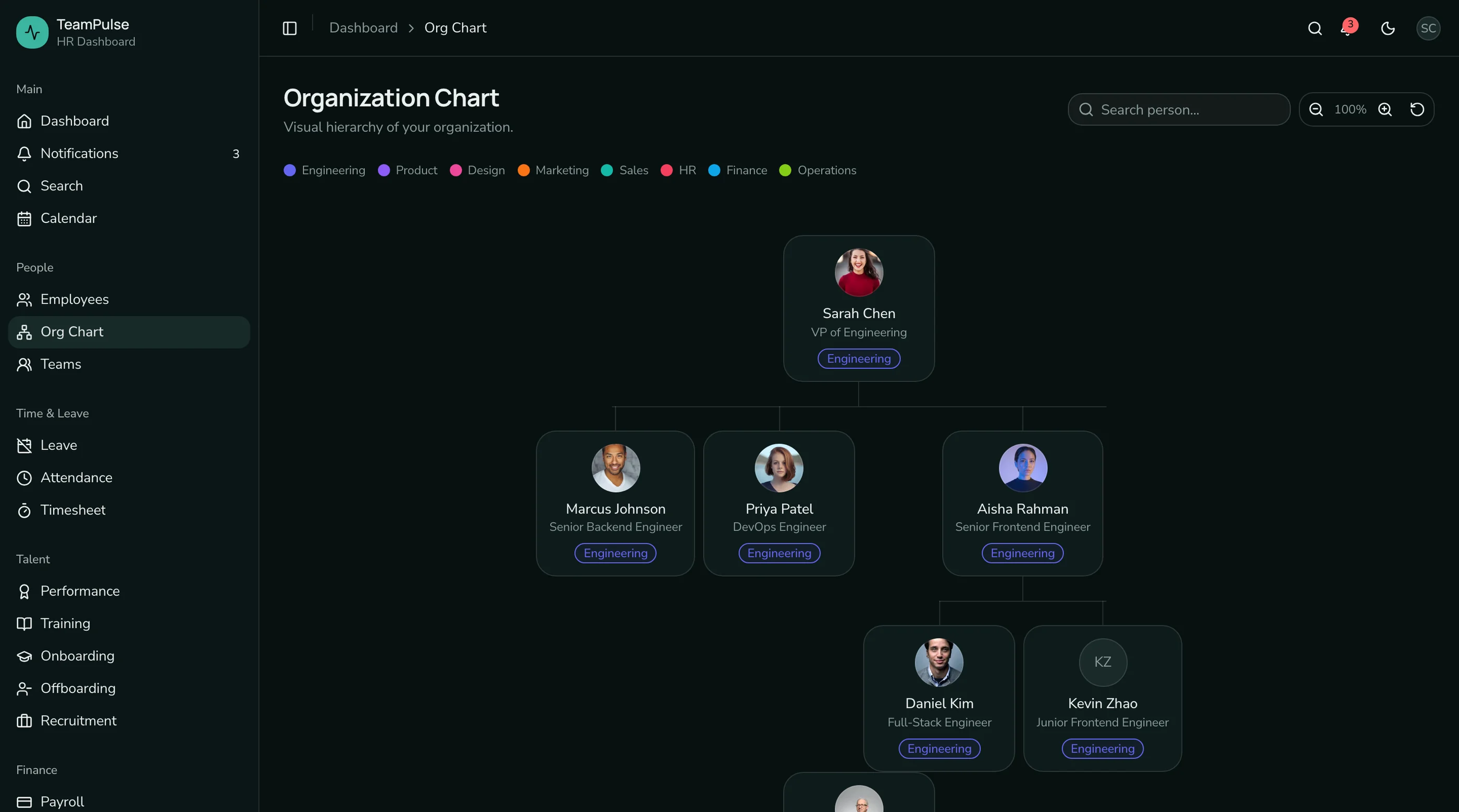
The HR Dashboard Kit is shipped: 48 screens covering employee directory, leave management, attendance tracking, an interactive org chart, onboarding checklists, performance reviews, and a recruitment pipeline. Next.js + Tailwind + shadcn/ui, WCAG AA. $131 solo, $199 team, $349 agency. Try the live demo.
Get the HR Dashboard Kit → or get every kit (18 total) for $749 via All UI Kits →
TL;DR: Quick Picks for 2026
| Need | Top pick | Price |
|---|---|---|
| Under 200 employees, easiest to run | BambooHR | $10-$25/employee/mo (add-ons quoted) |
| HR, IT, and payroll in one system | Rippling | From roughly $8/user/mo, modular |
| Mid-market, modern employee experience | HiBob | Quote-based |
| Payroll first, small business | Gusto | Base fee + per person, from roughly $6 |
| Mid-market HRIS with benefits admin | Namely | Quote-based |
| Cheapest credible option | Zoho People | From roughly $1.50/employee/mo |
| Open source, self-hosted | OrangeHRM | Free community edition |
| HR dashboard inside your own product | thefrontkit HR Dashboard Kit | $131+ one-time |
Pricing in HR software is quote-heavy and changes constantly. Treat every number here as directional and get your own quote before deciding.
What Workday Actually Does Well
Worth saying clearly, because the alternatives don't all replace it. Workday is genuinely strong at global payroll across many countries, at complex org structures with matrix reporting, and at workforce planning tied to finance. If you have 5,000 employees across 20 countries, most of this list cannot do what Workday does.
The case for alternatives isn't that Workday is bad software. It's that most companies buying it are buying for the org they hope to become rather than the one they are.
When to Leave Workday
Three signals:
- You're under 1,000 employees and the annual contract plus implementation support is a visible line in the budget.
- Every change needs a consultant. If adding a field or changing an approval flow takes a ticket and a quote, the system is heavier than your process.
- Managers avoid it. When people export to spreadsheets to do their actual work, the HRIS has become a system of record rather than a system of use.
1. BambooHR
The default answer for small and mid-size companies leaving enterprise HCM.
Strengths:
- Fast to implement, usually weeks rather than quarters
- Employees and managers actually use it without training
- Solid core HRIS: records, time off, onboarding, e-signature
- Good reporting for the size of company it targets
- Large integration marketplace
Weaknesses:
- Payroll is US-centric and weaker for international teams
- Advanced performance and compensation features cost extra
- Reporting gets thin once you want cross-object analysis
- Payroll, benefits and time tracking are quoted add-ons on top of the $10-$25/employee/month list price
Best for: 25 to 500 employees, primarily US-based, who want an HRIS people will open voluntarily.
2. Rippling
HR, IT, and payroll in one system, with device management as the differentiator.
Strengths:
- Onboarding provisions the laptop, the accounts, and the payroll record in one flow
- Genuinely modular, so you buy the parts you need
- Strong automation across HR and IT boundaries
- Global employment and contractor support
Weaknesses:
- Modular pricing adds up quickly once you enable several products
- The breadth means more setup than a pure HRIS
- Some depth is traded for coverage, particularly in talent management
- Best value only if you actually want the IT side
Best for: Companies that want to stop running HR and IT as separate systems with separate onboarding checklists.
3. HiBob
Mid-market HR platform built around employee experience rather than administration.
Strengths:
- Interface people are willing to use, which is rarer than it should be
- Strong on culture, engagement, and org visibility
- Flexible org structures for companies that aren't a clean hierarchy
- Good analytics for the mid-market
Weaknesses:
- Quote-based pricing, generally above BambooHR
- Payroll usually means a partner rather than native
- Overkill under about 100 employees
- Younger than the incumbents in benefits administration
Best for: 100 to 1,000 employees who care about the employee-facing side as much as the HR-facing side.
4. Gusto
Payroll-first platform that grew HR features, rather than the other way around.
Strengths:
- Payroll and compliance are the core product and it shows
- Benefits administration built in for US teams
- Genuinely simple for companies without a dedicated HR person
- Transparent pricing, which is unusual in this category
Weaknesses:
- HR features are lighter than a real HRIS
- US-focused, limited outside it
- Performance and talent management are basic
- Reporting is thin for larger teams
Best for: Small US companies where payroll accuracy matters more than org charts and performance cycles.
5. Namely
Mid-market HRIS with payroll and benefits administration bundled.
Strengths:
- Covers HRIS, payroll, and benefits in one contract
- Built for the mid-market gap between Gusto and Workday
- Managed benefits services available
- Reasonable reporting for compliance needs
Weaknesses:
- Quote-based pricing
- Support quality is a recurring theme in reviews
- Interface feels dated next to HiBob or Rippling
- Less flexible than newer platforms for unusual org structures
Best for: 50 to 500 employees who want HRIS, payroll, and benefits from a single vendor.
6. Zoho People
The budget option, and much more capable than the price suggests.
Strengths:
- Costs a fraction of everything else on this list
- Covers records, time off, attendance, and basic performance
- Integrates with the wider Zoho suite if you already use it
- Usable free or near-free tier for very small teams
Weaknesses:
- Interface is functional rather than pleasant
- Payroll is limited by region
- Depth drops off for complex requirements
- Support matches the price
Best for: Cost-conscious teams, especially those already running Zoho CRM or Books.
7. OrangeHRM
Open-source HRIS you can self-host.
Strengths:
- Community edition is free and genuinely self-hostable
- Covers the HRIS core: employees, leave, time, recruitment
- Your data stays on your infrastructure
- Paid editions available if you want support
Weaknesses:
- You own hosting, updates, and backups
- Interface is dated
- Payroll and benefits generally need other tools
- The free edition is meaningfully narrower than the paid ones
Best for: Teams with an ops or IT function who want data residency and no per-employee fee.
8. Build the Dashboard on Top with the HR Dashboard Kit
The option most teams skip: keep the HRIS, and stop asking it to be the reporting layer.
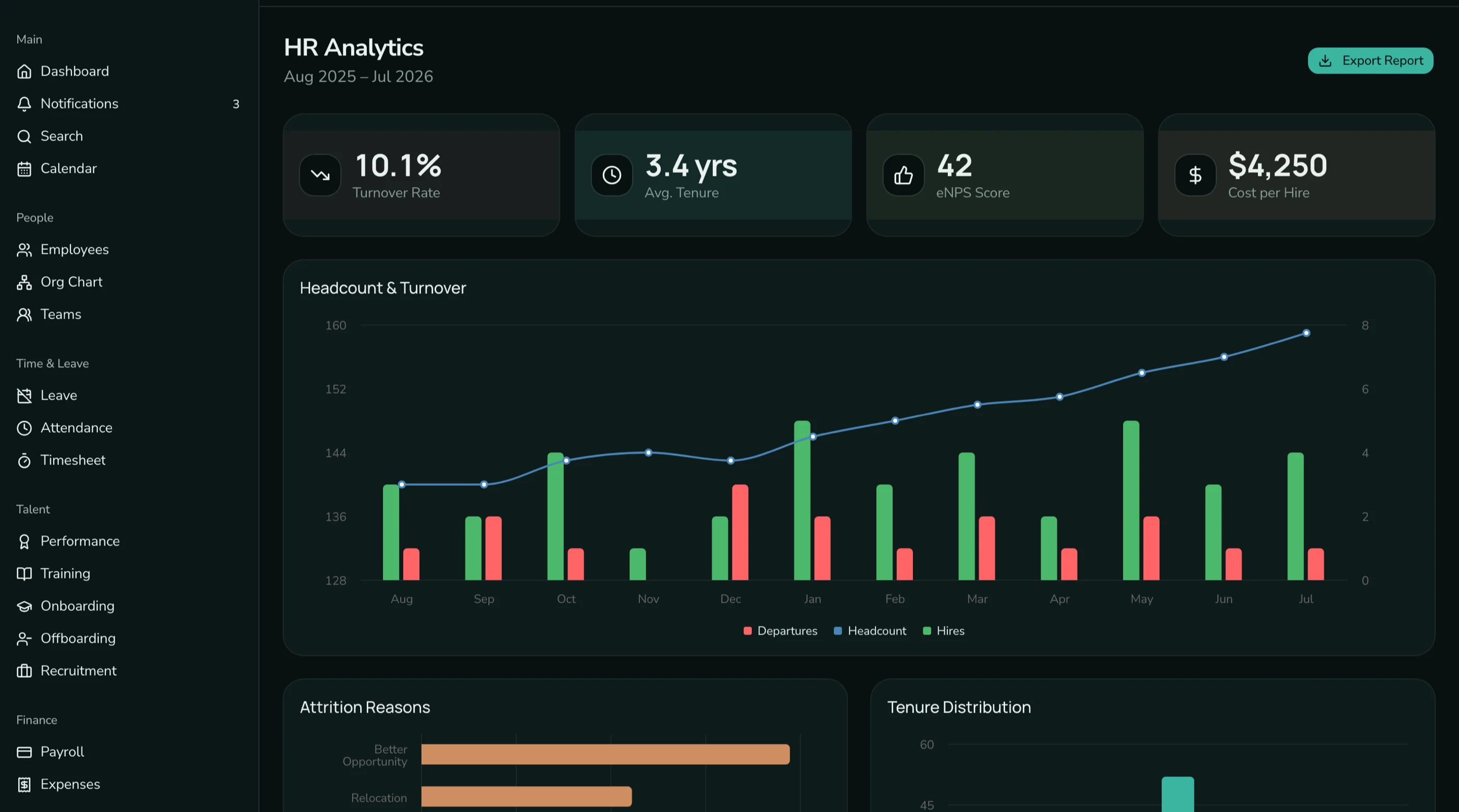
Most of the frustration with Workday isn't the record-keeping. It's that getting a headcount trend, an attrition breakdown, or a time-off forecast in front of a manager takes an export and a spreadsheet. That's a UI problem, not an HRIS problem.
The HR Dashboard Kit ships 48 screens for exactly that layer: employee directory with profiles, an interactive org chart, leave management with approval flows, attendance tracking, onboarding checklists, performance review cycles with goals and OKRs, and a recruitment kanban. Six Recharts dashboards cover the reporting. Everything is responsive, so an HR lead can approve time off on a phone and read performance reports on a desktop.
Be clear about what this is. It's the frontend. There's no backend, no database, no HRIS or payroll integration, and no auth service in the box. You point it at Workday's API, or BambooHR's, or your own warehouse, and you own the presentation layer completely. If you want a system of record, buy one from the list above. If you want the views your managers will actually open, this is the shortcut.
- Screens: 37
- People: Directory, profiles, interactive org chart, departments
- Time: Leave requests with approvals, attendance, balances
- Talent: Performance reviews, goals and OKRs, onboarding, recruitment kanban
- Not included: Backend, HRIS or payroll integration, auth, email delivery
- Price: $131 solo / $199 team / $349 agency
Recommendation by Team Profile
| You | Pick |
|---|---|
| Under 25 employees, payroll is the pain | Gusto |
| 25-500, US-based, want simple | BambooHR |
| Want HR and IT onboarding unified | Rippling |
| 100-1,000, employee experience matters | HiBob |
| 50-500, want HRIS + payroll + benefits bundled | Namely |
| Budget is the binding constraint | Zoho People |
| Need data on your own servers | OrangeHRM |
| 1,000+, global payroll, complex org | Stay on Workday |
| Keep the HRIS, fix the reporting | Build with the HR Dashboard Kit |
| Building HR features into your own product | Build with the HR Dashboard Kit |
Pricing at a Glance (200 Employees, Annual)
Directional only. Most vendors here quote rather than publish, and headcount tiers move the number a lot.
| Product | Typical basis | Rough annual cost (200 employees) |
|---|---|---|
| Workday | Quote, annual contract | Six figures is common at this size |
| BambooHR | Per employee, per month | $24,000-$60,000 list, before add-ons |
| Rippling | Per user, modular | Roughly $19,000+ depending on modules |
| HiBob | Quote | Typically above BambooHR |
| Gusto | Base fee + per person | Roughly $15,000-$29,000 |
| Namely | Quote | Mid-market range |
| Zoho People | Per employee, per month | Roughly $3,600-$12,000 |
| OrangeHRM (self-hosted) | Free community edition | Hosting and your time |
| HR Dashboard Kit + your HRIS | One-time | $131-$349 once, plus hosting |
The pattern is the familiar one. Per-employee SaaS compounds with headcount. Self-hosting compounds with your time. A one-time UI layer does neither, but it also doesn't replace a system of record.
Frequently Asked Questions
What is the best alternative to Workday?
It depends on why you're leaving. On cost and simplicity: BambooHR under 500 employees, Zoho People if budget is the hard constraint. On employee experience: HiBob. On unifying HR with IT provisioning: Rippling. On payroll specifically: Gusto. If the record-keeping is fine and only the reporting is broken, the cheapest fix is to keep Workday and build the dashboard layer separately.
Is there a free alternative to Workday?
OrangeHRM's community edition is free and self-hostable, covering employee records, leave, time tracking, and recruitment. You pay in hosting and maintenance instead of licence fees. Zoho People is not free at scale but starts low enough to be close for small teams.
What is the best open-source alternative to Workday?
OrangeHRM is the most complete open-source HRIS. Odoo's HR modules are worth a look if you already run Odoo for other operations. Neither replaces Workday's global payroll, so plan to pair them with a payroll provider.
Is Workday worth it for a company under 500 employees?
Usually not. Workday's economics and feature depth assume complex, multi-country organisations. Under 500 employees, most companies use a fraction of what they pay for, and the implementation and change-request overhead is felt more sharply on a smaller HR team.
Can I keep Workday and just fix the reporting?
Yes, and for a lot of companies that's the honest answer. HR keeps working in Workday as the system of record. You pull headcount, attrition, leave, and performance data through its API into a dashboard with your own views and definitions. That's the build path described above with the HR Dashboard Kit.
How hard is it to migrate off Workday?
Harder than migrating a CRM, because payroll and benefits have compliance implications and cannot be run half-migrated. The data export is manageable. The work is in reimplementing approval flows, comp structures, and integrations, then running a parallel payroll cycle before you switch. Budget a quarter for a mid-size company, and don't migrate in the middle of a benefits enrolment period.
The Honest Take
Workday is the right answer for large, complex, multi-country organisations, and most of this list cannot replace it at that size. The alternatives win at specific edges: simplicity and adoption (BambooHR), unified HR and IT (Rippling), employee experience (HiBob), payroll (Gusto), bundled mid-market (Namely), price (Zoho People), data ownership (OrangeHRM), or the reporting layer (build it).
The option most teams underweight is the last one. An HRIS is best at being the system of record. A custom dashboard is best at answering the questions managers actually ask. Those are different jobs, and forcing one system to do both is how companies end up paying enterprise prices for spreadsheets.
For the failure modes that hit HR dashboards specifically, see How to Build an HR Dashboard in Next.js, and for the build-versus-buy maths, HR Dashboard Template vs Building From Scratch.
Want it shipped without hiring a developer?
The build path above assumes you have engineers. If you don't, the team behind thefrontkit does done-for-you launches: we deploy the kit, apply your branding, and wire it to your stack. Fixed quotes, most builds ship in 2-4 weeks, from $1999.