Thinkific Alternatives: 10 Course Platforms for 2026
Thinkific Alternatives: 10 Options Compared for 2026
Short answer: Teachable is the cheapest like-for-like swap (Builder is $69/month billed yearly with no Teachable fee). LearnWorlds is the pick for interactive video and a branded academy. Kajabi if you want courses, email and funnels in one bill. Circle, Mighty Networks or Skool if the community matters more than the course. And if you'd rather own the platform than rent it, Moodle, Open edX or our LMS kits.
Thinkific's cheapest plan is now Start, at $109/month, or $82/month billed yearly. Grow is $219 ($164 yearly) and Expand is $499 ($374 yearly). There's no free plan, just a 30-day trial. A branded mobile app is a $199/month add-on.
That's close to four figures a year before you've sold anything, which is a lot for a creator still finding an audience. It's also the main reason this search exists.
Below are ten alternatives: four hosted course platforms, three community-first platforms, one budget all-in-one, open source, and building your own. We checked every price on the vendor's own pricing page on October 24, 2026.
Want to own your course platform? Start with the LMS Kit
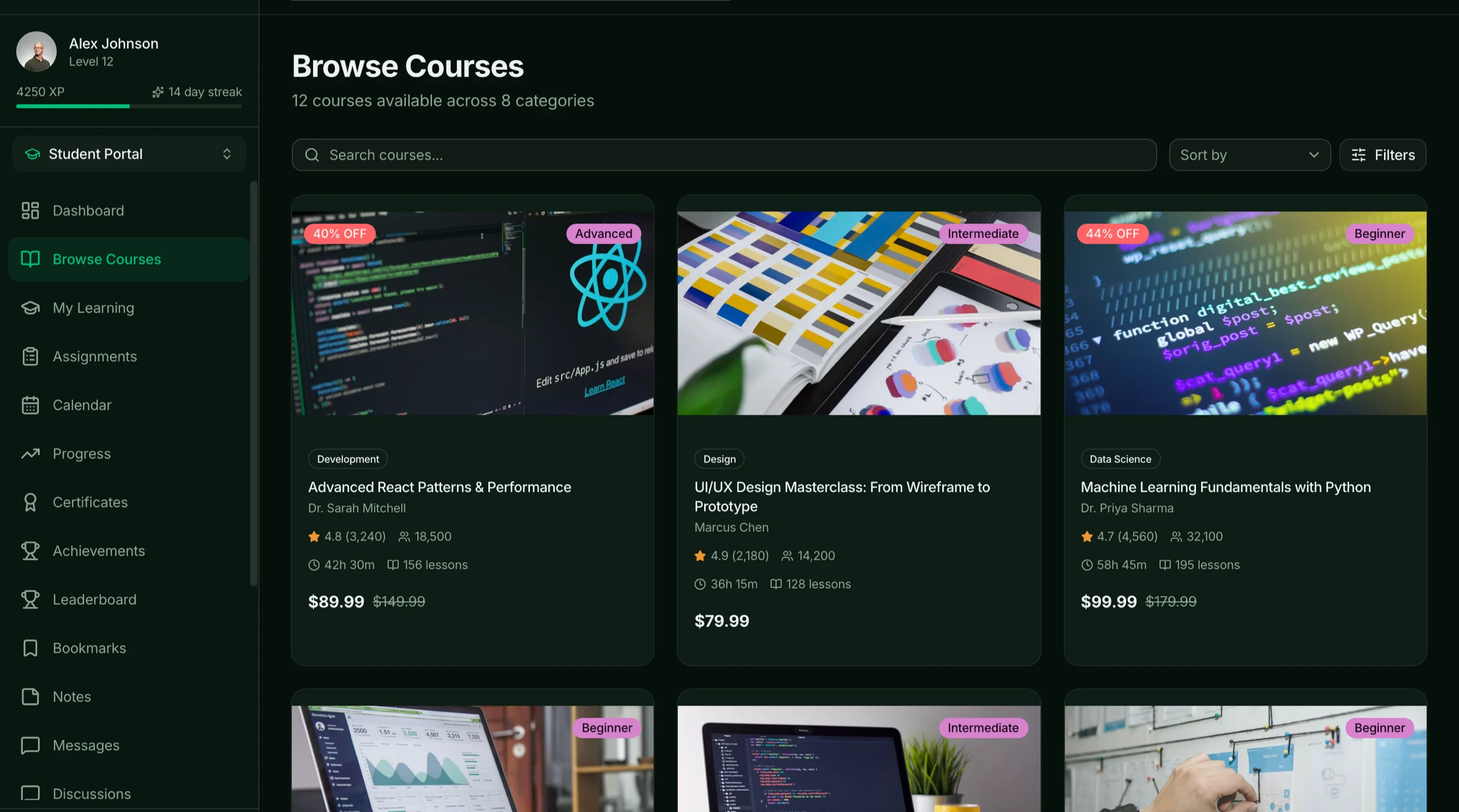
The LMS Kit gives you 39 Next.js screens: student dashboard, course catalog, a video lesson player with bookmarks, a quiz engine with timer and scoring, discussion forums, certificates, instructor tools and an admin panel. $131 one-time. Need a working backend too? The Full-Stack LMS Kit wires it all to Supabase for $332. Try the live demo.
Get the LMS Kit → or see the Full-Stack LMS Kit →
TL;DR: Quick Picks for 2026
| Need | Top pick | Price |
|---|---|---|
| Closest swap, lower bill | Teachable | From $29/mo yearly (7.5% fee), $69/mo yearly with no fee |
| Interactive courses, branded academy | LearnWorlds | From $24/mo yearly ($5 per paid enrollment) |
| Courses, email and funnels in one tool | Kajabi | From $143/mo yearly |
| Courses plus downloads and memberships | Podia | From $42/mo yearly (5% fee) |
| Community first, courses second | Circle | From $89/mo yearly |
| Branded community app | Mighty Networks | From $79/mo |
| Cheapest community plus classroom | Skool | $9/mo (10% fee) or $99/mo |
| Free to start | Systeme.io | Free plan, paid from $17/mo |
| Open source, self-hosted | Moodle or Open edX | Free (plus hosting) |
| Your own branded platform | thefrontkit LMS Kit | $131+ one-time |
What Thinkific Actually Does Well
Thinkific's course builder is still one of the best in the category. It's course-first, so the curriculum editor, quizzes, assignments and completion certificates feel like the core product. Communities live in the same place as the courses, and the app store covers most of what the core doesn't.
It also plays well with businesses selling training to other businesses, which is why the higher tiers and Plus exist. If you're on Grow and using most of it, staying is a reasonable call.
The trouble is mostly price. With Start at $109/month, a creator selling a few hundred dollars a month is paying a big share of revenue just to stay online.
When to Leave Thinkific
- The new entry price is out of proportion to revenue. If $984 a year (Start, billed yearly) is a large chunk of what your courses earn, a cheaper platform or a one-time build makes more sense.
- Community is the real product. Thinkific has communities, but Circle, Mighty Networks and Skool are built around them.
- You want the platform to be yours. Custom learner experience, your own domain end to end, your own data model. That's where self-hosting or building wins.
1. Teachable
The closest like-for-like swap, and now cheaper at the entry level.
Strengths:
- Starter $39/month ($29 yearly), Builder $89 ($69 yearly), Growth $189 ($139 yearly)
- 0% Teachable transaction fee on Builder and up when you use Teachable Payments
- Very fast to launch, with checkout, certificates and progress tracking built in
- Free trial plus a 30-day guarantee
Weaknesses:
- Starter takes 7.5% of every sale
- No free plan
- Customization is template-bound
- Same hosted model as Thinkific, so the same ownership question
Pricing: Starter $29/mo, Builder $69/mo, Growth $139/mo (billed yearly). Custom is quote-only.
Best for: Thinkific users who want the same kind of product at a lower monthly bill. We cover this platform's own alternatives in Teachable Alternatives.
2. LearnWorlds
The interactive-course platform, and the cheapest paid entry on this list.
Strengths:
- Interactive video, assessments and certificates are core features
- Pro Trainer and up have no LearnWorlds enrollment fee
- Strong for selling training to businesses under your own brand
- 30-day trial
Weaknesses:
- Starter charges $5 per paid enrollment
- More settings to learn than Teachable or Podia
- Card processing is separate (the page cites Stripe and PayPal at 2.9% + $0.30)
Pricing: Starter $29/month ($24 yearly), Pro Trainer $99 ($79 yearly), Learning Center $299 ($249 yearly). Corporate is quote-only.
Best for: Creators and training businesses who care about engagement and want the academy to look like their brand. If you're weighing it against other options, we have a separate LearnWorlds alternatives guide.
3. Kajabi
The all-in-one: courses, website, email, funnels and community.
Strengths:
- Replaces several tools with one login
- Polished for creators selling high-ticket programs
- Free trial on every plan
Weaknesses:
- Basic $179/month ($143 yearly), Growth $249 ($199), Pro $499 ($399)
- Kajabi Payments in the US runs 2.9% + $0.30 on Basic down to 2.7% + $0.30 on Pro
- Using a third-party payment provider adds a Kajabi fee of 2% on Basic, 1% on Growth and 0.5% on Pro
- Overkill if you only need a course player
Pricing: From $143/month billed yearly.
Best for: Established creators who'll actually use the email and funnel tools. More options in our Kajabi alternatives guide.
4. Podia
A simple storefront for courses, downloads and memberships.
Strengths:
- Sells courses, digital downloads and community from one storefront
- No Podia transaction fee on Shaker and Earthquaker
- Unlimited customers on every plan
- 14-day trial, no card needed
Weaknesses:
- Mover takes 5% and caps you at 100 email subscribers and 50 products
- Lighter course features than Thinkific
- Stripe or PayPal fees (2.9% + 30¢) are on top
Pricing: Mover $49/month ($42 yearly), Shaker $99 ($84 yearly), Earthquaker $179 ($150 yearly).
Best for: Creators selling a mix of small digital products. See our Podia alternatives roundup if you're comparing the two directly.
5. Circle
Community platform with courses, events and spaces.
Strengths:
- Best-in-class discussion and member experience
- Courses, events and spaces under one membership
- 14-day trial, no card required
Weaknesses:
- Course building is lighter than Thinkific
- Transaction fees of 2% on Professional and 1% on Business and Scale
- The pricing page lists yearly prices only
Pricing: Professional $89/month, Business $199, Scale $419 (all billed yearly). Circle Plus is quote-only.
Best for: Paid communities where the courses are supporting material.
6. Mighty Networks
Community, courses and a branded app, in one network.
Strengths:
- Courses sit inside the community, so members don't bounce between tools
- 14-day trial on the Growth Plan, no card needed
Weaknesses:
- Transaction fees of 2% on Launch, 1% on Scale and 0.5% on Growth
- More community-shaped than course-shaped
Pricing: Launch $79/month, Scale $179, Growth $354 (monthly billing). Annual billing gets 2 months free, and Launch is $950/year. Mighty Pro is quote-only.
Best for: Creators building a membership where the course is one part of the network.
7. Skool
Community, a classroom tab and a leaderboard. That's most of it, on purpose.
Strengths:
- The cheapest way in at $9/month
- Simple enough that members figure it out without onboarding
- Courses sit next to the community feed and calendar
Weaknesses:
- Hobby takes 10% of sales, and Pro takes 2.9%
- The classroom is basic: no deep quizzing or assessment
- Very little design control
Pricing: Hobby $9/month, Pro $99/month.
Best for: Creators whose course is really a community with lessons attached.
8. Systeme.io
The budget all-in-one with a real free plan.
Strengths:
- Free plan that covers courses, funnels and email
- Paid plans are cheap and the FAQ says 0% transaction fees across all plans
- Good for testing an offer before you commit
Weaknesses:
- Course delivery is functional, not pretty
- Smaller ecosystem than Thinkific
- You'll probably outgrow it if the business takes off
Pricing: Free, Startup $17/month, Webinar $47, Unlimited $97. Annual billing gets 2 months free.
Best for: Validating a course idea on a near-zero budget.
9. Moodle and Open edX
Open source, self-hosted, no per-student pricing.
Strengths:
- Free licences (Moodle is GPL, Open edX is AGPL)
- Deep assessment features and big plugin ecosystems
- Your data on your servers
- MoodleCloud gives you hosted Moodle with a free trial if you don't want to run servers
Weaknesses:
- You own hosting, upgrades and security
- The default UI feels institutional
- Selling courses takes extra setup, since both were built for education first
Pricing: Free to licence. You pay for hosting and your time.
Best for: Schools and training teams with engineering help. We compare the field in Moodle Alternatives.
10. Own It: The LMS Kit and Full-Stack LMS Kit
The option for creators who've done the math on renting and want an asset instead.
Every platform above charges you monthly for as long as you sell. Building your own swaps that for a one-time build cost plus hosting. Our custom LMS vs white-label cost guide runs that comparison over three years. The kits cut the build part down.
LMS Kit (frontend): 39 screens on Next.js 16, Tailwind CSS v4 and shadcn/ui. That's an 18-screen student experience, a 7-screen instructor dashboard and an 8-screen admin portal, plus auth and commerce flows. You get a video lesson player with sidebar navigation and bookmarks, a quiz engine with timer, scoring and a results breakdown, threaded discussion forums with upvotes, live sessions, certificates and achievements. WCAG AA across every screen. Live demo.
Full-Stack LMS Kit (with backend): 55 routes wired to Supabase. 38 database tables with row-level security for students, instructors and admins. Supabase Auth with email, Google and GitHub sign-in. Server Actions for every create, update and delete. A quiz engine with pass/fail tracking, gamification (XP, badges, certificates, a leaderboard, streaks), discussions, live sessions, study groups and messages. Instructors get a curriculum builder, student analytics and revenue tracking. Admins get user management, approvals, coupons, announcements and an audit log. Live demo.
What's not in the box, so you can plan for it:
- LMS Kit: no backend, database or API logic, no video hosting, no server-side payment code, no email notifications or real-time messaging backend
- Full-Stack LMS Kit: no video hosting, no payment processing (Stripe isn't wired up), no email sending, no real-time collaboration, and no production Supabase project (the free tier works for development)
- Neither kit has drip scheduling or cohort features. If you rely on Thinkific's drip content, you'd build that yourself.
Pricing: LMS Kit $131 solo, $199 team, $349 agency. Full-Stack LMS Kit $332 solo, $499 team, $749 agency. One-time.
Best for: Creators with a developer (or who are one) who want their own platform, their own domain and no platform subscription. For how the kits stack up against other templates, see Best LMS Templates.
Get the LMS Kit → or Get the Full-Stack LMS Kit →
Recommendation by Creator Profile
| You | Pick |
|---|---|
| Want Thinkific's shape for less | Teachable Builder |
| Selling interactive, assessment-heavy courses | LearnWorlds |
| Want email, funnels and courses in one place | Kajabi |
| Selling downloads alongside courses | Podia |
| Community is what members pay for | Circle, Mighty Networks or Skool |
| Testing an idea with no budget | Systeme.io |
| School or training team with engineers | Moodle or Open edX |
| Want to own the platform outright | LMS Kit or Full-Stack LMS Kit |
| Using most of Thinkific Grow | Stay on Thinkific |
Pricing at a Glance
Entry paid plan for each tool, as listed on the vendor's pricing page on October 24, 2026.
| Platform | Entry plan | Monthly billing | Yearly billing (per month) | Platform fee on entry plan |
|---|---|---|---|---|
| Thinkific | Start | $109 | $82 | None listed (Thinkific Payments 2.9%) |
| Teachable | Starter | $39 | $29 | 7.5% |
| LearnWorlds | Starter | $29 | $24 | $5 per paid enrollment |
| Kajabi | Basic | $179 | $143 | 2% on third-party processors |
| Podia | Mover | $49 | $42 | 5% |
| Circle | Professional | Not listed | $89 | 2% |
| Mighty Networks | Launch | $79 | $950 a year (2 months free) | 2% |
| Skool | Hobby | $9 | Not listed | 10% |
| Systeme.io | Startup | $17 | 2 months free | 0% |
| Moodle / Open edX | Self-hosted | Free | Free | None |
| LMS Kit | One-time | $131 once | n/a | None |
Cost Over a Year
| Platform and plan | Yearly cost |
|---|---|
| Thinkific Start (yearly) | $984 |
| Teachable Builder (yearly) | $828 |
| LearnWorlds Pro Trainer (yearly) | $948 |
| Podia Shaker (yearly) | $1,008 |
| Circle Professional (yearly) | $1,068 |
| Kajabi Basic (yearly) | $1,716 |
| LMS Kit | $131 once, plus hosting, video and payments |
Card processing fees are extra everywhere, including on your own platform.
Frequently Asked Questions
What is the best alternative to Thinkific?
For most creators, Teachable or LearnWorlds. Teachable Builder ($69/month yearly) has no Teachable fee and costs less than Thinkific Start ($82/month yearly). LearnWorlds is better for interactive video and starts at $24/month yearly, with a $5 fee per paid enrollment on that plan.
Does Thinkific still have a free plan?
No. Thinkific's pricing page lists Start, Grow, Expand and Plus, and its FAQ says there's no free plan, only a 30-day free trial. Systeme.io is the main course platform here that still has a free plan.
Is Teachable cheaper than Thinkific?
At list price, yes. Teachable Starter is $29/month yearly versus Thinkific Start at $82, though Starter takes 7.5% per sale. Teachable Builder at $69/month yearly has no Teachable fee and is still cheaper than Thinkific Start.
What's the best Thinkific alternative for a community?
Circle if you want the most polished community, Mighty Networks if you want a branded app, and Skool if you want the simplest and cheapest setup. All three charge a transaction fee on their entry plans.
Can I host my own course platform instead?
Yes. Moodle and Open edX are free and open source but need hosting and upkeep. Or build on Next.js with the LMS Kit for the interface, or the Full-Stack LMS Kit for the interface plus a Supabase backend. You still bring video hosting and payments.
The Honest Take
Thinkific is a good product that got more expensive. If you're on Grow and use it all, stay. If you're a smaller creator, Teachable Builder or LearnWorlds Starter does the same job for less, and a community platform might fit better if your members come for each other.
And if you keep paying a platform more every year for the right to sell your own content, it's worth pricing out ownership once. Our cost guide does that math, and the LMS Kit is the head start.
Want it shipped without hiring a developer?
The build path above assumes you have engineers. If you don't, the team behind thefrontkit does done-for-you launches: we deploy the kit, apply your branding, and wire it to your stack. Fixed quotes, most builds ship in 2-4 weeks, from $1,999.